JWST and the Institute of Astrophysics of Andalusia report rapid ring changes around Chariklo
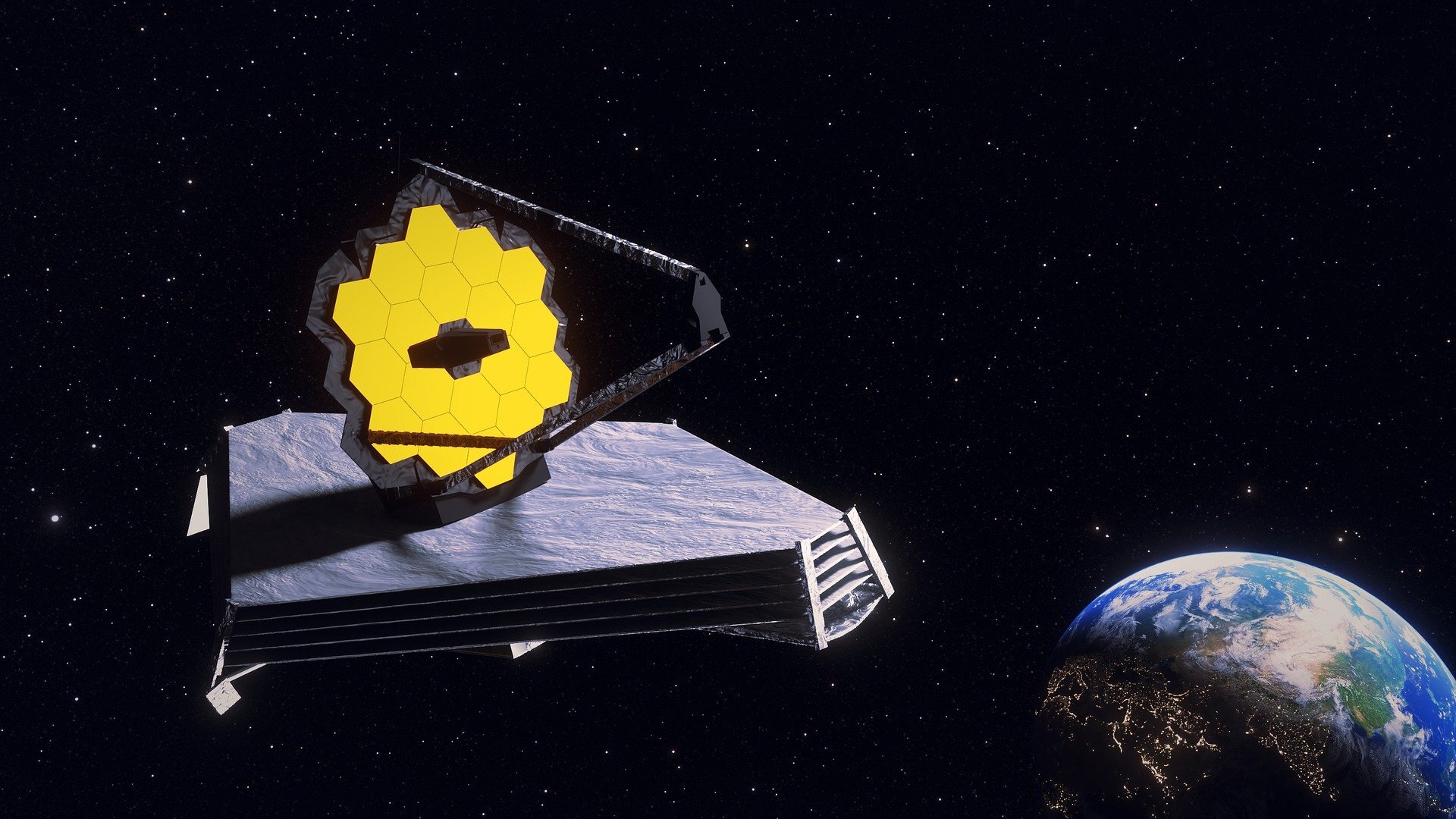
The Institute of Astrophysics of Andalusia (IAA‑CSIC), using a stellar occultation observed with NASA’s James Webb Space Telescope (JWST) on 18 October 2022 and comparing it to earlier ground‑based occultations, reports that the two rings around the Centaur (10199) Chariklo have changed substantially over a few years. The study, led by IAA‑CSIC researchers and published in Science Advances, finds the inner ring (C1R) increased in opacity by more than 50 percent compared with a 2017 baseline, while the outer ring (C2R) decreased in opacity by about 60 percent.
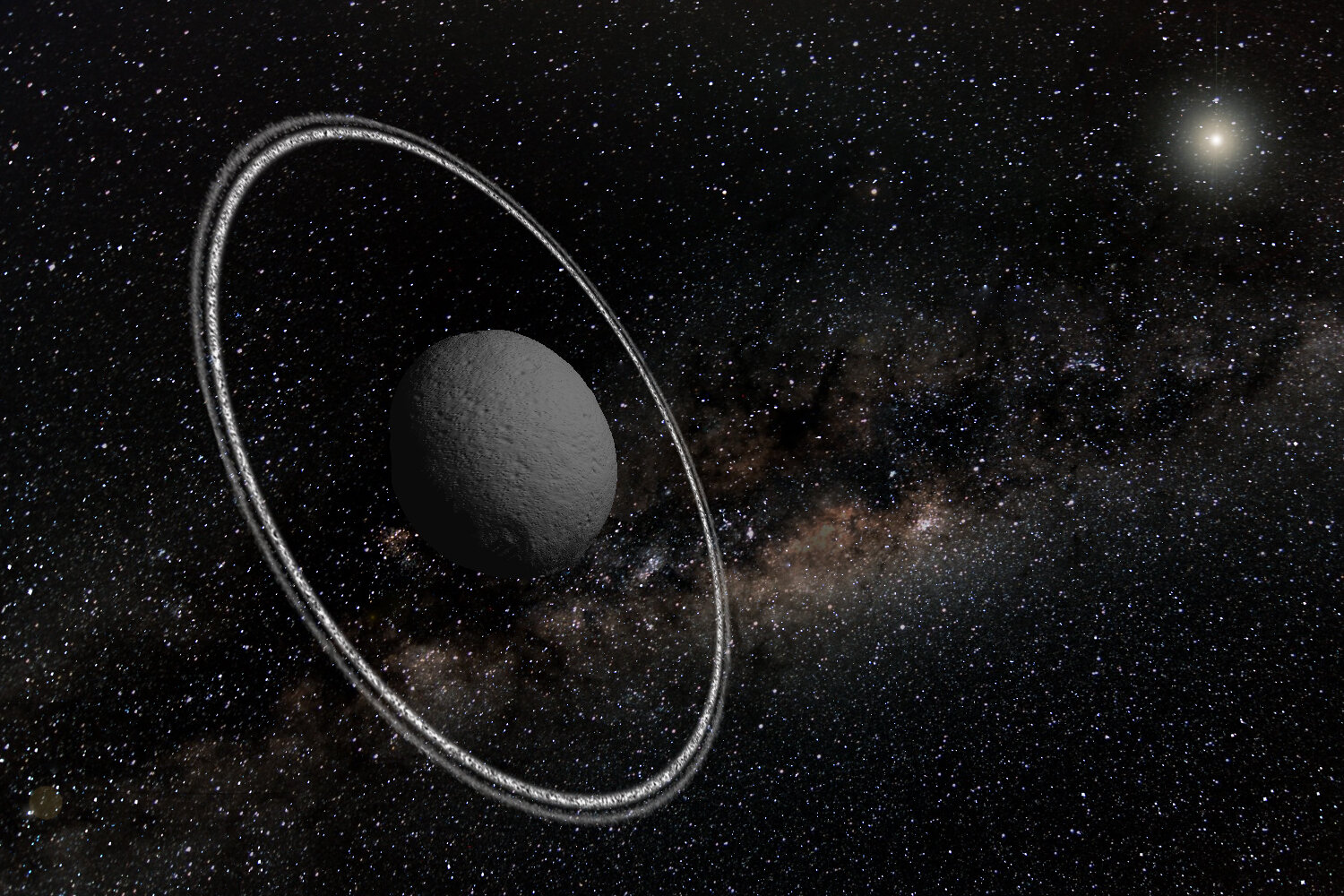
Chariklo is a Centaur — a class of small icy bodies whose orbits cross those of the outer planets — and is the largest known Centaur with a radius of about 125 kilometers (78 miles). Its two-ring system was first discovered in 2013. The two rings orbit at roughly 265 kilometers (165 miles) and 280 kilometers (174 miles) from Chariklo’s surface for C1R and C2R respectively.
Stellar occultation, the technique used in these observations, measures the drop in brightness of a background star as the object and any associated rings pass in front of it. The 2017 occultation provided a detailed baseline for ring composition and structure. The JWST observation in 2022 was the first stellar occultation specifically predicted and planned for JWST and required exceptionally precise predictions of Chariklo’s position and the occultation geometry to be successfully executed from space.
By contrasting the 2022 JWST light curves with earlier occultation records, the team concluded that the inner ring’s stronger signal indicates greater local density or additional material, while the outer ring’s weaker signal indicates a loss of material or a decreased particle concentration. Source articles quote Pablo Santos‑Sanz (IAA‑CSIC), lead author on the study, noting the opposite changes in the two rings and calling the behavior unexpected. The study text, cited in reporting, states these observations reveal previously unrecognized dynamical behaviour in minor‑body ring systems.
The physical interpretation offered by the authors is that material may be moving between the rings and the immediate environment: replenishment of C1R and depletion of C2R. The measured opacities—more than 50 percent increase for C1R and about 60 percent decrease for C2R relative to 2017—are direct observational descriptors of how much stellar light the rings block; they do not by themselves specify particle sizes or exact mass transfer rates, which the authors treat as an inference rather than a proved mechanism.
Beyond the immediate measurements, the result is notable for two reasons. Technically, it validates JWST as a platform for precision solar system occultation work: orchestrating a predicted occultation with JWST required extraordinary pointing and ephemeris accuracy, demonstrating the telescope’s utility for targeted small‑body studies in addition to its established exoplanet and deep‑space science roles. Scientifically, the detection of structural evolution in Chariklo’s rings over a few years challenges assumptions that rings around tiny bodies are static on short timescales.
Chariklo’s rings had already expanded the roster of ringed objects in the solar system beyond the giant planets when they were discovered. The new study places Chariklo among a smaller set of minor bodies — such as the Centaur (2060) Chiron and the dwarf planet Haumea — that exhibit ringlike structures or debris. Observing active changes in such a system provides a rare laboratory to probe ring dynamics outside the strong gravitational and collisional environments of giant planets.
The authors emphasize the need for continued monitoring. Multiple, well‑timed occultations from ground and space will be necessary to map the temporal evolution, constrain the mechanisms driving the observed opacities, and test hypotheses about particle transport, shepherding by possible tiny satellites, or dynamical interactions with Chariklo itself. The present data do not confirm the presence or absence of small moons, nor do they fully quantify the mass budget of the rings; those remain open questions.
In sum, the combination of ground‑based occultation baselines and a carefully executed JWST occultation has revealed that Chariklo’s rings are not static: the inner and outer rings have undergone opposing changes in opacity across a span of years. This discovery opens a new front in the study of minor‑body ring dynamics and underscores the value of coordinated, multi‑platform observations for small bodies in the outer solar system.
Sources: IAA‑CSIC-led Science Advances study (reported by Phys.org) and Universe Today’s synthesis of the JWST occultation comparison with 2017 data.