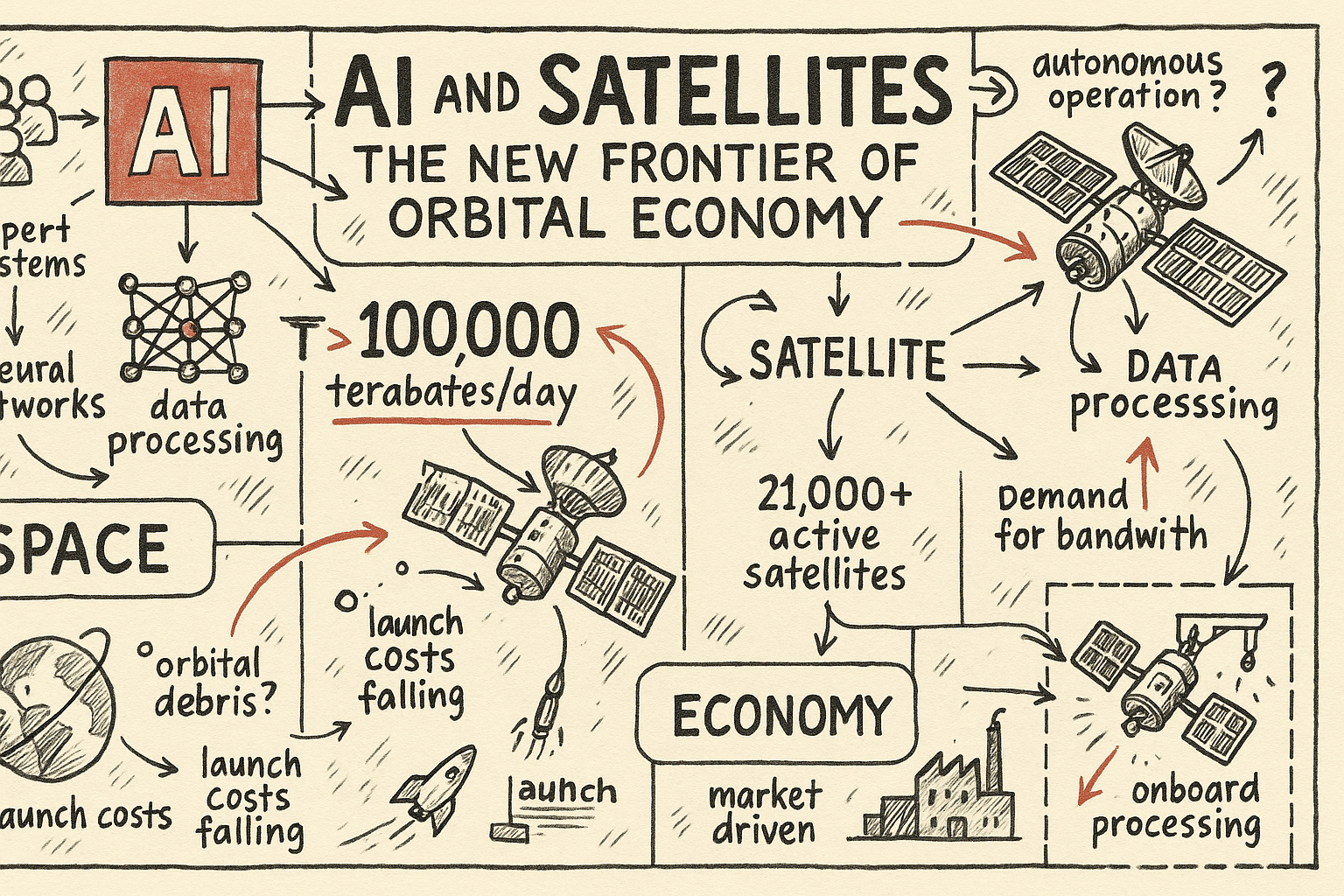
The space economy is experiencing a paradigm shift as artificial intelligence (AI) technologies are increasingly being integrated into satellite operations. Recent developments indicate a burgeoning trend towards not only deploying AI in space but also leveraging it to transform satellite functionalities into advanced data centers. This movement is reshaping the commercial space landscape, providing new opportunities and challenges for industry players.
The Rise of AI in Space
One of the most notable developments is Satlyt's recent $8 million funding round, aimed at expanding its virtual orbital data center (ODC) network. Founded by a former Google and SpaceX product manager, Satlyt aspires to be the 'Android' of orbital computing, offering open-source software for a wide range of satellite platforms. This approach starkly contrasts with SpaceX's more closed, proprietary 'iPhone-style' systems, highlighting a shift towards more collaborative and versatile operating environments in space.
Simultaneously, Google is preparing to launch a satellite equipped with its AI processors as part of Project Suncatcher. This initiative aims to test AI data center capabilities in space, potentially setting the stage for a future where AI-driven satellites perform complex data processing tasks autonomously. If successful, this could revolutionize satellite data handling and enhance the efficiency of space operations.
Collaborations and Innovations
The integration of AI into satellite technology is further evidenced by Starcloud's plans to send an AI computing payload to lunar orbit aboard Firefly's space vehicle. This mission, scheduled for 2028, will serve as a critical demonstration of in-space processing capabilities, emphasizing the growing importance of AI in expanding the functional scope of satellites beyond traditional communication and observation roles.
Moreover, companies like Aerospacelab and Galileo Space are pushing the boundaries of satellite applications. Aerospacelab's agreement to supply satellite platforms to Lockheed Martin signals an increasing demand for versatile satellite solutions capable of supporting both defense and commercial operations. Meanwhile, Galileo Space is developing satellites that can process signals into actionable insights directly in orbit, underscoring the trend towards real-time data processing.
Economic Implications and Future Prospects
The economic implications of these advancements are profound. The ability to process data in space reduces the need for costly data transmission to Earth and back, thereby lowering operational costs and enabling quicker decision-making. This shift could lead to a more democratized space economy, where smaller players can compete with established giants by offering innovative, cost-effective solutions.
Astro Digital's decision to go public via a SPAC deal further highlights the financial opportunities within the space sector. With a valuation of $587 million, Astro Digital's move reflects growing investor confidence in the scalability and profitability of satellite manufacturing and deployment ventures.
Surprising Insights
Perhaps the most counterintuitive insight is the burgeoning role of collaborative and open-source approaches in what has traditionally been a highly competitive and proprietary industry. Satlyt's strategy to emulate Android's open platform could disrupt the current market dynamics, encouraging more partnerships and shared innovation within the sector.
Conclusion
As AI continues to permeate the satellite industry, the ramifications for the space economy are immense. From reducing costs and enhancing capabilities to fostering new partnerships, the integration of AI is set to redefine how we conceive satellite operations. For stakeholders across the board, the challenge will be to adapt to these changes and harness the potential of AI-driven satellite technologies effectively.