Orbital Robotics to test AI arms on ISS Astrobees in 2027
Orbital Robotics announced on Oct. 5, 2026 that it plans to send a pair of autonomous, scaled-down robotic arms to the International Space Station in the third quarter of 2027 to be demonstrated on NASA’s Astrobee free-flying robots. The company said three separate demonstrations will be conducted, each about a month apart, using Astrobees to prove capture, manipulation and upgrade capabilities relevant to in-space servicing, assembly and manufacturing (ISAM).
The demonstrations are a joint effort with Arkisys, the sustaining and maintenance partner for the Astrobee program, which will provide integration support and the in-space platform infrastructure. Arkisys CEO David Barnhart is quoted in the announcement as saying, “Free flight proves you can get there, manipulation proves you can do something once you arrive.”
Orbital Robotics, founded in 2024 by former Blue Origin veterans including CEO Aaron Borger, lead hardware engineer Riley Mark, lead software engineer Sohil Pokharna and adviser Doug Kohl, has been developing arms controlled by artificial intelligence for free-flying spacecraft. According to the company’s news release and Borger’s comments to GeekWire, the goal of the ISS demo is to validate the company’s capture technology and autonomous control software together under microgravity, real-spaceflight conditions.
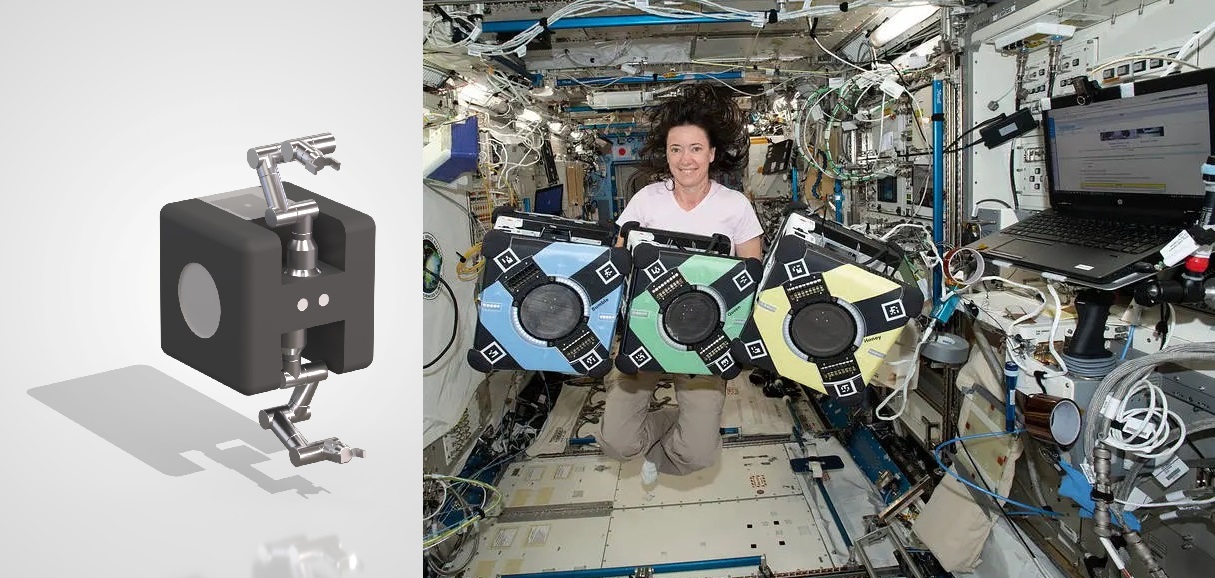
Three cube-shaped Astrobee robots — nicknamed Bumble, Queen and Honey — are currently available for testing aboard the station. Orbital Robotics said its planned demonstrations will be similar to a 2024 test in which an Astrobee fitted with tentacle-like arms grabbed onto a box-shaped cube to show gripping ability. For the upcoming work, the company will supply scaled-down versions of the arms for integration with Astrobee hardware.
A successful demonstration aboard the station would, according to Orbital Robotics, increase confidence that free-flying robots outfitted with its arms could conduct satellite servicing missions, including capture, manipulation and upgrades on orbit. In its news release, CEO Aaron Borger framed the effort as moving “humanity one massive step forward towards reusable satellites.”
The plan to use Astrobee as a testbed follows NASA and partner use of the platform as a low-risk way to trial technologies in microgravity. Arkisys’ involvement focuses on making the subsystem integration and operational support feasible on the ISS. The three demonstrations spaced about a month apart would allow incremental testing of capture and manipulation routines, and provide time to assess software performance and autonomy in the station environment.
Orbital Robotics’ technology development sits amid an expanding industry focus on in-orbit servicing, assembly and manufacturing. Recent commercial activity includes announcements and partnerships to develop servicing architectures and technologies, indicating a growing market for on-orbit maintenance, repair and life-extension of satellites. Using a flight-proven microgravity test platform such as Astrobee to validate AI-driven manipulation is a pragmatic step toward fielding operational servicing capabilities.
There are technical and programmatic challenges ahead. Integrating new hardware with Astrobee will require careful engineering and close coordination with Arkisys and NASA. Demonstrating reliably autonomous capture and manipulation in an operational, human-tended environment like the ISS will also require robust safeguards, clear operational procedures and thorough verification of the control software.
If the demonstrations succeed, they could inform the development of free-flying servicer spacecraft equipped with robotic manipulators designed to approach, capture and modify satellites on orbit. The Astrobee demo will not itself perform satellite servicing, but it is intended as a proxy to test the manipulation and autonomy elements that such missions require. Arkisys framed the combined capability as a “powerful proxy for the servicing and assembly operations that will shape the future ISAM economy.”
Orbital Robotics’ timeline calls for a launch to the ISS in Q3 2027 and three demonstrations about a month apart; the company and Arkisys will use the results to assess readiness for downstream satellite-servicing applications. The demonstrations will be the company’s first opportunity to validate its capture technology and autonomous control software together in microgravity under real spaceflight conditions.
Observers should expect public updates as integration and test milestones are met and as the planned launch window in 2027 approaches. The ISS-based demonstrations will provide early, flight-based evidence about whether small AI-controlled arms on free-flyers can perform the close-proximity manipulation tasks needed for commercial in-orbit servicing.