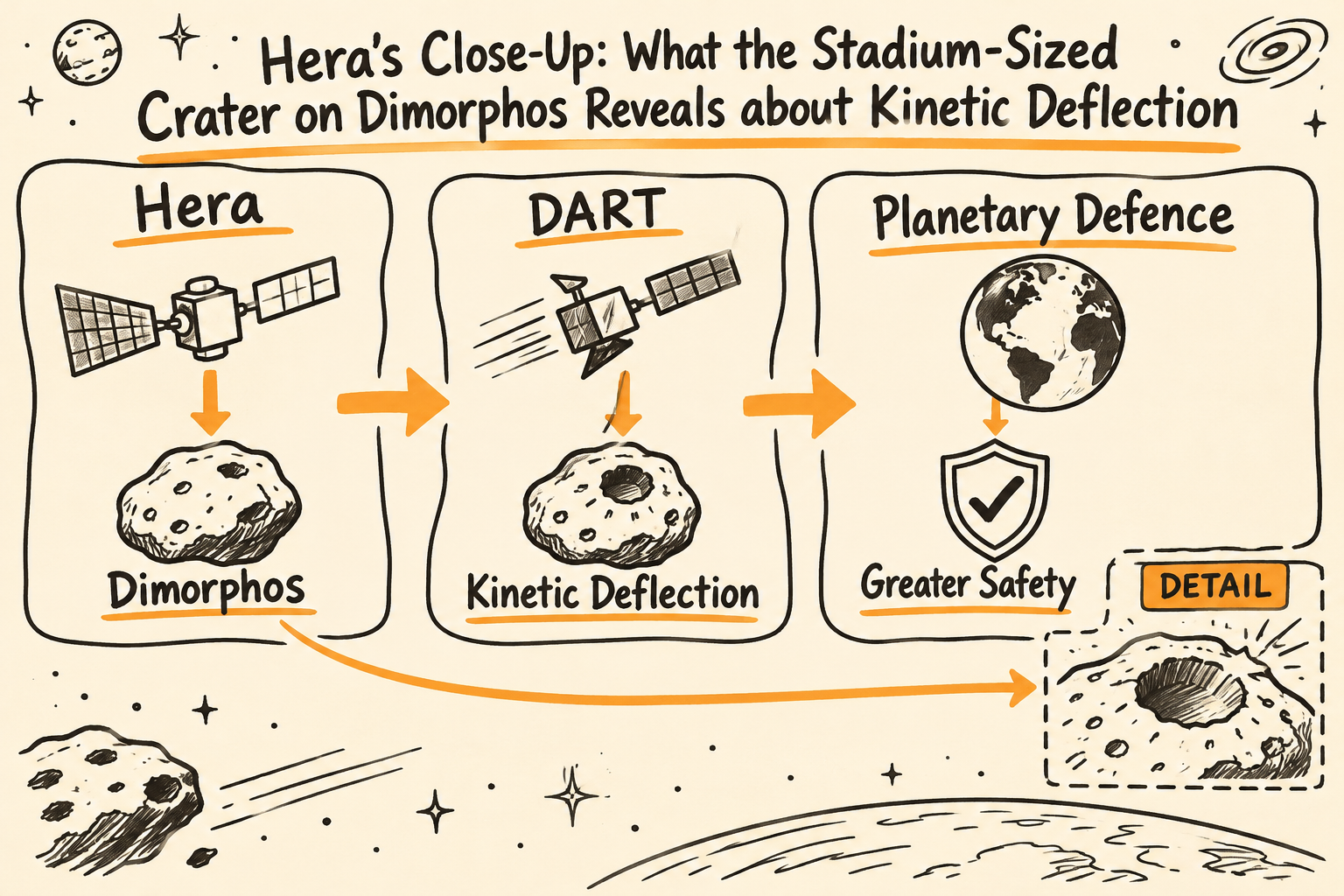
When NASA’s Double Asteroid Redirection Test (DART) slammed into the 151‑metre moonlet Dimorphos on 26 September 2022, ground telescopes detected a surprisingly large change in the moonlet’s motion: its orbit around the larger asteroid Didymos shortened by 33 minutes. What remained uncertain was the local physical outcome of that hit. Now, the European Space Agency’s Hera spacecraft has returned close‑range observations that answer that question in dramatic fashion.
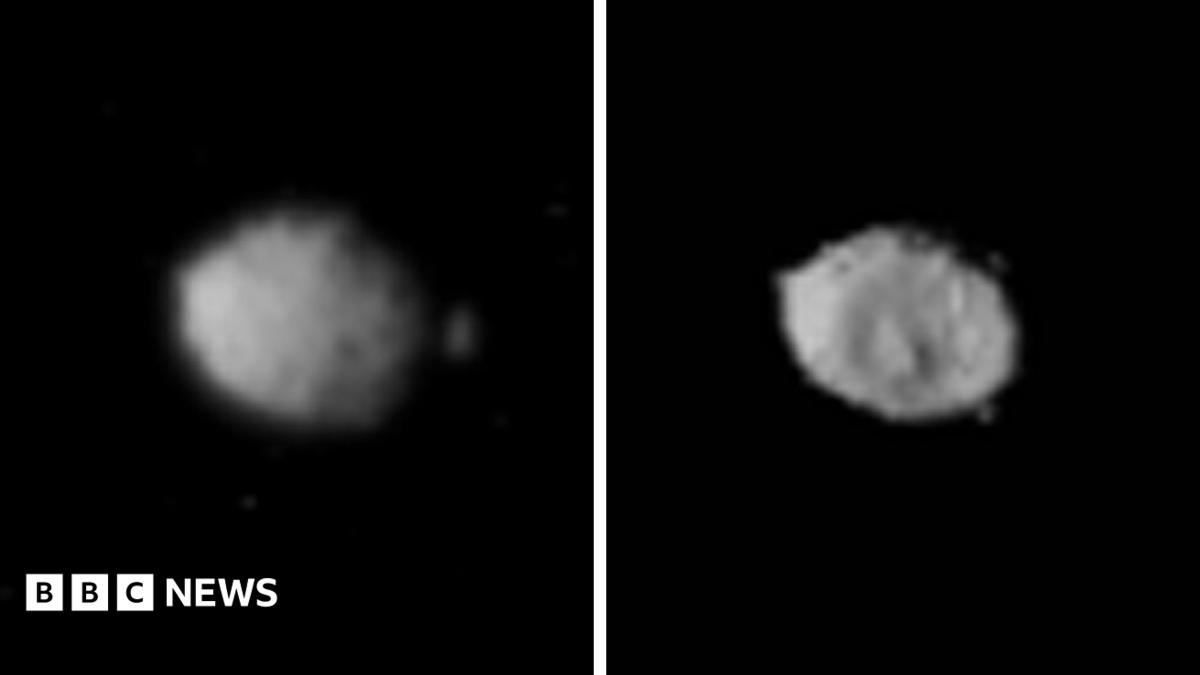
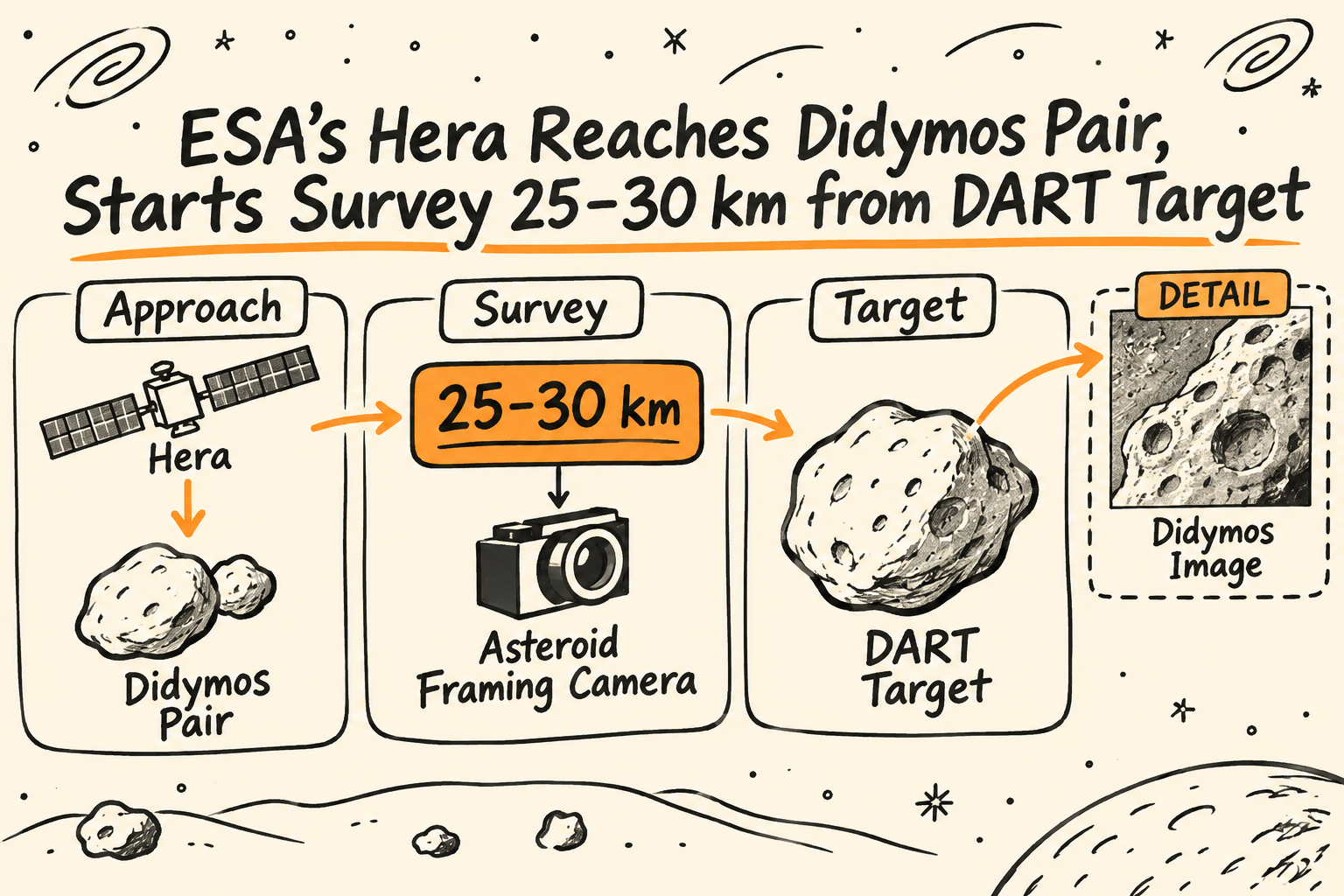
Hera arrived at the Didymos binary system in early November 2026 and began a months‑long inspection from tens of kilometres away. The mission’s first detailed imagery shows that the face struck by DART was flattened into an impact crater “the size of a sports stadium,” extending across the entire width of Dimorphos, according to ESA mission team statements reported by multiple outlets.
Crater, tumble and rubble
Hera’s images contrast the battered, flattened side with other regions of Dimorphos that appear largely unchanged from the boulder‑covered fields seen in DART’s 2022 images. Mission scientists described the surprising combination: the moonlet simultaneously bears a massive crater, retains much of its prior surface elsewhere, and now tumbles chaotically instead of keeping the same face toward Didymos.
In addition to the crater and new rotational state, Hera revealed hundreds of previously unreported meter‑scale boulders orbiting the binary system. These fragments, produced or mobilised by the DART impact, form a new hazard and a scientific opportunity: Hera’s team must account for them as the spacecraft approaches for higher‑resolution imaging, and the fragments provide direct evidence of ejecta distribution after a kinetic impact.
Implications for planetary defence
The combination of a large crater, substantial ejecta, and an altered spin state provides new constraints for models of kinetic deflection. The DART mission achieved measurable orbital change — the 33‑minute change observed from Earth — and Hera’s observations document the surface and near‑environment consequences that produced that change. Patrick Michel, Hera principal investigator, framed the mission as resolving debates about whether Dimorphos would show a crater, reshape, or remain unchanged; Hera’s answer is that the impact produced all three outcomes in different ways.
Hera’s findings also carry practical significance for future mitigation planning. The presence of hundreds of orbiting boulders highlights that a kinetic strike can produce a complex debris environment around a target, which missions or deflection strategies would need to consider. The newly observed tumbling of Dimorphos shows that a strike can alter rotational dynamics as well as orbital parameters — an effect that could influence how momentum is transferred and how ejecta contribute to net deflection.
Next steps for Hera
At the time of these initial reports, Hera was maintaining an orbit tens of kilometres from Didymos and Dimorphos while preparing closer approaches. The spacecraft planned to move nearer to capture higher‑resolution images and to deploy two CubeSats. According to mission descriptions, Juventas and Milani will make complementary measurements: Juventas will use low‑frequency radar to probe Dimorphos’s interior and attempt a landing to measure gravity, while Milani will carry instruments to characterise the system from close range.
Together, Hera’s contextual mapping of the crater, the cataloguing of orbiting fragments, radar probing of interior structure, and in‑situ CubeSat observations will let scientists link the surface and subsurface response of a real asteroid to a kinetic impact with the measurable orbital outcome first seen from Earth. Those linkages are precisely what planetary‑defence planners need to move from demonstration to a predictable toolset for protecting Earth.
Hera’s first close views therefore do more than show a dramatic scar on a small world: they supply the ground truth that models of kinetic deflection have lacked and expose the complexity of consequences — crater formation, ejecta fields and changed rotation — that must be understood if humanity is to use this technique responsibly.