NASA announced on Nov. 20, 2026 that its Small Business Innovation Research/Small Business Technology Transfer (SBIR/STTR) program selected 302 projects for a total investment of up to $171 million in seed funding to advance technologies relevant to Artemis, a U.S. Moon base and Mars exploration.
The awards span two phases of the program. New Phase I contracts will receive up to $225,000 each to establish feasibility, while Phase II awards continue work begun in 2025 Phase I projects with 98 contracts valued at up to $1.3 million each aimed at demonstration and delivery of the technologies. A portion of the selections are STTR awards, which pair small businesses with research institutions. NASA’s SBIR/STTR program is managed by NASA’s Ames Research Center in California’s Silicon Valley and sits within the agency’s Research and Technology Mission Directorate.
The agency highlighted several examples of supported work. Opterus Research and Development Inc. received an SBIR Phase II award to develop a modular system of rollable solar arrays sized to scale up to 50 kilowatts. The arrays are designed for robotic handling, compatibility with different support structures, and operation in dusty surface conditions—features intended to provide surface power for NASA and commercial infrastructure on the Moon and Mars.
Intelligent Fiber Optic Systems Corporation was awarded an SBIR Phase I contract to develop a 10-foot extendable robotic arm for lunar rovers that combines vision and tactile sensing. The arm’s camera and sensors will detect and measure surface textures, contact forces, and temperature, enabling autonomous tasks such as cleaning solar panels, positioning habitat structures, and collecting samples from hard-to-reach locations. NASA noted the same instrumented arms could have terrestrial uses inspecting and repairing power lines, nuclear reactors, and other hazardous infrastructure.
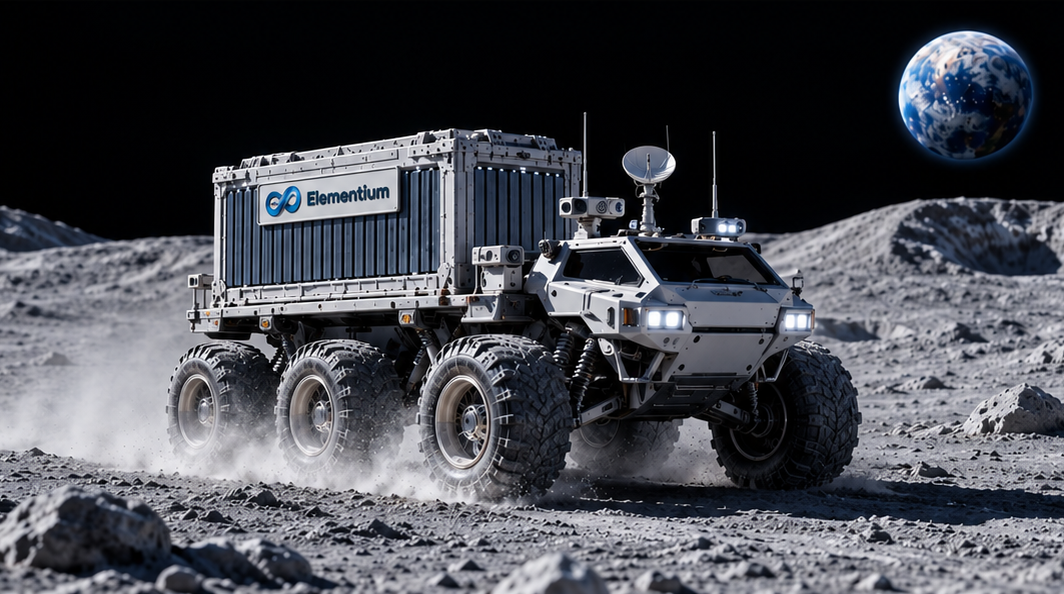
Elementium Materials Inc. received an SBIR Phase I award to develop an ultra-cold-tolerant battery module capable of operating down to minus 76 degrees Fahrenheit without active heating. NASA says that reducing reliance on heaters and insulation could save mass and volume on missions, helping rovers, habitats and infrastructure survive the lunar 14-day night and potentially operate on Mars.
An STTR Phase I award supports a collaboration between Slate Geotechnical Consultants Inc. and the Colorado School of Mines to evaluate two approaches for preparing lunar regolith into reusable landing pads. The study will examine methods to prevent rocket plumes from blasting loose regolith, throwing up dust or creating craters that could damage spacecraft and nearby assets, and will investigate use of rovers to repair and maintain landing pads.
NASA framed the awards as supporting entrepreneurs, startups and small businesses to advance and commercialize technologies that can be infused into agency missions. Complete lists of the 302 selected proposals are available on the SBIR/STTR program’s website.