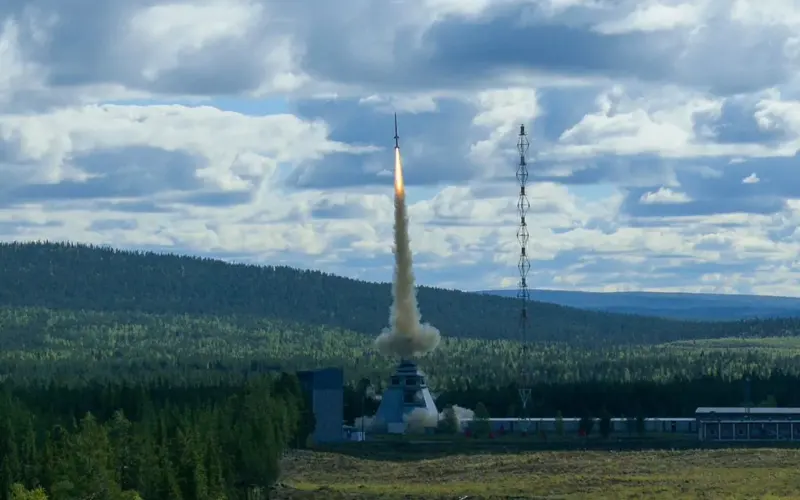
On 31 May, SSC Space successfully launched its SubOrbital Express-5 mission from the Esrange Space Centre, located in northern Sweden. This mission marks another achievement in the exploration of microgravity effects, enabled by the deployment of a sounding rocket powered by Red Kite rocket motors.
The 13-metre-tall rocket was tasked with carrying a suite of 12 scientific experiments into suborbital space. Among these experiments was a unique study examining the effects of microgravity on red hair samples, contributed by a Swedish influencer. This study highlights the diverse range of scientific inquiries being pursued in microgravity environments, which can offer insights into biological and physical processes that are not observable under Earth's gravity.
Sounding rockets like the one used in this mission are designed for brief, suborbital flights that allow researchers to conduct experiments in a microgravity environment for a short duration. These missions are crucial for advancing our understanding of various scientific phenomena, as they provide an accessible and cost-effective means of testing theories and technologies in space-like conditions.
The Esrange Space Centre has played a pivotal role in facilitating these types of missions. As a hub for European space activities, it offers a unique geographical advantage for launching high-altitude research rockets. The collaboration with SSC Space exemplifies the ongoing commitment to expanding scientific knowledge through innovative space missions.
While the specific outcomes of the experiments aboard the SubOrbital Express-5 mission are yet to be fully disclosed, the successful launch and execution of this mission contribute to a growing body of research aimed at understanding how different materials and biological samples behave in microgravity. Such experiments are essential for preparing for longer-duration spaceflights and potential human settlements beyond Earth.
The use of Red Kite rocket motors in this mission underscores the advancement in rocket propulsion technologies that are enabling more efficient and reliable access to suborbital and orbital space. These developments are critical as the space industry continues to evolve, with more frequent launches and a broader scope of scientific and commercial activities.