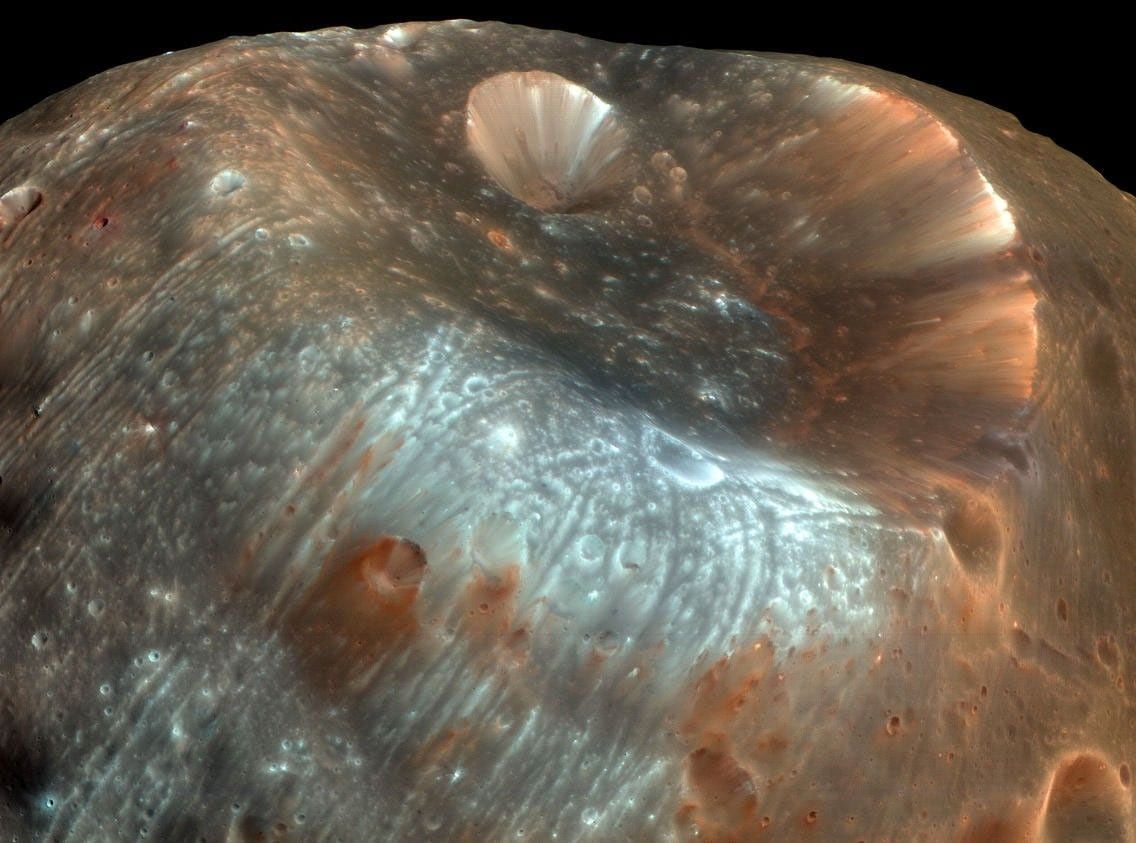
As humanity continues its quest to understand the complexities of our solar system, Mars' moon Phobos presents one of the most intriguing puzzles. This enigmatic celestial body, orbiting the Red Planet, has long been a subject of scientific curiosity. Now, with the upcoming launch of Japan's Martian Moons Exploration (MMX) mission, researchers are poised to unlock some of the secrets held by Phobos.
The MMX mission, spearheaded by the Japan Aerospace Exploration Agency (JAXA), is scheduled to launch in late 2026. Its primary goal is to study Phobos up close and, crucially, to return samples to Earth. This endeavor represents a significant step forward in planetary science, as it promises to shed light on the moon's origin, composition, and potentially, the history of Mars itself.
Phobos, along with its smaller companion Deimos, has posed numerous questions to scientists since its discovery in 1877 by American astronomer Asaph Hall. One of the most debated topics is the origin of these moons. Are they captured asteroids from the asteroid belt, or did they form from debris resulting from a massive impact on Mars? Understanding the interior of Phobos is key to answering these questions, and the MMX mission aims to provide the data necessary to resolve this debate.
Previous missions have provided some insights into Phobos, but significant gaps remain. The Soviet Union's Phobos program in the late 1980s and NASA's Mars Global Surveyor and Mars Reconnaissance Orbiter missions have gathered data from afar. However, direct sampling and close-up studies are necessary to fully comprehend the moon's geological and chemical properties.
The MMX spacecraft is equipped with a suite of sophisticated instruments designed to analyze Phobos in unprecedented detail. These include cameras for high-resolution imaging, spectrometers for surface composition analysis, and radar to probe the moon's subsurface structures. The mission will also attempt the first-ever sample return from a Martian moon, a feat that, if successful, will provide tangible material for scientists to study on Earth.
The implications of the MMX mission extend beyond Phobos itself. By understanding the moon's origin and composition, scientists can gain insights into the conditions of the early solar system and the processes that shaped planetary bodies. The mission could also inform future exploration efforts, particularly those aimed at Mars, by providing a deeper understanding of the planet's natural satellites and their potential resources.
In addition to its scientific goals, the MMX mission represents a significant achievement in international collaboration and technological innovation. It demonstrates Japan's growing capabilities in space exploration and its commitment to contributing to global scientific knowledge. The mission also sets a precedent for future international efforts to explore and understand our solar system.
As we await the launch of the MMX mission, the scientific community remains optimistic about the potential discoveries that await. The data returned from Phobos could revolutionize our understanding of Mars and its moons, providing a clearer picture of the Red Planet's past and its potential for supporting future exploration.
In conclusion, the forthcoming MMX mission is not just about exploring a tiny moon; it is about piecing together the history of our cosmic neighborhood. As the launch date approaches, the world watches with anticipation, hoping that Phobos will finally reveal its secrets and, in doing so, illuminate the path forward in our exploration of the solar system.