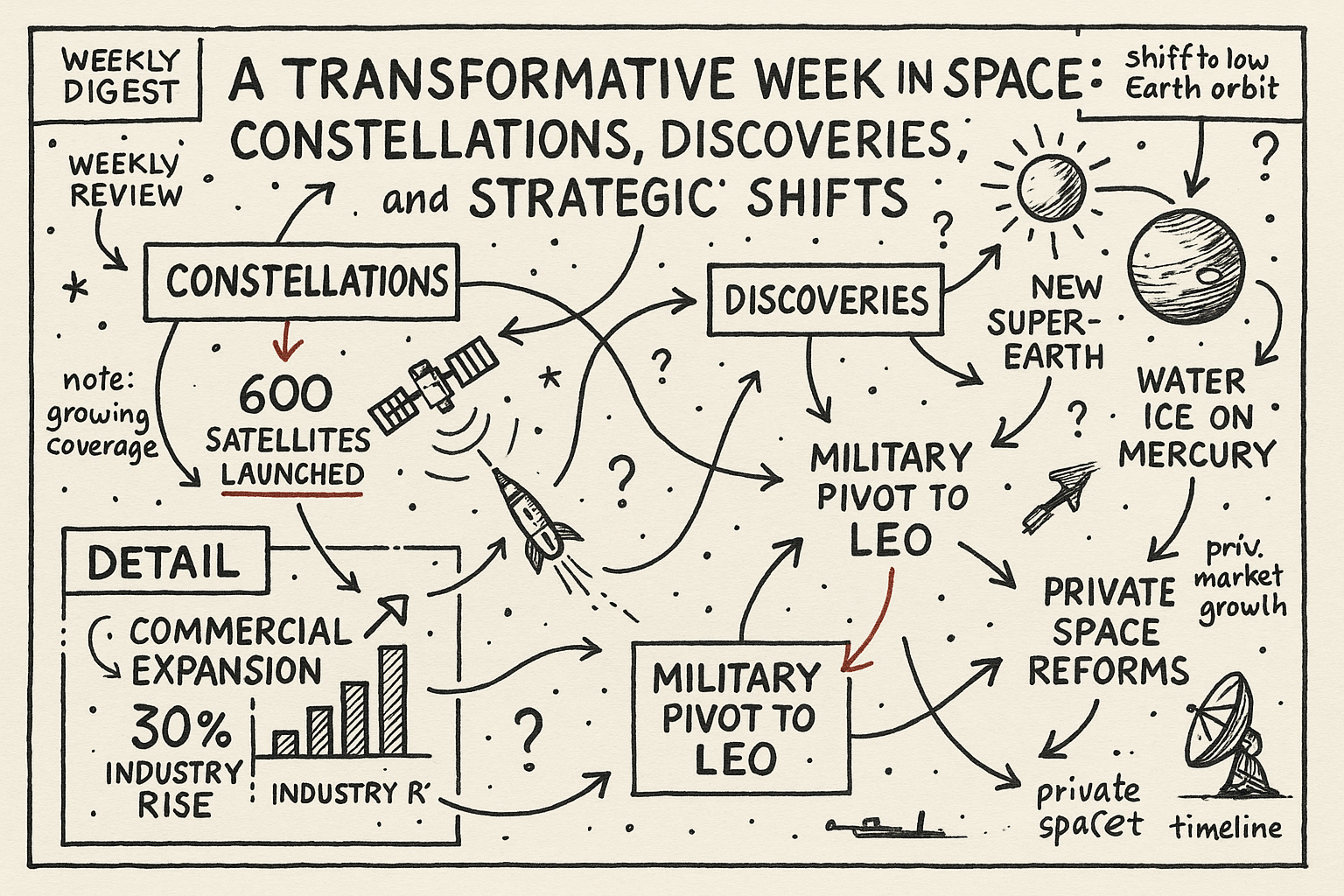
In an era marked by exponential technological advancements, this week in space has been transformative, showcasing bold ambitions and groundbreaking discoveries that continue to reshape our cosmic understanding and industry landscapes. At the forefront of these developments is Orbital’s ambitious plan to deploy a revolutionary satellite constellation, setting the stage for a new era in space-based AI workloads.
Orbital's Satellite Vision: A New Era for AI in Space
Orbital’s announcement of securing $5 million in funding for its innovative ODC satellite constellation marks a pivotal moment in satellite technology. This initiative is poised to revolutionize how artificial intelligence workloads are managed in space, potentially leading to more efficient and powerful processing capabilities. The constellation aims to enhance data handling and computation, thereby reducing latency and increasing the potential for real-time analytics on a global scale. Such advancements are not only pivotal for commercial telecommunications but also have far-reaching implications for scientific research and military applications.
While SpaceX has long dominated the low Earth orbit (LEO) satellite sector, China's recent move to reserve 244,000 satellite slots signals a strategic countermeasure. This maneuver highlights the intensifying race for orbital real estate, which underscores the geopolitical dimensions of LEO operations. As nations vie for dominance, the regulatory and diplomatic implications of these actions are profound, setting the stage for potential conflicts and collaborations in managing the crowded orbital environment.
Scientific Revelations: Pulsars and Cosmic Chemistry
This week also brought fascinating discoveries from the scientific community. The FAST telescope in China has identified a pulsar exhibiting an unusually circular orbit, a rarity that provides unique insights into the dynamics of stellar remnants. Such findings not only enrich our understanding of pulsar mechanics but also contribute to broader astrophysical models regarding the formation and evolution of neutron stars.
In tandem, the exploration of cosmic chemistry continues to unveil the intricate tapestry of the universe. Studies focusing on interstellar molecules and the impact of celestial collisions are shedding light on the chemical origins that influence planetary formation. These investigations are crucial for reconstructing the history and evolution of our solar system, offering clues about the processes that might lead to the emergence of life.
Launch Activity: A Burst of Global Endeavors
The space launch sector witnessed significant activity, with several major missions poised to redefine our technological capabilities. SpaceX, continuing its relentless pace, successfully launched three Block 2 BlueBird satellites for AST SpaceMobile, marking a notable advancement in global mobile connectivity. This mission is part of a broader effort to bridge the digital divide, providing internet access to underserved regions worldwide.
Meanwhile, Arianespace is gearing up for its heaviest payload launch yet, the Leo Europe 03 mission, which will deploy 36 Amazon Leo satellites into orbit. This mission represents a significant milestone in payload capacity and underscores Europe’s commitment to remaining competitive in the global launch market.
On the other side of the globe, Japan’s Martian Moons Exploration (MMX) mission is set to launch by the end of 2026. This ambitious project aims to unravel the mysteries surrounding Mars' moon Phobos, potentially unlocking secrets about its origin and composition.
Industry Dynamics: Strategic Expansions and Collaborations
The space industry is undergoing strategic shifts as companies expand their capabilities and redefine their market positions. Eutelsat, for example, has secured a critical defense contract with the French Ministry of the Armed Forces and Veterans, marking a strategic expansion into defense and LEO markets. This move signifies the increasing importance of satellite technology in national security and defense strategies.
In a similar vein, MDA Space’s acquisition of Blue Canyon Technologies enhances its footprint in the U.S. space defense market. This acquisition, valued at $620 million, underscores the growing demand for advanced satellite systems and services in military applications. Additionally, the collaboration between NASA and Eric Schmidt’s Rocket Company for a Mars mission highlights the intensifying competition in the realm of interplanetary exploration, particularly against powerhouses like SpaceX.
Forward-Looking Perspectives
As we look forward to the coming weeks, several key developments warrant close observation. The ongoing reconstruction of Blue Origin’s New Glenn launch pad following a recent explosion is critical, as it will determine the company’s ability to meet its ambitious launch schedule. Moreover, as satellite constellations proliferate, the industry must address the environmental impacts of satellite re-entry and the broader challenges of space debris management.
In the scientific domain, the impending launch of new missions and the continuous analysis of data from instruments such as the Hubble and Webb telescopes promise to yield further insights into cosmic phenomena, from black holes to the potential resources of Titan. The convergence of technological innovation, strategic industry maneuvers, and scientific discovery continues to drive the evolution of space exploration, paving the way for a future where the boundaries of human capability are constantly redefined.
As these narratives unfold, NovΔ mAInd remains committed to bringing you the most comprehensive and insightful coverage of the cosmos, reflecting the dynamic and ever-expanding universe that we seek to understand and explore.