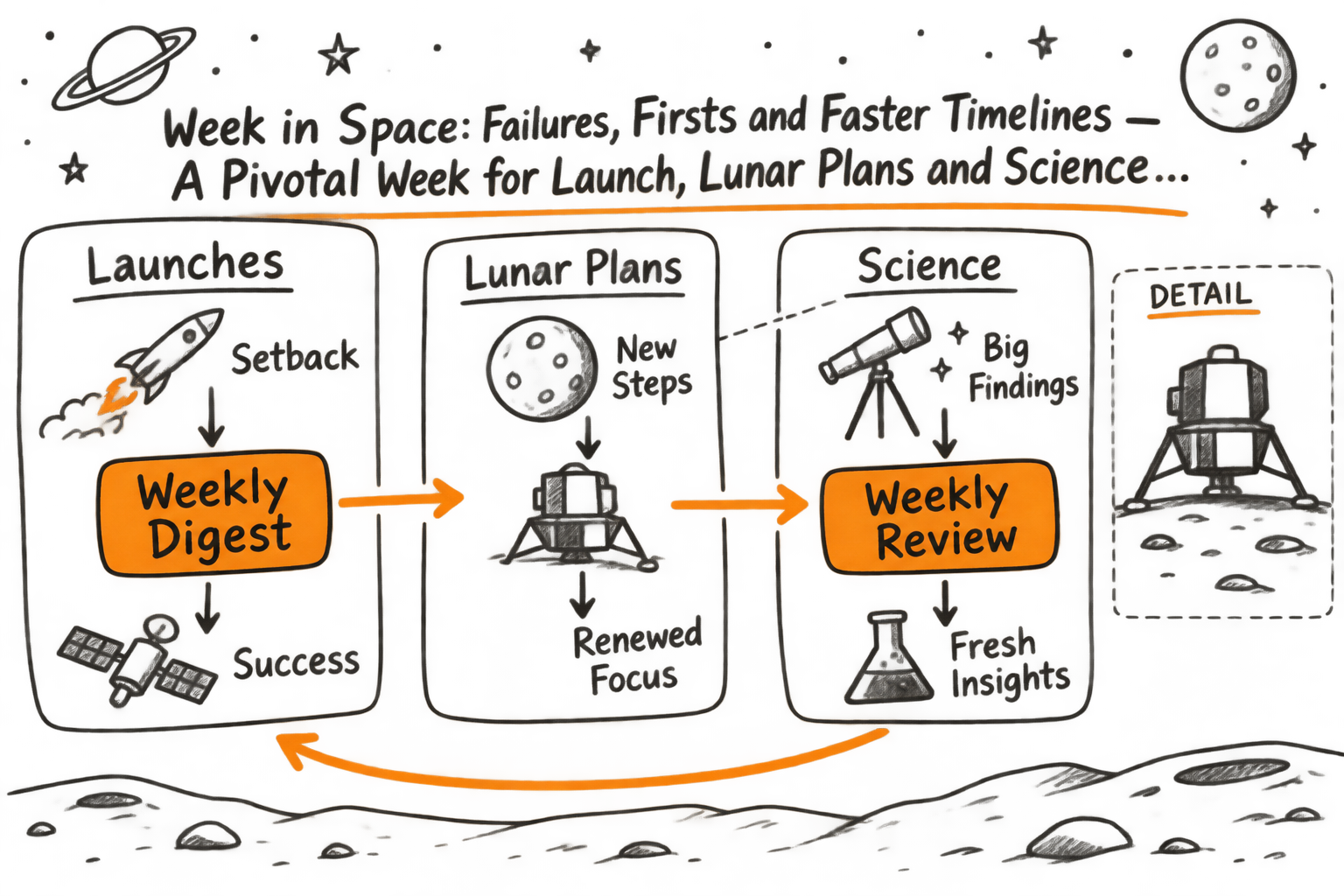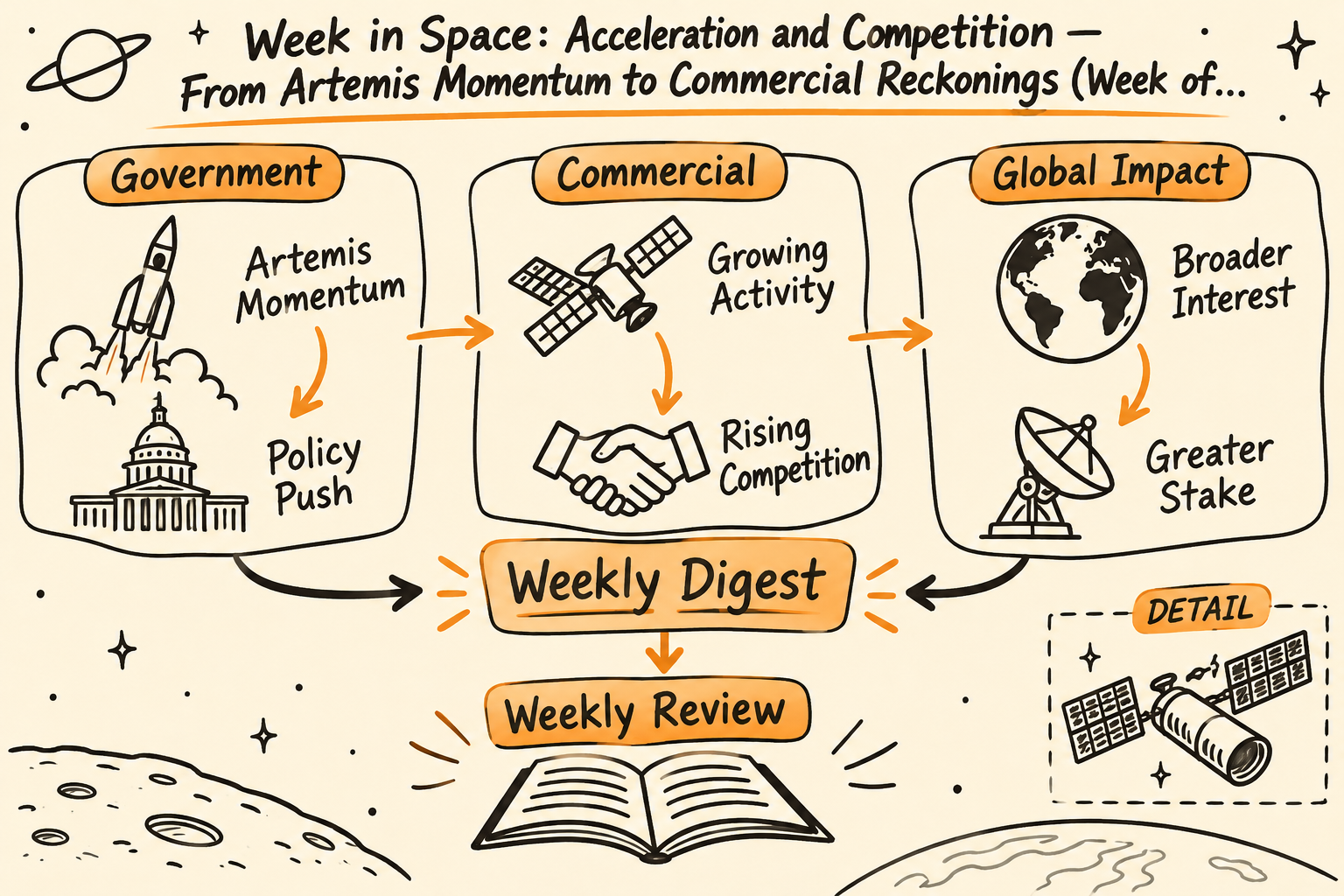
In a week that felt like a hinge between eras, the space domain moved faster and closer to politics, money and national ambition than it has in years. From NASA’s stepped-up Artemis tempo and powered Earth flybys on the road to Mars, to multimillion- and multibillion-dollar industrial deals and nervous regulatory chess across three continents, the story was not only what was launched or discovered but how the pieces of the space ecosystem are rearranging. Science advanced with James Webb’s revelations, Vera Rubin’s early preview discoveries and new insights from interstellar visitors. At the same time, policy and commercial debates — about industrial concentration, conflicts of interest, and the geopolitics of constellations — sharpened, pointing toward a season in which capability growth collides with governance shortfalls.
Launch Activity: Reuse, return-to-flight and the choreography of orbital logistics
The cadence of launches and test campaigns this week illustrated a bifurcated industry: the pragmatic squeeze on operational logistics and the high-stakes gambit of restoring or scaling heavy capability. SpaceX’s Falcon 9 launched the Cygnus CRS-25 resupply mission while Callisto’s reusable flight tests continued in French Guiana, underlining that routine station logistics and experimental reusability tests remain twin pillars of near-term orbital activity. Blue Origin, meanwhile, raised expectations and questions at once, pushing its New Glenn return-to-flight into early 2027 while simultaneously unveiling ambitious upgrades — GS3 and Northstar — that aim to give the rocket direct-to-GEO and trans‑lunar injection scope. That dual message is telling: Blue Origin needs pad and hardware stability, yet it cannot wait to promise capability gains that shape large customers’ roadmaps.
Complementing these developments, CesiumAstro’s $730 million funding round, AST SpaceMobile’s $1.3 billion engine pact with Firefly, and Orbital’s $20 million deal with Orca signal that the market is pivoting from simply putting hardware into space to underwriting end-to-end service models and bespoke launcher supply chains. Firefly’s engines for AST’s Blacklift rocket show how vertically integrated plans are migrating to integrated commercial bets: if AST succeeds, five BlueBird payloads at a time could change how direct-to-handset connectivity is provisioned. Yet each of these ventures carries executional risk — technical, regulatory and supply‑chain — that will be tested as New Glenn attempts a comeback and as smaller launchers press from below.
Exploration & Science: Momentum on multiple fronts — Mars, Moon, exoplanets and early galaxies
The exploration narrative this week was anchored by two synchronous threads: bold mission choreography and sharp scientific returns. NASA’s ESCAPADE twin spacecraft executed powered Earth flybys on Nov. 7 and Nov. 9, performing Oberth maneuvers to inject themselves on a 10‑month cruise to Mars. Those burns — nine minutes or so, delivering a roughly 1,600 km/h boost — are emblematic of a new operational fluency for small interplanetary probes, where complex planetary gravity assists and precisely timed engine firings can send modest spacecraft to distant targets with mission‑defining energy gains. The success of ESCAPADE’s maneuvers will be watched closely as an example of how nimble missions can expand scientific return without the mass and cost of classical flagship approaches.
On the Moon, Artemis momentum continued to tighten. NASA’s accelerating timetable toward a 2028 lunar landing, and parallel Chinese planning reportedly aiming for lunar presence before 2030, have ratcheted up geopolitical stakes. NASA’s announcements at MAX POWER — $1.3 billion in VADR task orders, eight CLPS 2 vendors under a $10 billion ceiling, and the nuclear-powered PROMISE rover — show an agency that is intentionally generating industrial capacity and mission redundancy. The CLPS 2 selections, in particular, represent a strategic bet: distributed commercial lander services are now core to NASA’s architecture for science and sustained presence. The PROMISE rover, with JPL management and a Blue Origin Mark 1 lander contract, signals the agency’s willingness to layer advanced power systems, including nuclear thermal-electric architectures, onto commercial platforms — an important evolution for high-latitude, long-duration lunar science.
Scientific discoveries this week continued to showcase the power of new observatories. JWST produced striking advances, from atmospheric spectra of exoplanets to studies of dusty water‑ice in interstellar comet 3I/ATLAS, linking its composition to trans‑Neptunian origins. JWST analysis, together with pulsar timing constraints on early supermassive black hole pairs, is changing our view of cosmic structure formation. Meanwhile, the Vera C. Rubin Observatory’s early data preview revealed two Milky Way companions — the ultra-faint Aquarius IV and a dust-shrouded globular cluster, Rubin‑GC1 — reminding us that the local neighborhood still hides faint, telling relics of galaxy assembly.
Closer to home, Perseverance and Curiosity missions highlighted the environmental realities that future human explorers must confront. New analyses of dust in Jezero and Gale craters, showing ultrafine components that can penetrate seals and instruments, reemphasize that understanding local regolith and atmospheric particulate behavior is not an academic exercise but a prerequisite for habitability and operations. And on the astrophysical front, Sapienza‑led JWST studies suggesting collision-driven formation of intermediate-mass black holes in young massive clusters reopen long-running debates about seed black hole demographics and early galactic dynamics.
Industry & Economy: Deals, consolidation and regulatory friction
Money, contracts and strategic positioning dominated the commercial headlines this week. Deutsche Telekom’s blunt assessment — that SpaceX would need at least $200 billion to become a major mobile operator with Starlink Mobile — underscored how capital‑intensive scale remains in connectivity. That comment matters because it frames investor and partner expectations about what constellations can realistically do in terrestrial telecom markets, and it casts new light on consolidation risks and strategic partnerships.
Consolidation narratives crystallized in several filings and deals. Globalstar asked the U.S. FCC to scrutinize Rocket Lab’s supplier relationships as the company pursues an acquisition of Iridium, flagging the cross-cutting competition concerns that follow supplier-customer entanglements. In Canada, a Conservative MP’s call for an ethics review of Prime Minister Mark Carney’s friendship with Telesat’s CEO after a C$2.3 billion Arctic award put a political spotlight on the blurred borders between government decision-making and private space ventures. These developments echo a wider pattern: as national strategic investments grow — Germany’s €35 billion space defense plan with EIB–Deutsche Bank €560 million backing is a striking example — so do questions about procurement integrity, market power and geopolitical risk.
The financial endgame of many of these shifts is visible in a flurry of contracts and funding rounds. CesiumAstro’s large raise, AST SpaceMobile’s Firefly engine pact and Orbital’s deal with Orca reveal a market investing in networked systems — a transition from selling launch services to selling on‑orbit capability, integration and recurring revenue. At the same time, SoftBank’s multi-year HAPS pact with Sceye and SES’s in-flight connectivity wins with Finnair show that customers are hedging risk across platforms: GEO, MEO, LEO and high-altitude pseudo-satellites are all in play as carriers and airlines seek resilient connectivity chains.
But the capital is not without skepticism. Investors and industry watchers will want to see the path to margin and scale for many of these plays, especially as technical risk remains high and regulatory scrutiny intensifies. The week’s deals are as much about signaling — to customers, to competitors, and to governments — as they are about immediate cash flow.
Policy & Governance: Blurring, defense spending and the politics of access
Policy friction manifested in both symbolic and substantive ways. Apple Maps’ quiet blurring of imagery for selected U.S. military and space facilities — including Cape Canaveral Space Force Station, Vandenberg Space Force Base and Wallops — raises questions about corporate responsibility, national security, and public transparency. The selective nature of the blurs, leaving other major bases unredacted, prompted observers to ask how private platforms should balance safety with open access to geospatial information. This episode sits alongside larger governance challenges: Germany’s announced €35 billion space defense program and the European Investment Bank–Deutsche Bank financing signals national governments accelerating sovereign capabilities, even as fragmentation and governance gaps raise the specter of vulnerabilities in Earth observation and space-based services.
At the operational level, NASA’s industrial choices — awarding substantial VADR task orders and opening CLPS 2 pools — represent a policy trajectory that leans heavily into public–private partnership. The decisions show an agency trying to sculpt competitive markets while guaranteeing mission assurance for critical science and exploration tasks. However, the political scrutiny in Canada and regulatory petitions in the U.S. suggest that commercial competition and government procurement are becoming contested arenas in which domestic politics, industrial policy and national security considerations intersect.
Cross-cutting Dynamics: Congestion, competition and capability
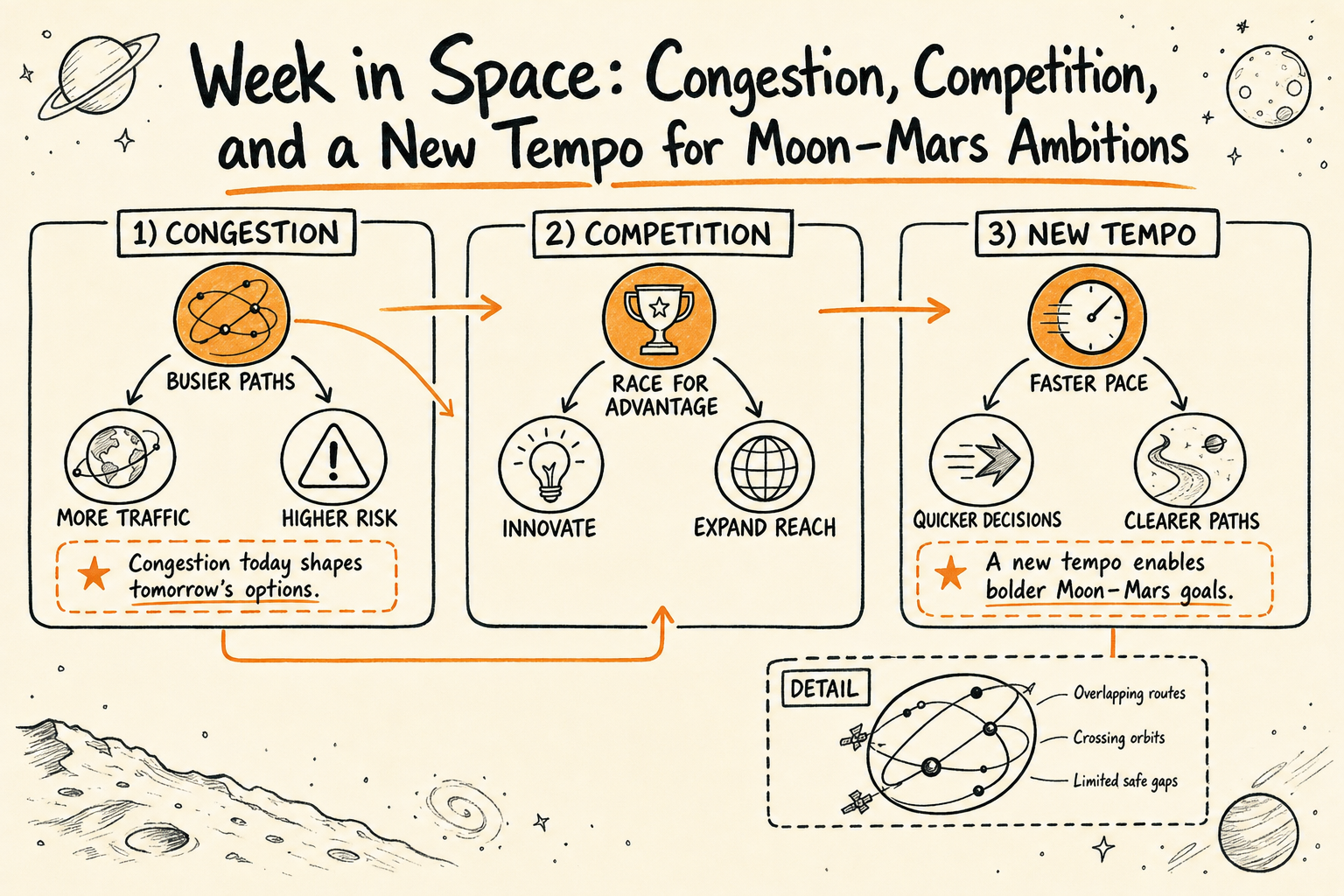
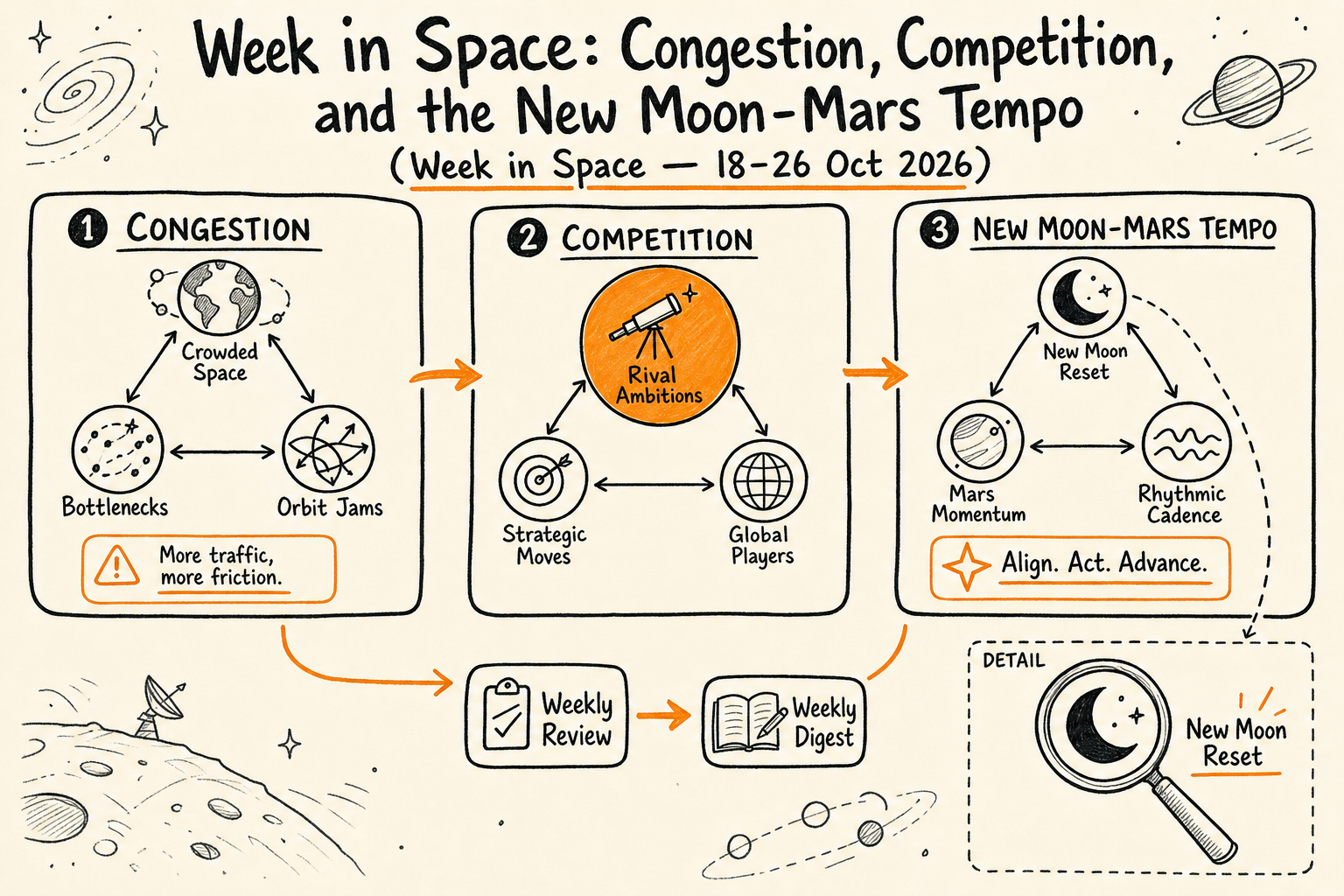
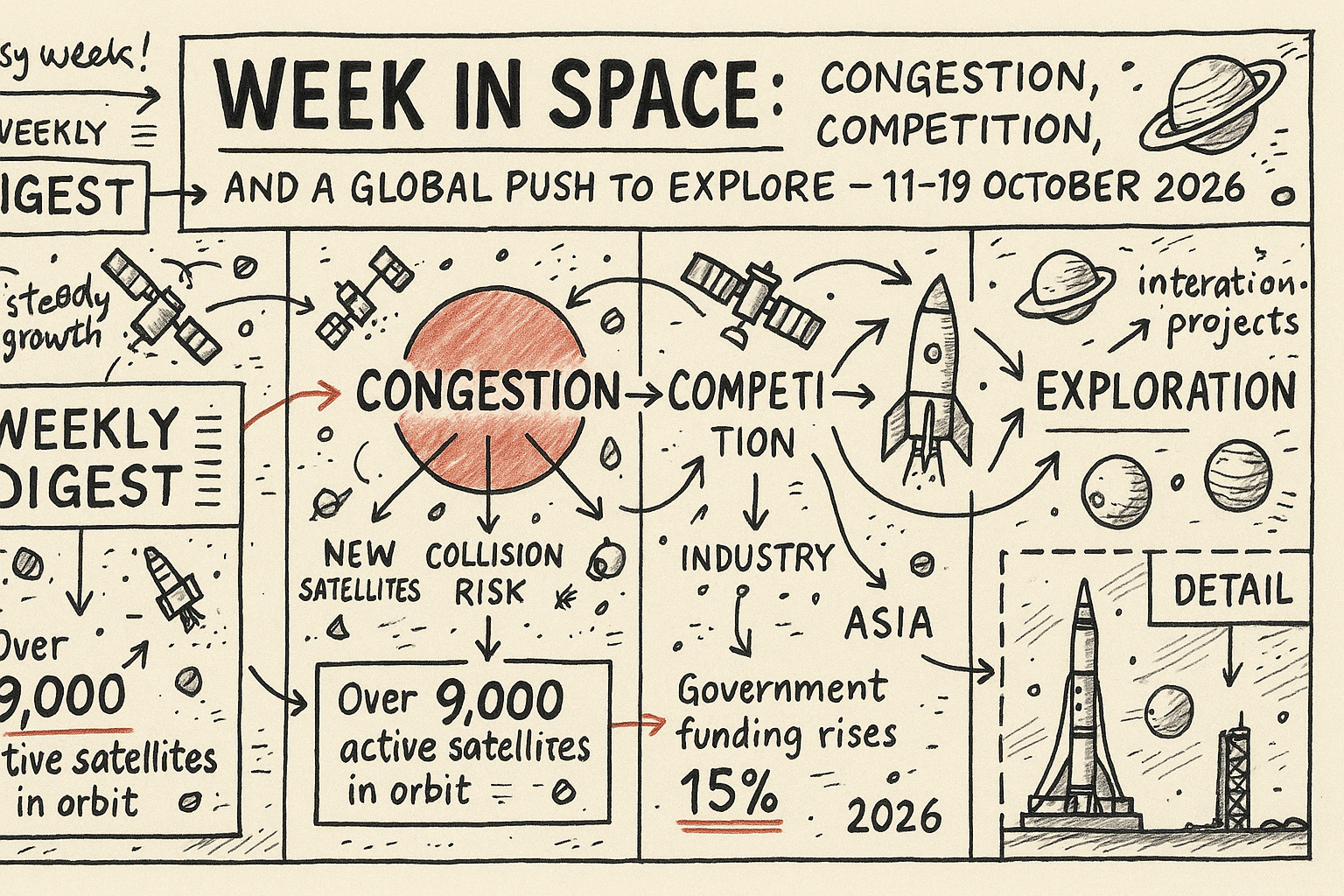
When stitched together, the week’s stories paint a world where congestion — both physical and institutional — is the defining constraint. Physical congestion is evident in the sheer number of planned landers, constellations and launch campaigns; institutional congestion is manifest in overlapping regulatory jurisdictions, public–private partnerships under political scrutiny, and competing strategic doctrines among nations that all seek sovereign access to space. The Artemis acceleration and China’s lunar objectives demonstrate how temporal competition can create a premium on speed, which in turn pressures procurement, safety margins and diplomatic coordination.
Competition is not only intergovernmental. Commercial rivalry is sharpening: image blurring by Apple raises public-interest and safety questions for civilian infrastructure; Deutsche Telekom’s comments on Starlink refract concerns about vertical integration and market dominance; Globalstar’s FCC filing flags supplier entanglement as a competitive wedge. The industry’s move toward integrated service offers — engines, landers, connectivity and satellite hardware tied into long-term contracts — will produce winners, losers and regulatory headaches. This is a market maturing rapidly but unevenly, where scale economies and geopolitical support can determine outcomes as much as technical merit.
Capability growth continues apace. From JWST’s ability to characterize exoplanet atmospheres and early galaxies, to ESCAPADE’s precise interplanetary maneuvers, cost-effective science and exploration are pushing forward. But the juxtaposition of high science returns against geopolitical tension and industrial complexity creates a reminder: technical capability does not automatically reduce risk in other domains. It may, in fact, intensify competition for access to orbits, spectrum and secure supply chains.
Historical perspective and what it means
Viewed through a longer lens, this week reads like an acceleration of patterns that began a decade ago. Commercial launch and private sector entrepreneurship moved from novelty to infrastructure; governments responded by treating space as a domain of sovereign capability and industrial policy. The result is a new equilibrium in which states still set the strategic architecture but rely heavily on private actors for implementation. Where the balance used to be clearer — governments alone building launchers and satellites — it is now a negotiated partnership ecosystem. That system brings unparalleled innovation but also new failure modes: industrial concentration, political influence in procurement, and multinational regulatory mismatches.
The week’s events make that tension visible. NASA’s strategic bets on multiple providers, the European moves to finance defense-capable space industries, and the political scrutiny of commercial winners in Canada all show that the last decade’s laissez-faire phase is over. We are now in an era where public policy seeks to corral private dynamism into durable national and international architectures — and where private actors must operate in a heavier political and regulatory atmosphere.
Looking ahead: What to watch next week
Next week’s calendar will not be measured only in launches, though those remain important; it will be measured in reactions. Watch for further developments around the ESCAPADE cruise and its trajectory checks, which will either vindicate or complicate NASA’s approach to small interplanetary missions. Pay attention to regulatory filings and hearings: Globalstar’s FCC complaint could presage tougher U.S. scrutiny of consolidation and supplier influence, and Canada’s ethics inquiry request may produce political fallout or new procurement safeguards.
On the scientific front, follow-up JWST papers and Rubin Observatory data releases will refine or revise some of the early headline-grabbing claims about early galaxies and local faint structures. Expect additional analysis of 3I/ATLAS’s composition to feed into debates about solar system formation models and the origin pathways for interstellar visitors. Finally, keep an eye on Blue Origin’s pad rebuild progress and any new launch manifests for New Glenn; its success or delay will reverberate through launch markets and customers’ planning calendars.
In sum, this week underscored that technology is only half the story. The other half is money, politics and governance — and the interplay among them will determine which scientific visions become reality, which companies scale, and how nations manage a domain that is simultaneously global, strategic and profoundly transformative. As the next week unfolds, the industry will test whether it can turn accelerated ambition into sustainable capability without succumbing to the very congestion and contestation now shaping its future.