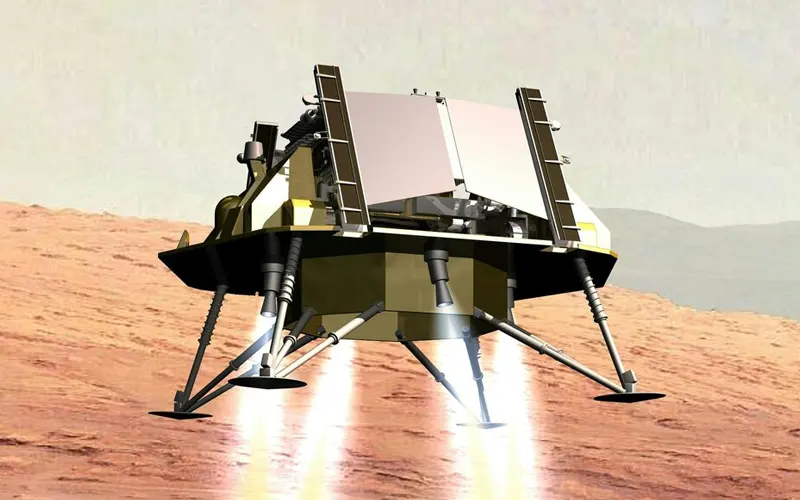
The European Space Agency's (ESA) Rosalind Franklin mission to Mars, a critical part of the international effort to explore the Red Planet, is advancing with notable contributions from NASA. Recently, NASA delivered the first set of braking engines for the mission, a significant milestone that underscores the agency's essential role in this collaborative venture.
This delivery represents one of three major commitments NASA has made to ESA’s mission, reflecting a dynamic shift in international space cooperation. In addition to the braking engines, NASA is responsible for providing the launch services and Radioisotope Heater Units (RHUs) necessary to maintain the rover’s instruments at operational temperatures during the frigid Martian nights.
The path to this collaboration was set in motion after ESA's decision in March 2022 to sever ties with its initial partner, Russia, in response to geopolitical tensions following Russia's invasion of Ukraine. This decision left the Rosalind Franklin rover without the Russian-built landing platform and the Proton-M launch service that had been integral to the mission’s original design.
To fill the resulting void and keep the mission on track, ESA awarded Thales Alenia Space a €522 million contract in April 2024 for the development of replacement hardware, including a new landing platform. Meanwhile, NASA stepped in with a Memorandum of Understanding signed in May 2024, committing to supply the aforementioned critical components.
Despite the clear path forward, NASA’s involvement has been marked by some uncertainty, particularly concerning budget allocations. The agency’s FY2027 budget request appeared to reduce funding for the mission, raising questions about the sustainability of these commitments. Yet, recent updates from ESA’s director of human and robotic exploration, Daniel Neuenschwander, have provided some reassurance.
During a press briefing following ESA’s 347th Council meeting, Neuenschwander confirmed that NASA had secured a SpaceX Falcon Heavy rocket for the launch, scheduled for the near future. He also noted the successful delivery of the first braking engines, adding momentum to the mission’s progress.
However, the situation regarding the RHUs remains less certain. Neuenschwander indicated that the procurement process is ongoing and will require several critical decisions before completion. This is particularly noteworthy given that Europe currently lacks the capability to produce flight-ready RHUs, a gap that ESA is actively working to address.
The Rosalind Franklin mission, named after the pioneering scientist whose work was crucial in understanding DNA, is a testament to the spirit of international collaboration in space exploration—a field where challenges are as vast as the cosmos itself. The mission aims to search for signs of past life on Mars and understand the planet’s geological history, tasks that demand robust technology and global partnerships.
Looking ahead, the success of the Rosalind Franklin mission could pave the way for future cooperative efforts between space agencies, illustrating the importance of adaptability and collaboration in the face of geopolitical shifts. As the mission progresses, the contributions from NASA and other international partners will be crucial in unlocking Mars' secrets and potentially marking new milestones in human understanding of the universe.