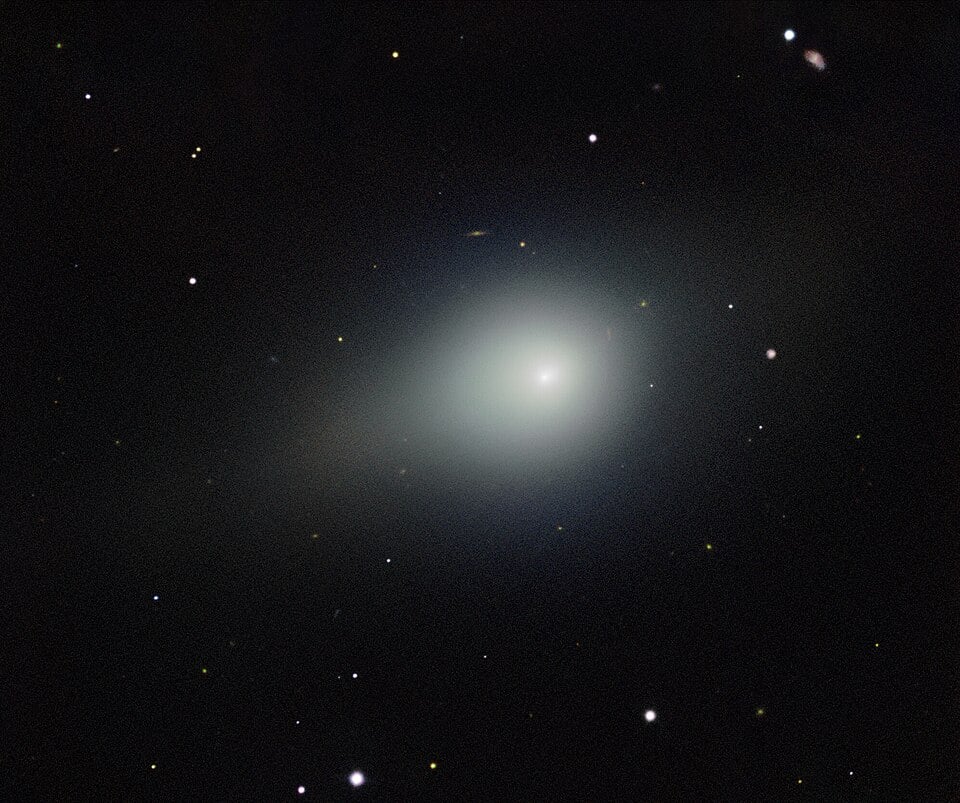
In a remarkable discovery, astronomers have unveiled new insights into the origins of the interstellar comet 3I/ATLAS. This cosmic wanderer, which traversed near Earth on October 30, 2025, has been identified as originating from a distant, ancient star system, based on its unique chemical composition. This finding, led by a team of astronomers under the guidance of Cyrielle Opitom from the University of Edinburgh, provides a rare glimpse into the early chemical environments of the universe.
The study utilized the Ultraviolet and Visual Echelle Spectrograph at the Very Large Telescope (VLT) in Chile. By observing the spectra of the comet's coma, the researchers detected chemical signatures that starkly differ from those of comets within our Solar System. These chemical clues, particularly the isotopic ratios of nitrogen and carbon, suggest that 3I/ATLAS formed in a region around a star with very low metallicity. Such stars are predominantly composed of hydrogen and helium, with a scarcity of heavier elements.
According to Aravind Krishnakumar from the Université of Liège, the nitrogen isotopic ratio in 3I/ATLAS is approximately double that of comets native to our Solar System. Similarly, the carbon-12 to carbon-13 ratio is significantly higher. These ratios are crucial as they are highly sensitive to the specific conditions prevalent in the circumstellar disks where planetary systems form. In the case of 3I/ATLAS, these unusual ratios suggest a formation environment markedly different from that of our Solar System.
This discovery adds to our understanding of cosmic history, pointing to a time when such low-metallicity stars were more common. These stars, believed to have formed long before our Sun, provide vital clues about the composition of the universe during its formative years. The research on 3I/ATLAS offers a valuable opportunity to study these ancient processes and enriches our knowledge of planetary formation beyond our Solar System.
The significance of this discovery extends beyond the mere identification of the comet's origin. It challenges our understanding of the diversity of planetary systems and the chemical processes that occur around different types of stars. Comets like 3I/ATLAS are often referred to as 'cosmic fossils' because they preserve the conditions of their birth environments. Their study can thus shed light on the evolutionary pathways of planets and other cosmic bodies.
Furthermore, the study of interstellar objects like 3I/ATLAS is crucial in the context of understanding the broader universe. Such studies can inform us about the conditions and processes that were prevalent during the universe's 'cosmic noon,' a period characterized by significant star formation and galaxy evolution.
While 3I/ATLAS is not the first interstellar object to be observed—following the discovery of 'Oumuamua in 2017—it is among the few whose chemical composition has been studied in detail. The information gleaned from these studies helps refine our models of how planetary systems might form around different types of stars and under varying conditions.
As we continue to develop more advanced observational technologies, the study of interstellar comets like 3I/ATLAS will undoubtedly provide further insights into the mysteries of the universe. These celestial visitors offer a unique window into the past, allowing us to peer back in time and unravel the complex history of our galaxy.