JWST Pinpoints Faint Galaxy Near GRB 061201
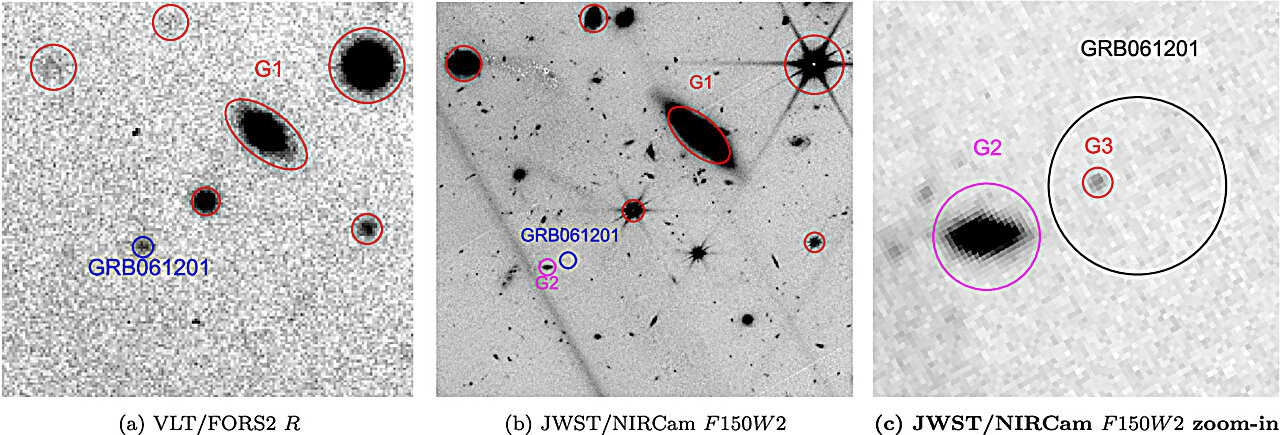
On Aug. 3, 2026, a study published in The Astrophysical Journal reported that observations with the James Webb Space Telescope (JWST) have revealed a previously hidden, ultrafaint galaxy candidate near the position of the short gamma‑ray burst GRB 061201. The JWST/NIRCam images, together with archival ground‑based data from the Very Large Telescope (VLT) and SOAR, identify a likely host galaxy (labelled G2 in the paper) and an even fainter nearby source (G3), addressing why GRB 061201 appeared "hostless" for nearly two decades.
GRB 061201 was first detected in 2006. Short gamma‑ray bursts (GRBs) like this one are commonly interpreted as the product of mergers between compact objects such as two neutron stars or a neutron star and a black hole. Determining the host galaxy and hence the distance — the redshift — is crucial to derive the burst's true energy release, the geometry of its jet, and other physical parameters. Until now, two competing explanations persisted: either the burst originated in a nearby galaxy (G1) at redshift z = 0.111, or its host was too faint and distant for previous telescopes to detect.
The new JWST imaging resolves that ambiguity by detecting sources at the burst position that are much fainter than the limits of earlier optical surveys. The paper's figures include VLT/FORS2 R‑band and FORS1 I‑band images and SOAR/OSIRIS J‑ and K‑band observations alongside the JWST/NIRCam F150W2 image. In the JWST data, the afterglow position is flanked by sources that were not clearly seen before, with G2 and G3 explicitly marked in the high‑resolution infrared view.
How the JWST Result Reconciles the Energy Puzzle
GRB 061201 had been anomalous because its measured energy output, when associated with the nearby galaxy G1 at z = 0.111, did not fit well with patterns established for other short GRBs. If the burst were instead located at a substantially larger distance, the inferred isotropic energy and jet properties would change accordingly. The JWST detection of a faint host‑galaxy candidate suggests that the latter scenario — a more distant, fainter host beyond the sensitivity of earlier telescopes — is viable. This resolves the 20‑year mismatch between GRB 061201's observed properties and the expectations from the short‑GRB population.
Because the JWST data provide greater sensitivity in the near‑infrared, they are particularly effective at revealing faint, redshifted galaxies that optical telescopes miss. The study's images explicitly show sources detected in both VLT and JWST images (marked in red) and the position of the optical afterglow (marked in blue), with the JWST zoom giving a clear view of G2 and G3 in the burst's immediate environment.
Implications for Short GRB Host Studies
This result highlights a broader observational challenge: some short GRBs classified as "hostless" may actually have ultrafaint hosts below the detection thresholds of ground‑based optical surveys. JWST's capabilities are therefore well suited to revisit other long‑standing hostless cases and to improve statistics on host types, offsets, and the environments of compact‑object mergers. Improved host identifications feed directly into population studies that aim to connect electromagnetic short GRBs with gravitational‑wave detections of compact binary mergers.
The identification of G2 (and the ultrafaint G3) does not by itself supply a spectroscopic redshift in the report, so uncertainty remains until follow‑up spectroscopy can confirm the distance and measure the host's properties unambiguously. The paper frames the JWST detection as resolving why GRB 061201 appeared to violate expected energy correlations: a previously unseen faint host changes the inferred energetics when the burst is placed at a larger distance than z = 0.111 or otherwise revises assumptions about its local environment. Until spectroscopic confirmation, however, the host association is the best explanation consistent with the new imaging data rather than a definitive measurement of redshift.
Context and Next Steps
GRB host identification has a history of driving astrophysical interpretation: knowing the galaxy and its redshift converts observed brightnesses into intrinsic energies and enables studies of progenitor populations. The JWST observations of GRB 061201 exemplify how deeper infrared imaging can overturn long‑standing classifications and clarify the physical nature of transient events. Follow‑up work will likely focus on obtaining spectroscopic redshifts for G2 or G3 and on searching other archival "hostless" short GRBs with JWST to reassess their distances and energy budgets.
The new study demonstrates the value of combining archival ground‑based optical and infrared observations with JWST's sensitivity and resolution. For GRB 061201, nearly 20 years after the burst, that combination appears to have solved a puzzling inconsistency in the burst's derived energetics by revealing a faint, previously hidden galactic neighborhood.