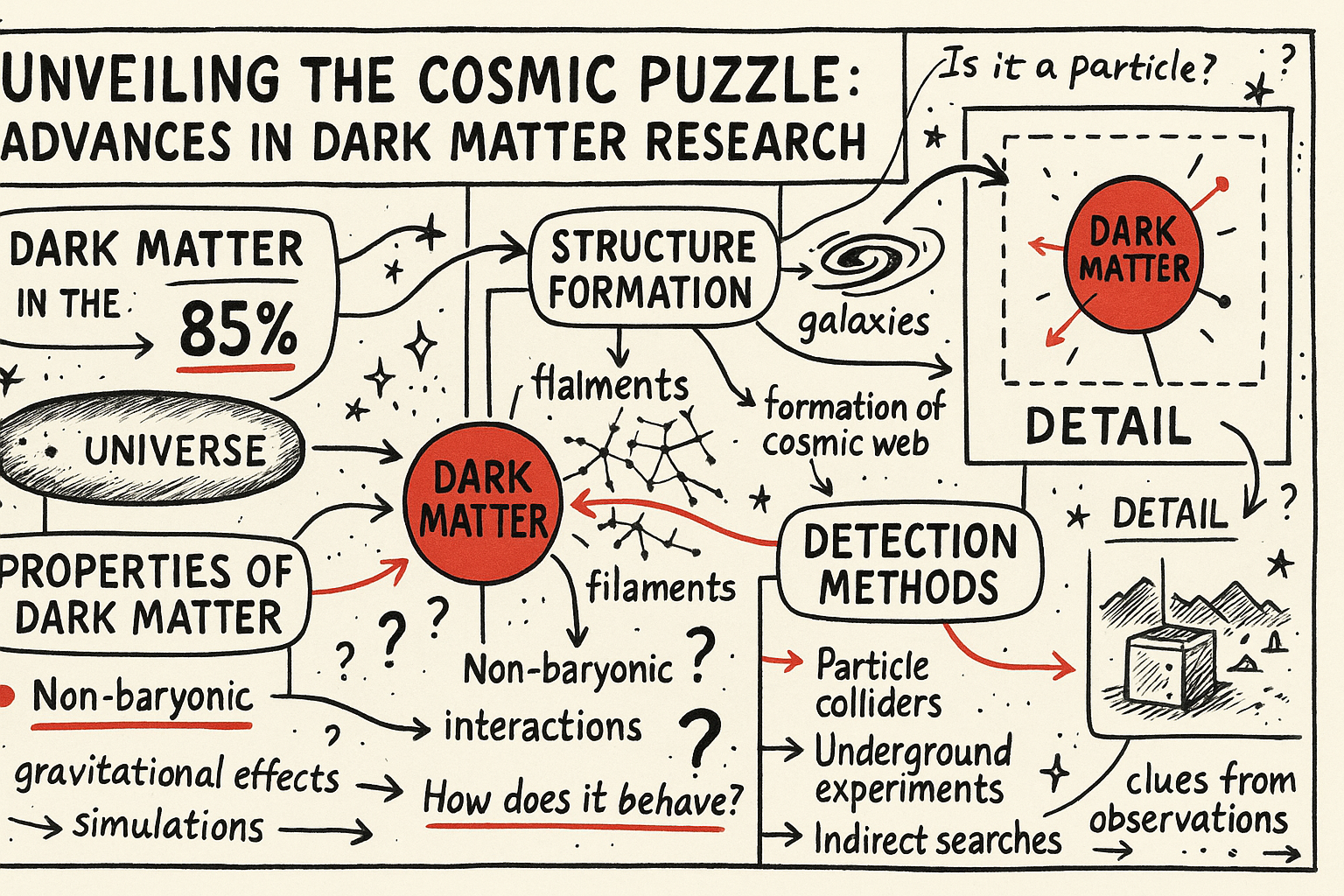
The enigmatic nature of dark matter continues to captivate the scientific community, as recent developments promise to redefine our understanding of the universe's unseen mass. Despite accounting for approximately 85% of the universe's mass, dark matter remains elusive, primarily detectable through its gravitational effects on visible matter. Recent findings from various research initiatives are offering glimpses into this cosmic mystery, potentially revolutionizing our approach to studying the cosmos.
In a surprising turn of events, an underground facility in South Dakota recorded an unexpected subatomic interaction that may signify the presence of dark matter. This groundbreaking observation has intrigued scientists worldwide, as it deviates from known interactions of ordinary matter, hinting at a potentially significant breakthrough in dark matter detection.
SuperCDMS SNOLAB: A New Chapter in Dark Matter Research
Meanwhile, the Super Cryogenic Dark Matter Search (SuperCDMS) SNOLAB has begun its scientific operations in Ontario. This state-of-the-art facility aims to uncover direct evidence of 'light' dark matter particles over the coming years. These efforts reflect a broader shift in the scientific community's approach, focusing on detecting lighter and potentially more elusive particles than previously targeted.
Historically, the mass of the universe has been estimated by observing the brightest stars in galaxies, alongside gas, dust, and dark matter. However, recent findings suggest that this method oversimplifies the complex interplay of cosmic masses. A study highlighted that stellar streams orbiting the Milky Way could mimic dark matter's gravitational effects, adding another layer of complexity to our understanding.
Stellar Streams: Cosmic Clues or Cosmic Red Herrings?
The role of stellar streams in dark matter research is gaining attention. These rogue bands of stars, orbiting galaxies akin to planetary orbits, could provide new insights into dark matter's gravitational influence. While they complicate the task of discerning dark matter's effects, they also offer a unique opportunity to refine our models and improve the accuracy of cosmic mass measurements.
Adding to the intrigue is the exploration of 'dark photons' as a potential dark matter candidate. Cross-disciplinary research suggests that these hypothetical particles may be more widespread than previously thought, expanding the horizons of dark matter research. This approach underscores the importance of innovative thinking and cross-disciplinary collaboration in tackling one of the universe's most profound mysteries.
The Path Forward: Challenges and Opportunities
The ongoing quest to unravel the nature of dark matter is marked by both challenges and opportunities. As new technologies and methodologies emerge, they promise to sharpen our understanding and redefine our place in the cosmos. However, the path is fraught with complexities, as illustrated by the difficulty in distinguishing genuine dark matter signals from cosmic noise.
One of the most counterintuitive insights from recent research is the potential for the Milky Way’s gravity to mimic dark matter clues. This revelation challenges the foundational assumptions of dark matter detection, urging scientists to refine their models and consider alternative explanations for observed phenomena.
The implications of these findings extend beyond theoretical physics, influencing future space exploration and our understanding of the universe's formation and evolution. As we push the boundaries of knowledge, each discovery serves as a stepping stone, guiding us toward a more comprehensive understanding of the cosmos.
In conclusion, the quest to decipher dark matter is far from over, but recent advances offer promising pathways. As we continue to probe the universe's hidden realms, the pursuit of dark matter remains a testament to human curiosity and the relentless drive to uncover the mysteries of the universe.