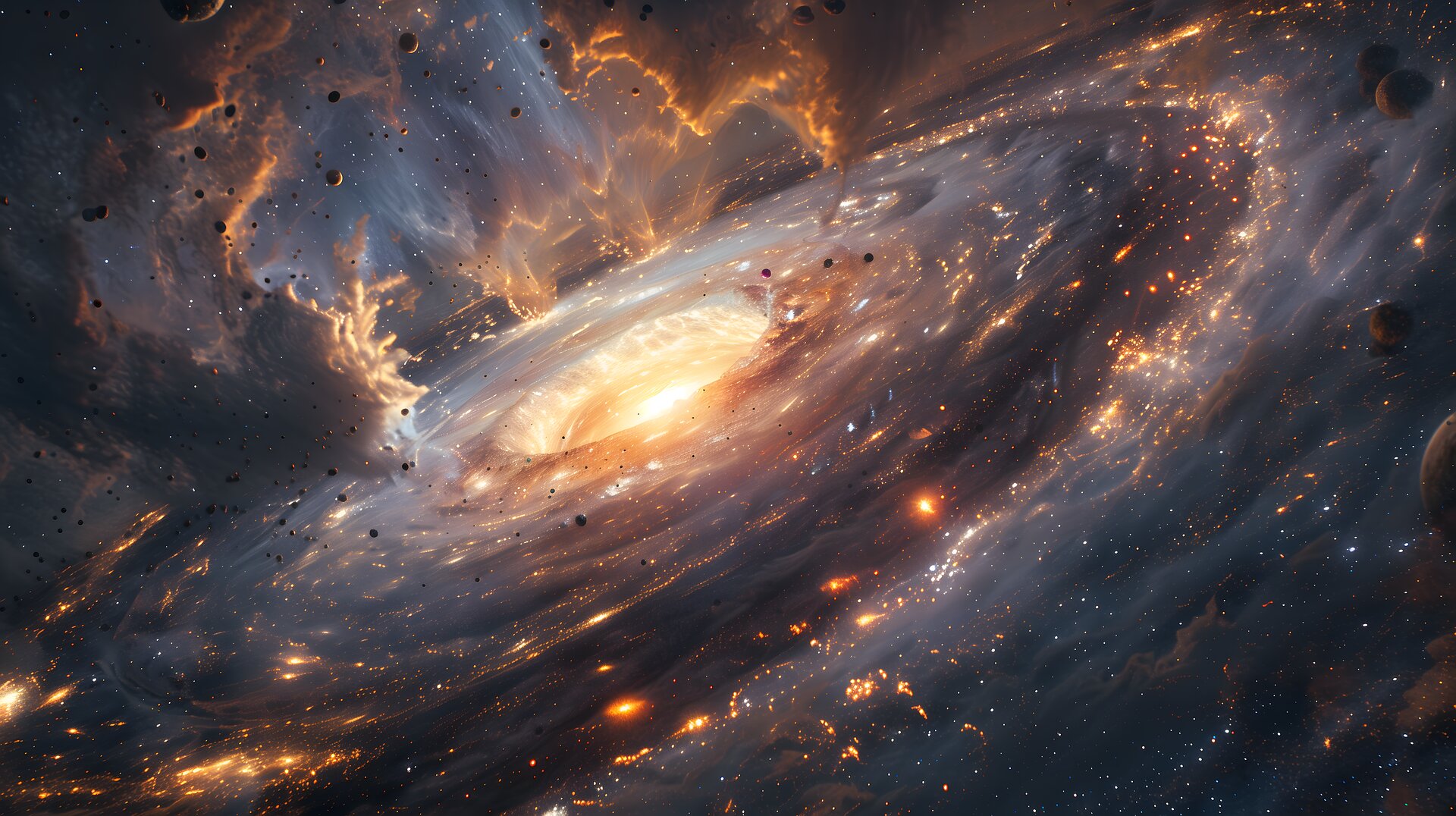
Astronomers have successfully captured a black hole eruption at the center of the galaxy IC 3599 in real time, marking a significant milestone in the study of these enigmatic cosmic events. Located about 280 million light-years away, IC 3599 has experienced such eruptions twice before, in 1990 and 2010, but those events were only documented retrospectively. This recent observation, however, unfolded under the watchful eyes of researchers, offering a more detailed understanding of the processes at play.
Led by D. Grupe from Northern Kentucky University, the team employed the Neil Gehrels Swift Observatory to monitor the black hole since 2013, following its flares in the past decades. Notably, in October 2025, the black hole's brightness surged to 50 times its typical low state, triggering an intensive observational campaign using Swift, the XMM-Newton space observatory, and ground-based telescopes at Lick Observatory, Xinglong Observatory, and the Caucasian Mountain Observatory.
The mass of the black hole was estimated to be around 2 million solar masses, with its luminosity aligning with theoretical expectations for maximum accretion rates. A dedicated 120,000-second XMM-Newton observation revealed oscillating X-ray brightness with a potential period of 7.4 hours. This oscillation, paired with the appearance of new emission lines, including highly ionized iron coronal lines, suggests that the eruption is affecting gas far beyond the immediate vicinity of the black hole.
The repeated flares from this black hole spark curiosity about their origin. Two primary hypotheses are under consideration: an intrinsic instability within the accretion disk or tidal disruption events where a star is torn apart by the black hole's gravitational forces. The real-time observation of the current eruption provides crucial data for testing these theories, although the exact cause remains debated.
Understanding such phenomena is vital for broader astrophysical studies, as black holes are key to many processes in the universe. These cosmic giants, with gravitational forces so intense that even light cannot escape, challenge our understanding of physics and the dynamics of galaxies. Observations like those at IC 3599 contribute to a growing body of knowledge that could eventually illuminate the behaviors and characteristics of black holes in various cosmic environments.
Moreover, the study of black holes like the one in IC 3599 offers a glimpse into conditions that might have been prevalent in the early universe. The extreme physical conditions around supermassive black holes can produce radio transients and other phenomena that provide insights into the universe's formative years. Similar studies have focused on rapidly growing black holes that emit bursts of radio emissions, potentially mirroring the processes that governed the early universe's development.
The research at IC 3599 aligns with ongoing efforts worldwide to understand black holes in different contexts. It highlights the importance of continuous monitoring and multi-wavelength analyses, which can uncover new aspects of known phenomena and reveal unexpected behaviors.
As astronomers continue to study IC 3599 and other galaxies with active black holes, the data collected will not only refine existing models but also potentially lead to new discoveries about the universe's most mysterious inhabitants. The real-time capture of this eruption is a testament to the advancements in astronomical observation technologies and methodologies, promising more detailed and timely insights into the dynamic and often violent cosmos.