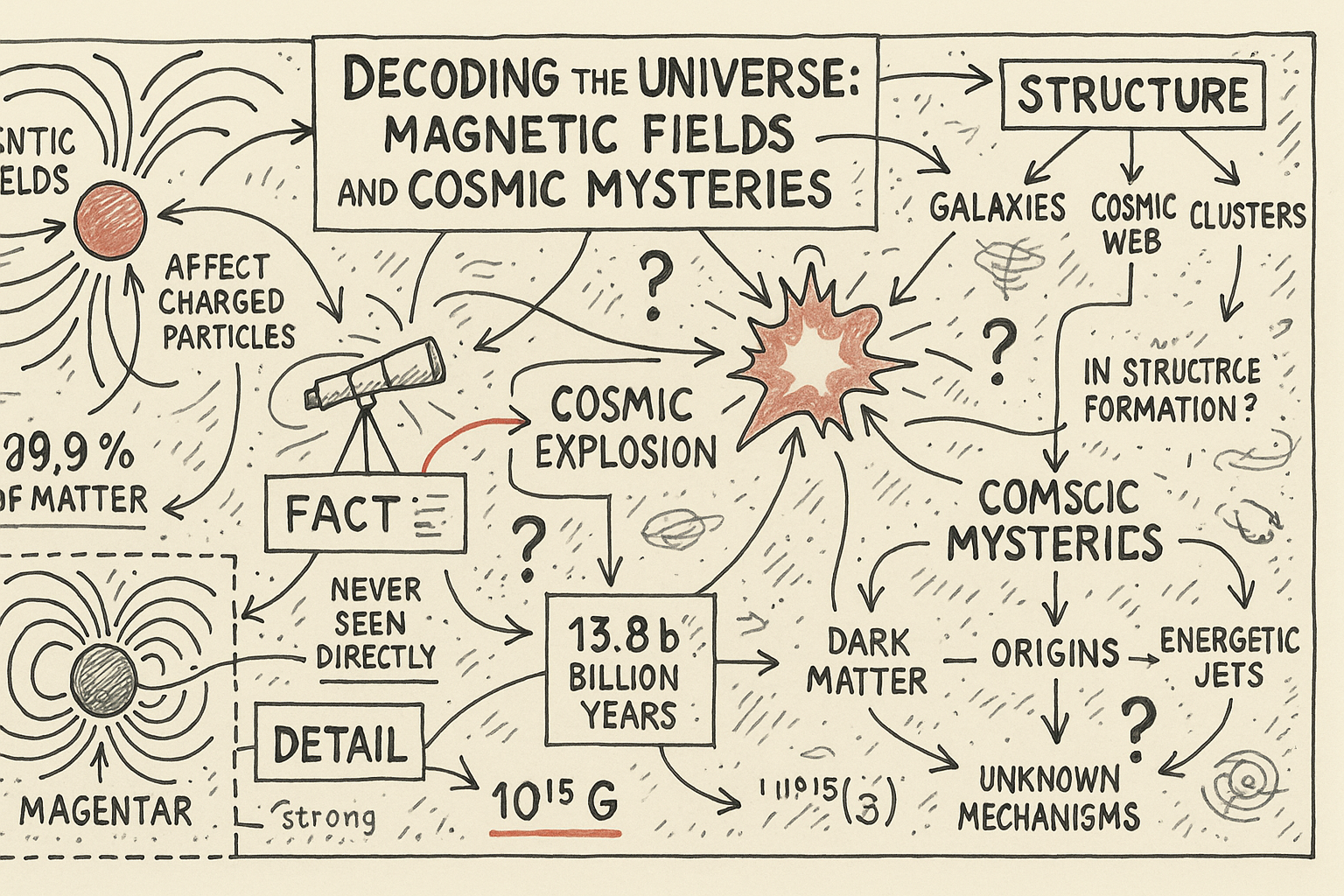
The universe, with its vast expanse and intricate cosmic phenomena, continues to captivate scientists and astronomers. Recent breakthroughs have unveiled new insights into the magnetic forces governing some of the universe's most powerful events. From gamma-ray bursts to pulsars, these discoveries are reshaping our understanding of cosmic interactions.
Magnetic Fingerprints in Cosmic Explosions
In a landmark observation, astronomers detected the magnetic fingerprint of a gamma-ray burst (GRB) afterglow using the NSF Very Large Array radio telescope. This discovery marks the first time polarized radio light from a GRB has been observed, providing critical clues about the magnetic fields involved in such cataclysmic events. The polarization of light reveals the alignment and strength of magnetic fields, allowing scientists to better understand the forces at play during these explosive cosmic occurrences.
Pulsars: Cosmic Lighthouses and Their Magnetic Mysteries
Meanwhile, NASA's Imaging X-ray Polarimetry Explorer (IXPE) has been mapping the magnetic fields of the 'Lighthouse' pulsar, PSR J1101−6101. These pulsars, often described as cosmic lighthouses due to their rotating beams of radiation, offer a unique opportunity to study magnetic field structures. The IXPE's findings confirm that high-energy particles are emitted along these magnetic field lines, providing new insights into the pulsar's magnetosphere and the surrounding nebula.
The Expanding Universe: A New Approach
In another fascinating development, astronomers have utilized neutron star mergers to measure the universe's expansion. This method combines gravitational wave data with traditional telescope observations to refine the Hubble Constant—a value that has long been a source of contention among cosmologists. By providing a new way to measure cosmic expansion, this approach could resolve decade-long debates and lead to a more unified understanding of the universe's growth.
Hidden Jets and Black Hole Mysteries
Furthermore, the discovery of a hidden jet from an intermediate-mass black hole has added yet another piece to the cosmic puzzle. Detected by the NSF Very Large Array, this off-axis afterglow of a powerful jet highlights the complexity of black hole interactions. As a 'missing-link' black hole tears apart a star, it sheds light on the processes that govern black hole evolution and jet formation.
Implications for the Future
These findings not only enhance our understanding of cosmic phenomena but also pave the way for future explorations. As telescopes and detection methods become more advanced, the potential for new discoveries increases. The integration of radio, X-ray, and gravitational wave observations exemplifies a multi-faceted approach to space science, one that will likely become the standard in unraveling the universe's mysteries.
Moreover, the ability to map magnetic fields and measure cosmic expansion with greater precision could lead to groundbreaking advancements in astrophysics and cosmology. These techniques may eventually help answer fundamental questions about the universe's origin, structure, and ultimate fate.
Conclusion
The universe's hidden magnetic forces and cosmic events offer a glimpse into the complex dynamics that shape our cosmos. As scientists continue to decode these mysteries, each new discovery brings us closer to understanding the grand tapestry of the universe. The future of space science promises exciting revelations, driven by the relentless pursuit of knowledge and the ever-expanding frontiers of technology.