In a groundbreaking study, astronomers have discovered that the Milky Way's outer spiral arms may stretch further into space than previously estimated. This revelation comes from observations of gamma-ray bursts (GRBs), which have provided new insights into the structure of our home galaxy.
The research, led by Beatrice Vaia from the Scuola Universitaria Superiore IUSS of Pavia, Italy, utilized data from NASA's Chandra X-ray Observatory and ESA's XMM-Newton satellite. The team focused on three specific GRBs—GRB 031203, GRB 160623A, and GRB 221009A—the latter being the most luminous burst recorded to date. These bursts occurred in such a way that their high-energy radiation passed through the Milky Way's disk, allowing the researchers to analyze the light echoes created by the interaction with dust clouds in the galaxy's spiral arms.
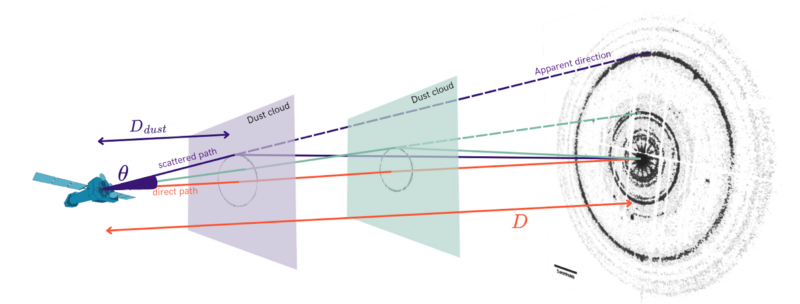
Gamma-ray bursts are the universe's most powerful explosions, often resulting from the collapse of massive stars or the merger of neutron stars. The intense light from these events creates light echoes when it scatters off dust in the spiral arms, forming rings that can be observed in X-rays. The size of these rings helps determine the distance to the dust clouds, offering a geometric method to measure the distance to the spiral arms without relying on assumptions about the Milky Way's rotation.
Vaia and her colleagues found that the Outer and Outer Scutum-Centaurus arms of the Milky Way might be located up to 10% further away than previous estimates suggested. This shift in distance could have significant implications for our understanding of the galaxy's structure and dynamics. According to Vaia, "This is a very direct way—relying only on geometry—to precisely measure distances to the Milky Way’s spiral arms, which is crucial for understanding our galaxy's shape."
The study, published in the journal Astronomy & Astrophysics, builds on previous measurements that were often uncertain due to the limitations of observing the galaxy from within. While ESA's Gaia mission has provided precise distances for numerous stars, its reach does not extend to the full breadth of the galaxy's disk. As a result, astronomers have had to rely on indirect methods, such as the rotation curves of the galaxy, which become less reliable for the outer regions.
This new approach, leveraging the unique light echoes of GRBs, provides a clearer picture of the Milky Way's outer reaches. The researchers also estimated the diameter of the dust clouds in the most distant arm to be about 3,500 light-years, indicating the full thickness of the spiral arm rather than isolated dust clouds.
The findings prompt a reevaluation of existing models of the Milky Way, suggesting the galaxy might be larger and more complex than previously believed. This could affect our understanding of the galaxy's formation and evolution, as well as the distribution of material within it.
Understanding the structure of spiral galaxies like the Milky Way is an ongoing challenge for astronomers. Spiral arms are known to play a crucial role in star formation by acting as 'fuel pumps' that channel gas into regions where stars are born. Therefore, accurately mapping these structures is vital for understanding not only the Milky Way but also spiral galaxies in general.
This research marks a significant advancement in galactic astronomy, offering a more refined map of our cosmic neighborhood. The continued study of GRBs and their interactions with the galaxy's dust clouds promises to further illuminate the mysteries of the Milky Way's vast and intricate spiral structure.