NASA's Juno spacecraft has once again put the spotlight on Jupiter's moon Io, the most volcanically active body in the solar system. Recent data from Juno's 57th and 58th close flybys of Jupiter have provided unprecedented insights into the subsurface temperatures of Io, marking a significant advancement in our understanding of extraterrestrial volcanism.
Io's extreme volcanic activity is primarily driven by tidal heating. As the moon orbits Jupiter in a slightly elliptical path, it experiences intense gravitational forces causing it to stretch and squeeze, which generates significant internal heat. This heat output is several times greater than that of Earth, yet until recently, most studies focused solely on surface temperatures observed through infrared techniques.
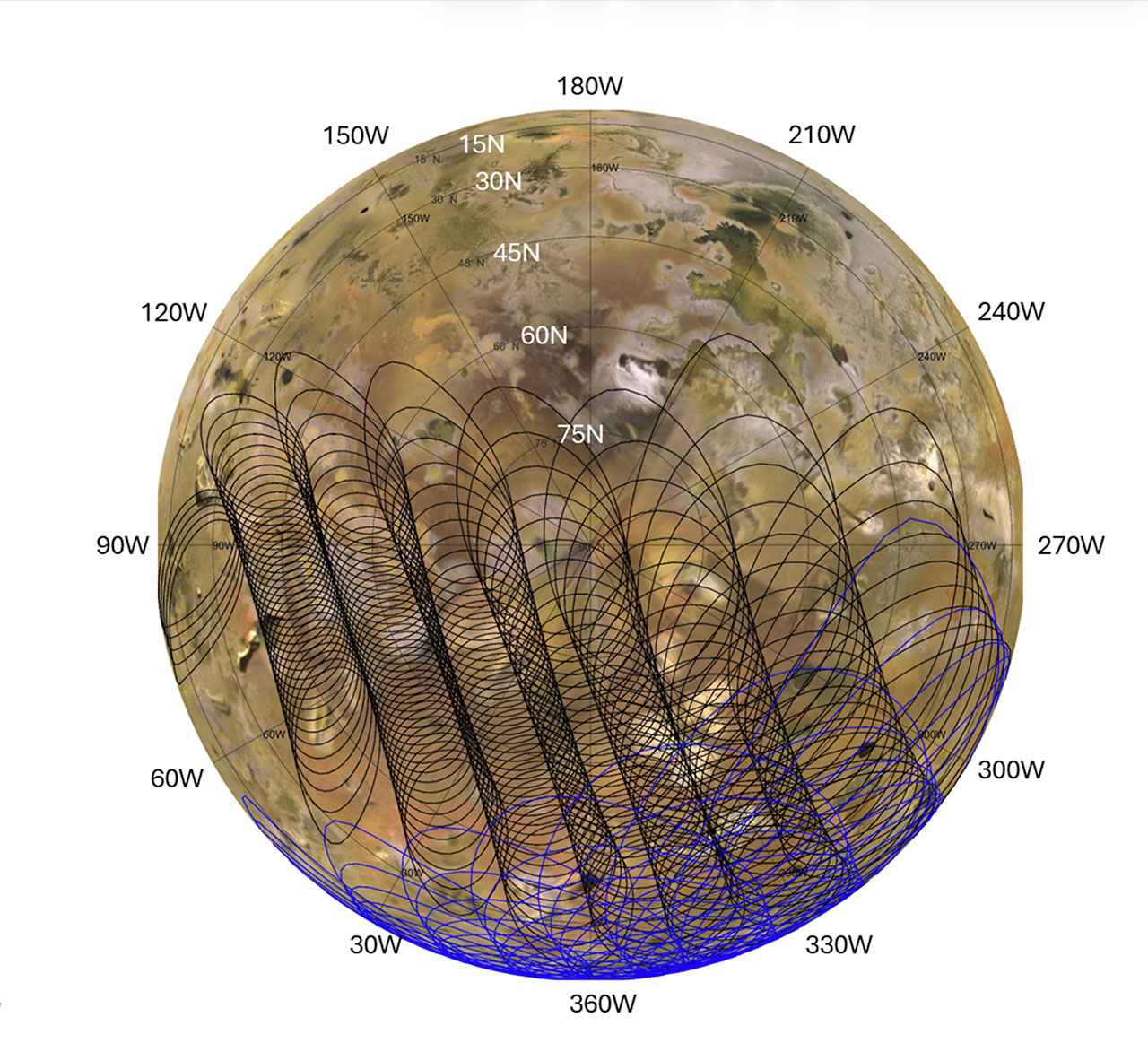
The breakthrough comes from Juno's Microwave Radiometer (MWR) instrument, which has been instrumental in peering beneath Io's surface. Designed originally to study Jupiter's deep atmosphere, the MWR has now revealed substantial subsurface heating in Io, providing the first direct measurements of temperature below the moon's crust.
Scott Bolton, Juno's principal investigator at Southwest Research Institute, underscored the significance of this discovery, stating, "The surprising discovery that we could see below a rocky moon's surface has important implications for studying Earth's volcanoes." This revelation suggests that similar MWR-type instruments could enhance our understanding of terrestrial volcanic activity by offering a new perspective on subsurface temperature gradients.
The findings, published in the Journal of Geophysical Research: Planets, highlight that most of Io's surface is remarkably smooth, consisting of low-density materials. This smoothness contrasts with the moon's fiery reputation, hinting at complex geological processes at play beneath its surface.
These observations are not only a testament to the capabilities of the Juno mission but also open new avenues for comparative planetology. By drawing parallels between Io's volcanic systems and those on Earth, scientists can develop a deeper understanding of geological processes that are universal across rocky bodies in our solar system and beyond.
Juno's innovative approach of using microwave technology to assess subsurface conditions could revolutionize the way we study other planetary bodies. This method could be applied to future missions targeting icy moons or other volcanic worlds, providing a more comprehensive view of their geology.
As we look to the future, the implications of these findings extend beyond our solar system. With ongoing discoveries of exoplanets and potential volcanic activity on other worlds, the techniques honed by Juno could play a vital role in unraveling the mysteries of these distant bodies.
Io's study exemplifies how targeted scientific missions can yield insights that transcend their initial objectives, offering new tools and perspectives for planetary science. As Juno continues its journey, the scientific community eagerly anticipates further revelations that may reshape our understanding of the solar system's dynamic and diverse landscapes.