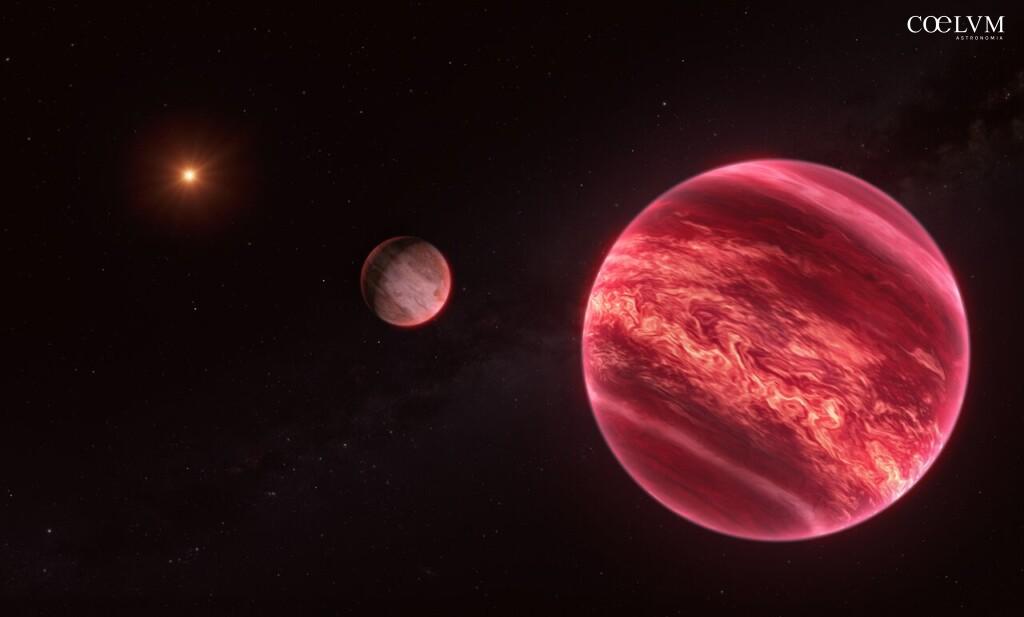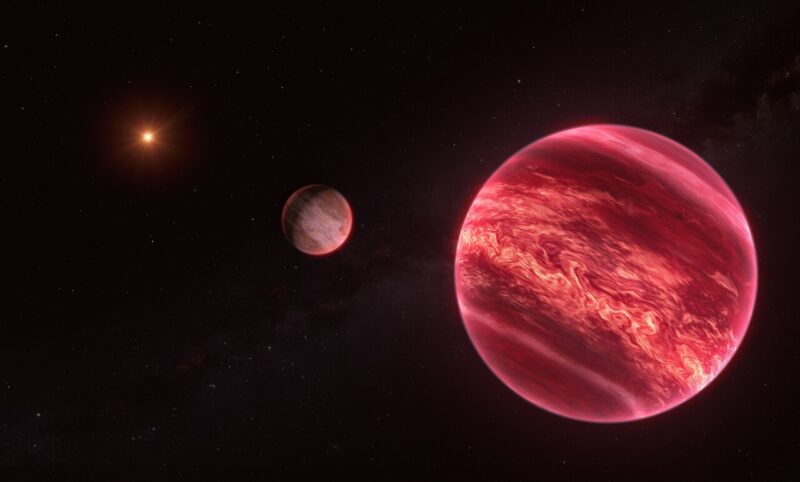
Astronomers have recently identified a Jupiter-mass object orbiting a brown dwarf in a binary system, raising intriguing questions about its classification. This discovery, centered around the star system CD-35 2722, located approximately 72 light-years from Earth, has sparked discussions on whether the object should be labeled as an exosatellite, an exoplanet, or even the first exomoon discovered outside our solar system.
The system comprises an M-class red dwarf star, CD-35 2722 A, and a brown dwarf, an object that is too massive to be a planet but lacks the necessary mass to sustain nuclear fusion like a star. The brown dwarf, itself weighing over 37 times the mass of Jupiter, is orbited by the newly discovered object, which is at least as massive as Jupiter.
This discovery was made possible by the European Southern Observatory's Very Large Telescope (VLT) in Chile. Over two years, a team led by Kevin Hoy from Diego Portales University, Chile, conducted meticulous observations to detect minute changes in the velocity of the brown dwarf, indicative of the gravitational influence of the orbiting object. These measurements, published in the journal Nature, are significantly more precise than previous attempts, thanks to the relatively large angular separation between the star and the brown dwarf, minimizing light contamination during observations.
The classification dilemma stems from the unique orbital dynamics observed. Traditionally, moons orbit planets, which in turn orbit stars. However, this object orbits a brown dwarf, which orbits a star, complicating the use of conventional terms like 'planet' and 'moon.' Kevin Hoy, an ESO student and lead author of the study, described the system as 'super weird' and difficult to define using solar-system-based terminology.
Two scenarios fit the observed data: The object could be a single, Jupiter-mass entity on an eccentric orbit around the brown dwarf, or it might follow a different, yet equally complex orbital path. The inability to categorically label the object highlights the limitations of our current classification system and underscores the need for a broader understanding of celestial hierarchies.
Brown dwarfs, often referred to as 'failed stars,' occupy a niche between planets and stars, lacking the mass to ignite hydrogen fusion. This particular brown dwarf, part of the binary system with CD-35 2722 A, challenges our understanding by hosting an object that behaves like a moon but possesses planetary mass.
This discovery is pivotal as it could potentially represent the first confirmed exomoon, a term reserved for moons outside our solar system. Exomoons have eluded astronomers due to their typically small size and dimness, overshadowed by the glare of their parent stars. If confirmed, this object would redefine our understanding of moons and their formation in diverse cosmic environments.
Looking forward, the implications of this discovery extend beyond mere classification. It opens new avenues for studying planetary formation and migration in systems containing brown dwarfs. It also raises questions about the possible habitability of such objects, considering their unique positions in the cosmic hierarchy.
As astronomers continue to explore the cosmos, they may discover more such systems, challenging and refining our understanding of celestial bodies and their intricate relationships. The debate surrounding the classification of this object not only highlights the dynamic nature of astronomical research but also the ever-evolving narrative of our universe.