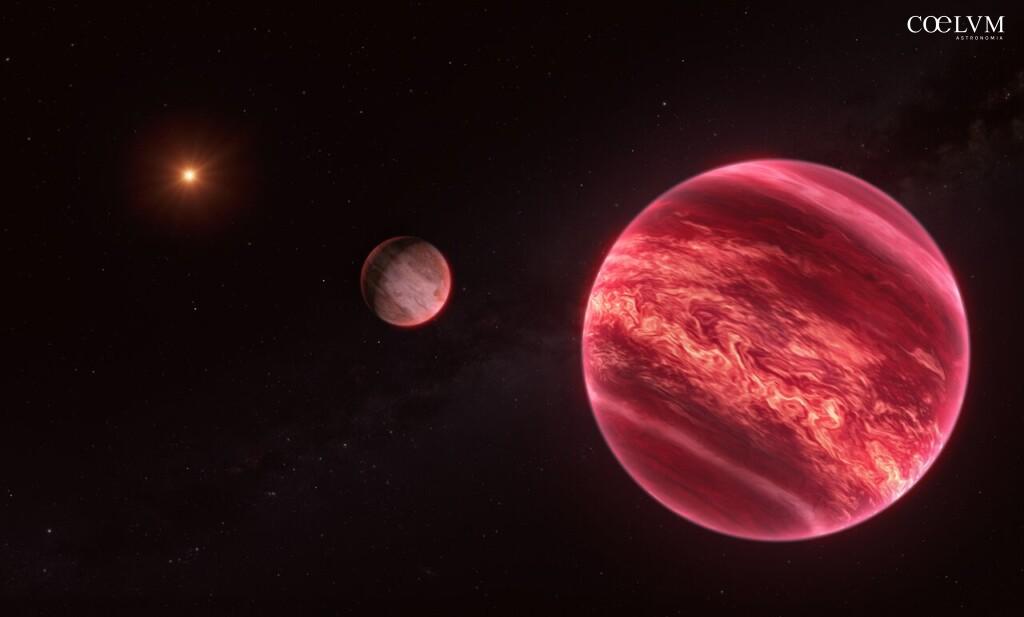
Astronomers have uncovered a remarkable celestial object in the CD-35 2722 system, which defies conventional classification as either an exoplanet or an exomoon. Discovered using the European Southern Observatory's (ESO) Very Large Telescope (VLT), this object is revolutionizing our understanding of celestial bodies and their classification.
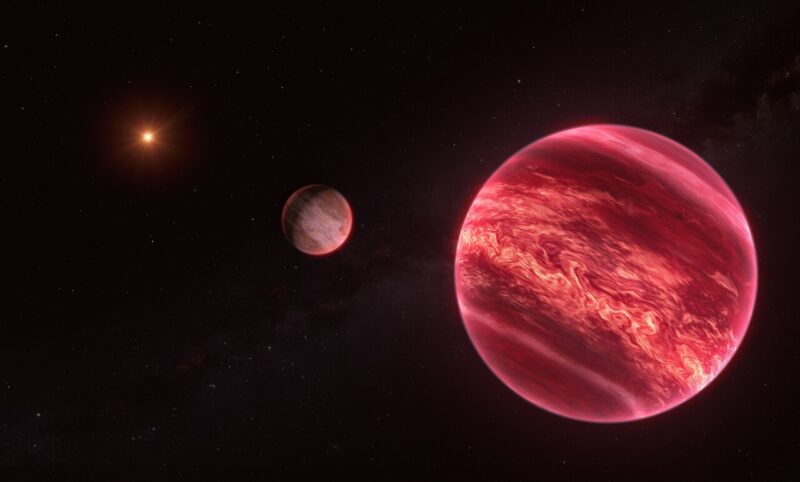
The system in question is centered around the star CD-35 2722, which possesses about half the mass of our Sun. Orbiting this star is a brown dwarf, a type of substellar object often described as too massive to be a planet yet not massive enough to sustain nuclear fusion like a star. The brown dwarf in the system has about 37 times the mass of Jupiter. It is this brown dwarf that hosts the newly discovered object, which has a mass comparable to that of Jupiter, making it significant enough to challenge existing astronomical categories.
Researchers from the Universidad Diego Portales in Chile, ESO, and the Italian National Institute for Astrophysics (INAF) collaborated on this study, which has been published in the journal Nature. They describe the object as behaving like a moon because it orbits an object (the brown dwarf) that itself orbits a star. However, due to its substantial mass, it could also be considered a planet. The astronomical community has tentatively labeled it an 'exosatellite', though this term does not fully encapsulate its unique characteristics.
To date, more than 6,000 exoplanets have been identified since the early 1990s, yet the existence of an exomoon around any of these has not been definitively proven until now. This discovery is significant because it introduces a new kind of celestial body that blurs the lines between existing categories. The term 'moon' typically refers to smaller rocky bodies like those orbiting the planets in our Solar System, but this newly found object challenges that notion.
The implications of this discovery extend beyond mere classification. It opens up new avenues for research into the formation and evolution of celestial bodies. The presence of such a massive 'moon' raises questions about the processes that can lead to the formation of such systems. It also suggests that similar objects might exist in other star systems, awaiting discovery.
From a historical perspective, the discovery of such an object highlights the evolving nature of astronomical classification systems. Similar to how Pluto's reclassification in 2006 spurred debate and a reevaluation of planetary definitions, this finding challenges astronomers to rethink the criteria that define celestial bodies. The discovery underscores the importance of direct imaging techniques, which have been pivotal in identifying both the brown dwarf and its orbiting companion in the CD-35 2722 system.
Looking ahead, astronomers are eager to explore whether similar objects exist elsewhere in the universe. Advances in telescope technology, like those employed by the VLT, will continue to play a crucial role in uncovering such enigmatic celestial bodies. Future research may focus on the formation mechanisms of such objects, their potential atmospheres, and their dynamics within their host systems.
In summary, this discovery not only adds a new layer to our understanding of the universe but also invites the scientific community to reassess and expand existing frameworks for classifying cosmic phenomena. As we continue to probe the cosmos, the boundaries of what we know and how we categorize the universe's many wonders are constantly being redefined.