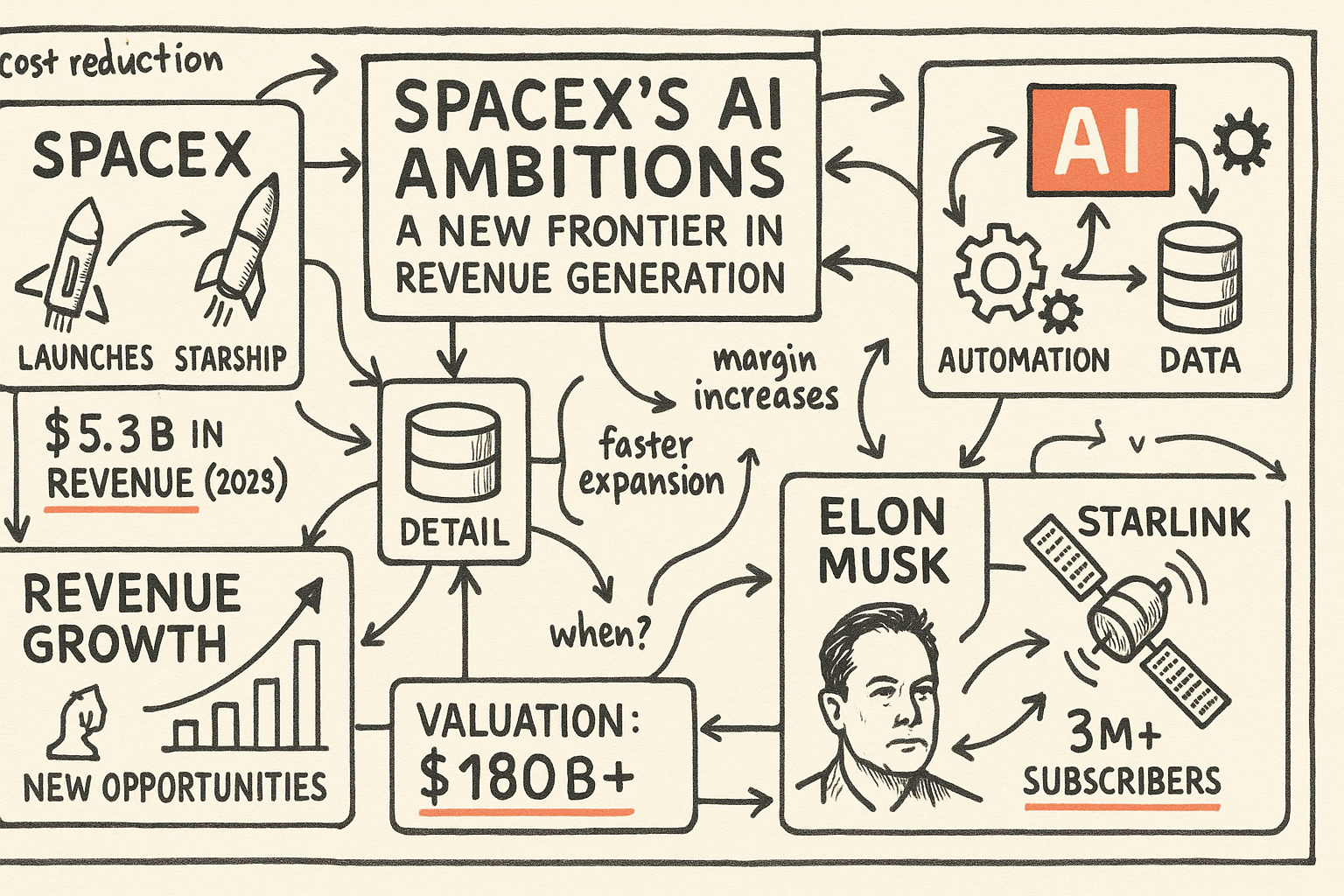
SpaceX, traditionally recognized as a pioneering space exploration company, has recently made headlines for a different reason. The company, led by Elon Musk, has reported that its artificial intelligence (AI) segment has surpassed its space division in revenue generation, marking a significant shift in its business strategy. According to SpaceX's latest quarterly earnings report, the AI division brought in a staggering $2.6 billion, tripling its revenue from the previous year.
This remarkable growth in AI revenue is largely attributed to strategic deals with other leading AI companies, such as Anthropic in May and Google in June. These partnerships have positioned SpaceX as a formidable competitor in the neocloud market, where it competes with other companies like CoreWeave. Despite the impressive revenue figures, SpaceX's AI division is not yet profitable, reporting a loss of $1.5 billion for the quarter, slightly better than the same period last year.
SpaceX's foray into AI is part of a broader strategic vision outlined in the documents filed for its initial public offering (IPO), which was the largest ever in June. The company has identified AI as the primary driver of its future value, with ambitions to build data centers in space, leveraging its expertise in space technology to offer unique advantages in the AI sector.
However, this pivot is not without its financial challenges. SpaceX's capital expenditures have soared to $18.37 billion, reflecting the significant investment required to build AI compute capacity at scale. Elon Musk emphasized on an investor call that the company is building this capacity faster than any other competitor, which he believes will significantly enhance their AI models.
The company's financial strategy appears to be a double-edged sword. On one hand, the diversification into AI and connectivity—through its Starlink internet service—has opened new revenue streams. The space segment, traditionally SpaceX's core business, generated $962 million this quarter. However, the high spending and losses have spooked some investors, leading to concerns about the company's ability to sustain such a capital-intensive expansion.
Elon Musk's interconnected business ecosystem also plays a role in SpaceX's financial strategy. The company has purchased $329 million worth of Tesla Megapacks this year, illustrating the synergies Musk aims to exploit between his various enterprises. This strategy, while ambitious, has led to mixed reactions from investors who are cautious about the high levels of spending and the long-term profitability of these ventures.
SpaceX's pivot to AI highlights a broader trend in the technology industry, where companies are increasingly focusing on artificial intelligence as a key growth area. The ability to process vast amounts of data and develop advanced AI models is seen as a crucial competitive advantage in today's digital economy. SpaceX's unique position as a space and technology company allows it to explore innovative solutions, such as space-based data centers, which could redefine the AI landscape.
Looking forward, SpaceX's success in AI will depend on its ability to balance investment with financial sustainability. The company's leadership, under Elon Musk, remains confident in its strategy, but the path forward is fraught with challenges. Investors and industry observers will be watching closely to see if SpaceX can turn its AI ambitions into a profitable reality while maintaining its pioneering role in space exploration.
As SpaceX continues to navigate this complex landscape, its developments in AI and space technology will undoubtedly have far-reaching implications for the broader industry. The company's ability to innovate and adapt will determine its future trajectory and influence the next generation of technological advancements.