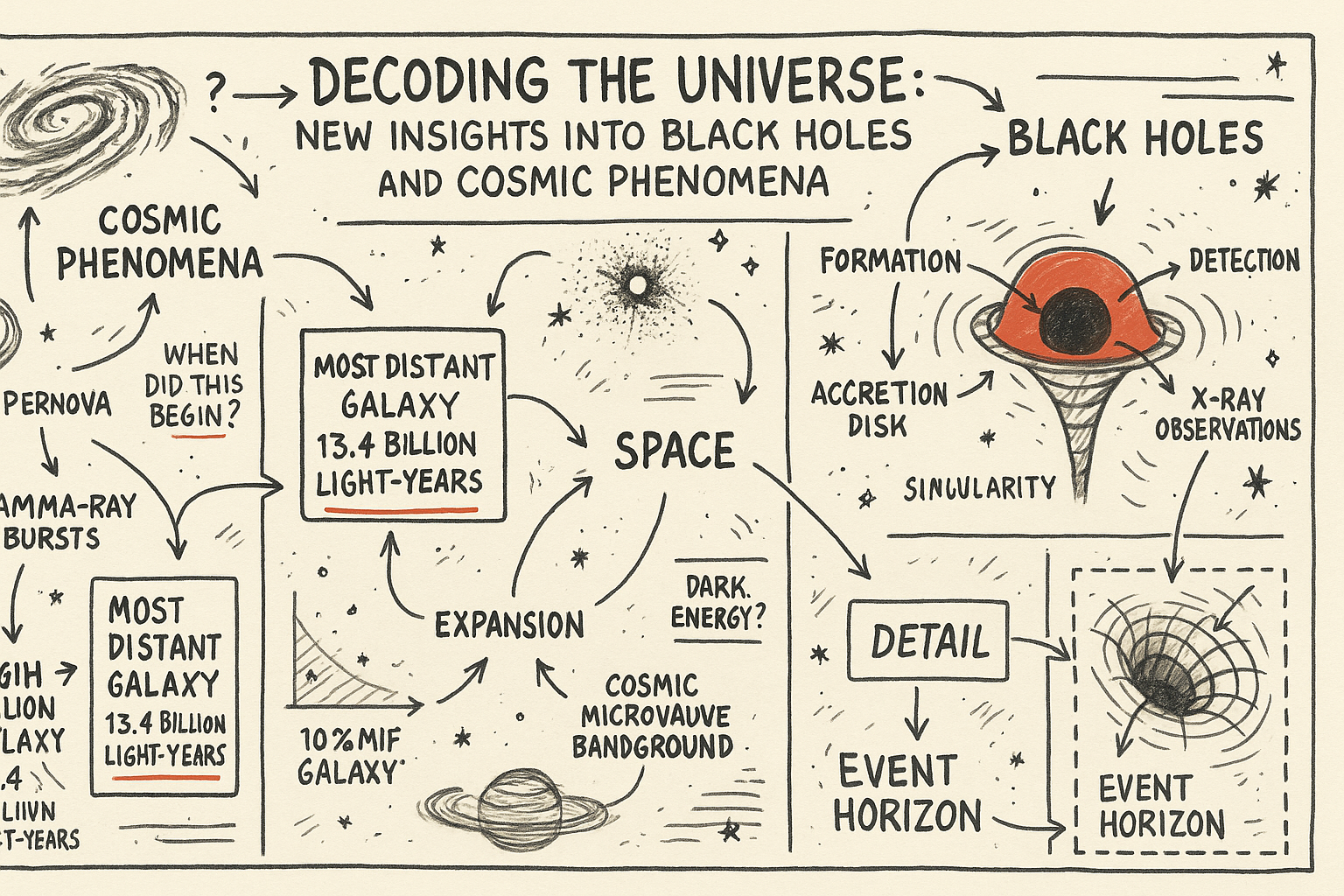
In recent months, astronomers have unveiled groundbreaking discoveries that deepen our understanding of the universe, particularly focusing on black holes and cosmic phenomena. These advancements not only challenge existing theories but also open up new avenues for exploration and understanding.
The Black Hole ‘Star’ Phenomenon
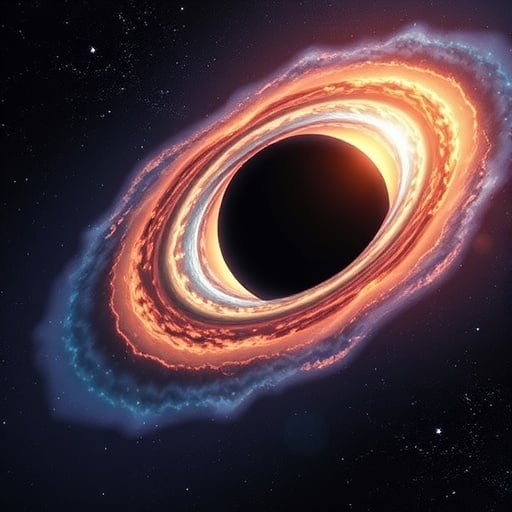
One of the most intriguing discoveries is the identification of a new cosmic object termed as a black hole 'star'. This object, discovered 30 billion light-years from Earth, is the size of the entire solar system and emits a brilliant red glow. This unexpected find, as reported by The Guardian, suggests the presence of phenomena that defy conventional categorizations of cosmic objects.
This discovery raises questions about the lifecycle of black holes and the possibility of intermediate states that blend characteristics of different cosmic entities. It challenges the traditional boundary lines between stars and black holes, suggesting that these lines may be more blurred than previously thought.
Galaxies Hosting Multiple Supermassive Black Holes
In addition to the black hole 'star', another team of astronomers has identified three supermassive black holes within a single galaxy, J0148-4214. This rare finding, led by the Max Planck Institute for Extraterrestrial Physics, indicates a complex gravitational interaction that could potentially lead to novel insights into galaxy formation and evolution.
The presence of multiple supermassive black holes within a single galaxy could suggest past collision events or mergers that influenced the galaxy's current structure. It also poses questions about the fate of these galaxies and the role such black holes play in shaping their environments.
Exploring Ancient Cosmic Structures
With the aid of the James Webb Space Telescope, researchers have discovered a gravitational arc candidate in the galaxy cluster MACS J0308.9+2645, dating back to the early universe. This object, with a photometric redshift close to 4.4, offers a crucial glimpse into the universe's formative years.
This finding demonstrates the power of advanced telescopes in uncovering the universe's history and the importance of gravitational lensing in observing distant cosmic phenomena. Understanding these ancient structures provides insights into the early conditions that led to the universe we observe today.
From Supernova Shock Waves to Runaway Black Holes
Astronomers have also captured the initial shock breakout of a supernova, offering a rare view into the death of a star. This early observation helps determine the type of progenitor star and its pre-explosion environment, marking a significant step in understanding stellar lifecycles.
In another development, the discovery of a runaway supermassive black hole, RBH-1, provides a new method to reconstruct ancient galactic mergers. Such black holes, which have been ejected from their host galaxies, offer unique insights into gravitational interactions and galaxy dynamics.
Implications and Future Directions
These discoveries collectively highlight the dynamic and interconnected nature of cosmic phenomena. They challenge established models and hint at complex interactions that govern the universe's evolution. From the potential of new cosmic categories like the black hole 'star' to understanding the role of multiple supermassive black holes in a single galaxy, these findings push the boundaries of our cosmic knowledge.
Moreover, the technological advancements that facilitated these discoveries underscore the importance of continued investment in space science and exploration. As we refine our tools and methods, the potential for new insights into the universe remains vast and exciting.