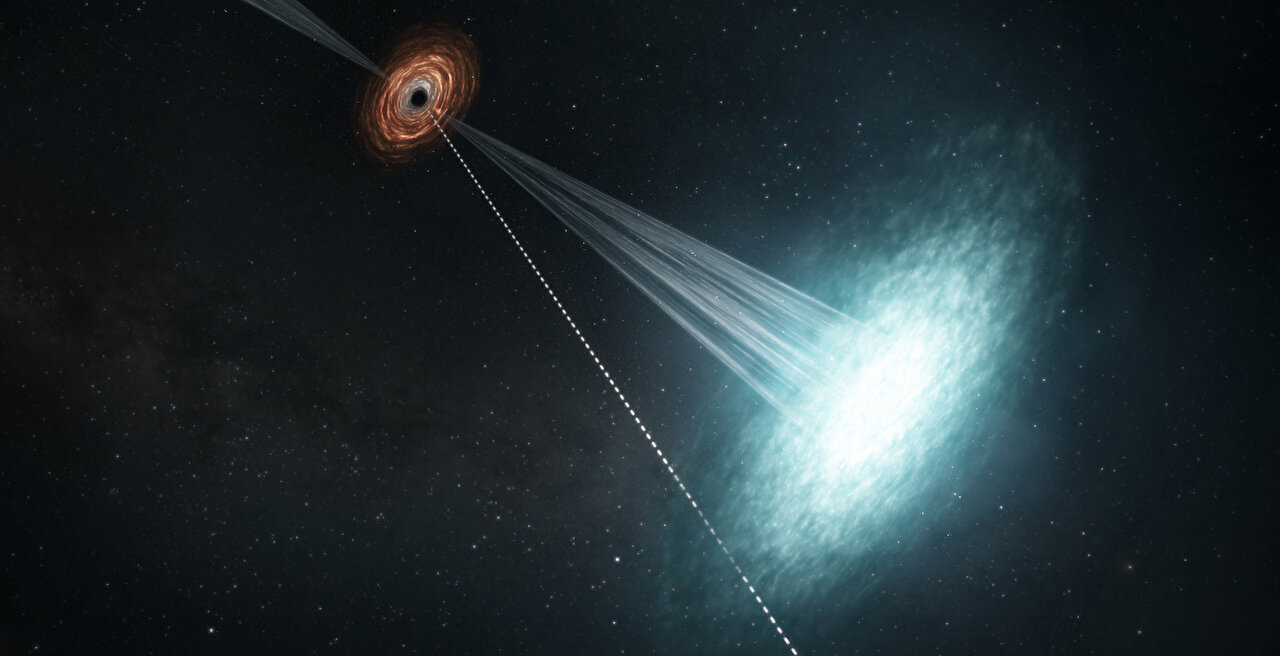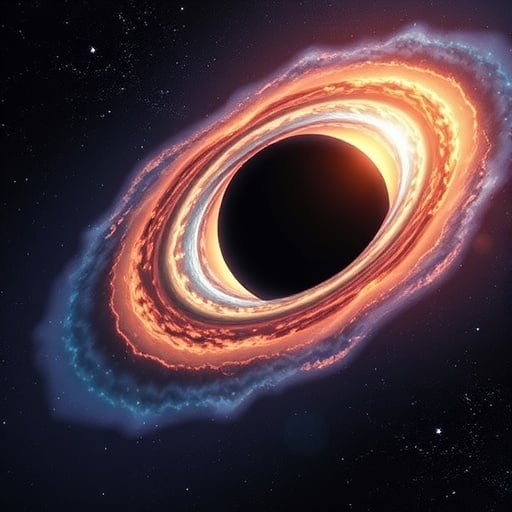
In a striking astronomical observation, a team of researchers from the University of North Carolina at Chapel Hill has identified a rare occurrence involving a 'wandering' black hole. This event, termed TDE 2025abcr, marks the first optical tidal disruption event (TDE) discovered on the outskirts of a host galaxy, approximately 30,000 light-years from its galactic core.
Typically, tidal disruption events occur when a star ventures too close to a supermassive black hole, resulting in the star being gravitationally torn apart. The intense gravitational forces exerted by the black hole create a process known as 'spaghettification,' where the star is stretched and its material is drawn into an accretion disk around the black hole. The friction and magnetic fields within this disk heat the material, causing it to emit radiation detectable across various wavelengths, including visible light, X-rays, and radio waves. It is this radiation that allows astronomers to witness the dramatic unfolding of a TDE.
While TDEs have been observed since the late 20th century, they are predominantly detected in the cores of galaxies, home to supermassive black holes surrounded by dense fields of stars and gas clouds. However, the recent observation of TDE 2025abcr challenges this understanding. Utilizing the Southern Astrophysical Research Telescope (SOAR), the team employed an AI classification program to detect potential TDEs beyond the dense galactic cores. This cutting-edge approach enabled the identification of TDE 2025abcr as a candidate, subsequently confirmed through optical observations.
The discovery of TDE 2025abcr provides crucial insights into the dynamics of black holes outside the traditional galactic centers. This 'wandering' black hole, located tens of thousands of light-years from its galaxy's core, exemplifies a rare phenomenon that may reshape our understanding of black hole movement through the universe, particularly following galaxy collisions. These findings, published in The Astrophysical Journal Letter, suggest that such orphaned black holes might be more common than previously thought.
Historically, the study of TDEs has been pivotal in understanding the growth and behavior of supermassive black holes (SMBHs). As these colossal entities consume stars, they offer astronomers a glimpse into the complex processes that govern their evolution over cosmic time. Future missions, such as those involving NASA's Nancy Grace Roman Space Telescope, aim to uncover more about these enigmatic events, with the potential to discover around 100 TDEs annually.
Moreover, the observation of TDE 2025abcr aligns with recent findings that illustrate the powerful influence of supermassive black holes beyond their immediate surroundings. Researchers have discovered that winds generated by these black holes can carry energy across distances of approximately 300,000 light-years, affecting the vast regions of space beyond their host galaxies.
The implications of these discoveries are profound. They not only enhance our understanding of black hole dynamics but also highlight the importance of employing innovative technologies and methodologies in astronomical research. As AI and advanced telescopes continue to play a pivotal role, the ability to detect and study such rare cosmic events will undoubtedly expand, paving the way for new discoveries and insights into the universe's most mysterious phenomena.