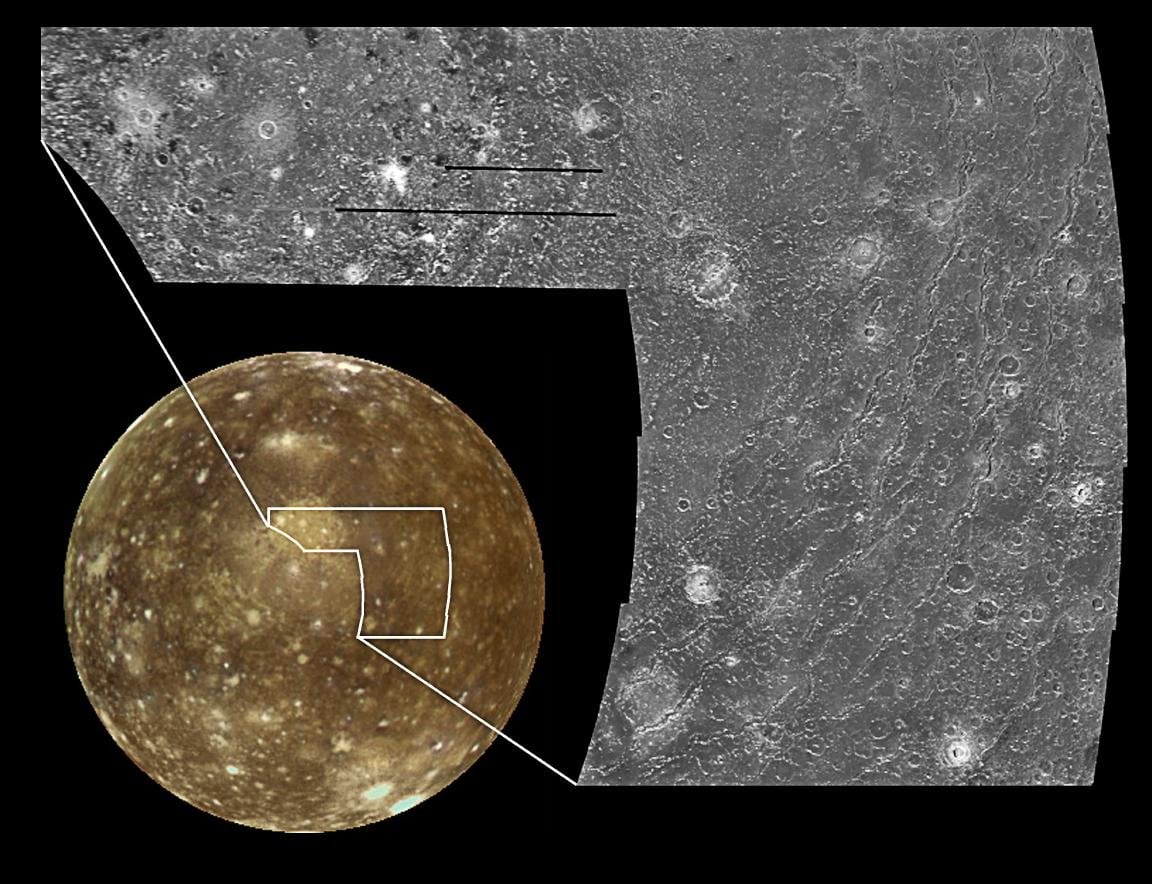
Callisto, one of the four Galilean moons orbiting Jupiter, has long been seen as the quiet sibling among its more dynamic counterparts. While Io is known for its volcanic activity, Europa for its subsurface ocean, and Ganymede for its unique magnetic field, Callisto has generally been regarded as a relic of the past, with an ancient, heavily cratered surface. However, recent observations from the James Webb Space Telescope (JWST) have revealed that Callisto is more geologically active than previously thought.
A study led by Maria Camarca of Caltech, published in the Planetary Science Journal, utilized the JWST’s Near-Infrared Spectrograph (NIRSpec) instrument to examine Callisto in unprecedented detail. The focus was on three key areas: the trailing hemisphere, the massive Asgard impact basin, and Valhalla, the largest multi-ring impact structure in the solar system. These observations have provided new insights into the moon's surface composition and geological processes.
One of the most notable findings was the presence of water ice on Callisto’s surface. NIRSpec detected the 3.1 µm “Fresnel peak,” which is indicative of ice crystals. This discovery allowed researchers to map the distribution of water ice across Callisto with unmatched precision. Interestingly, the ice distribution is not uniform; it varies significantly between the leading and trailing hemispheres of the moon.
On the leading hemisphere, the water ice aligns closely with geographical features. Bright impact basins like Valhalla and Asgard, along with younger craters such as Lofn and Heimdall, exhibit sharp increases in water ice. These areas, where ancient impacts have brought fresher, brighter material to the surface, contrast starkly with Callisto’s otherwise dark and weathered landscape.
In contrast, the trailing hemisphere of Callisto presents a distinct “bullseye” pattern of water ice distribution. The ice is scarcest near the equatorial center and becomes more concentrated at higher latitudes. This pattern is likely influenced by plasma interactions, with charged particles from Jupiter’s magnetosphere impacting the moon and altering its surface ice.
The study also identified a significant presence of dry ice, or frozen carbon dioxide, on Callisto. The 4.25 µm spectral band, characteristic of CO2, appeared prominently in the data. On the trailing hemisphere, solid CO2 is concentrated at the center of the disk, creating an anti-correlation with water ice. This suggests that particle radiation may be actively converting water ice and carbon-rich grains into CO2.
On the leading hemisphere, the strongest CO2 signal was found around the craters Lofn and Heimdall. This discovery raises intriguing questions about the mechanisms that trap or replenish CO2 on Callisto’s surface, as it is not expected to remain stable over long periods without such processes.
The revelations about Callisto’s surface activity challenge previous assumptions about its geologic dormancy. Understanding the dynamics at play on Callisto is crucial for unraveling the history of the Jovian system and the processes shaping its moons. The findings could have broader implications for the study of icy bodies elsewhere in the solar system and beyond.
The JWST’s observations of Callisto are a testament to the telescope’s capabilities in advancing our understanding of celestial bodies. As the mission continues, astronomers are hopeful that further studies will shed more light on the complex interplay of geological and atmospheric processes on Callisto and other icy moons.