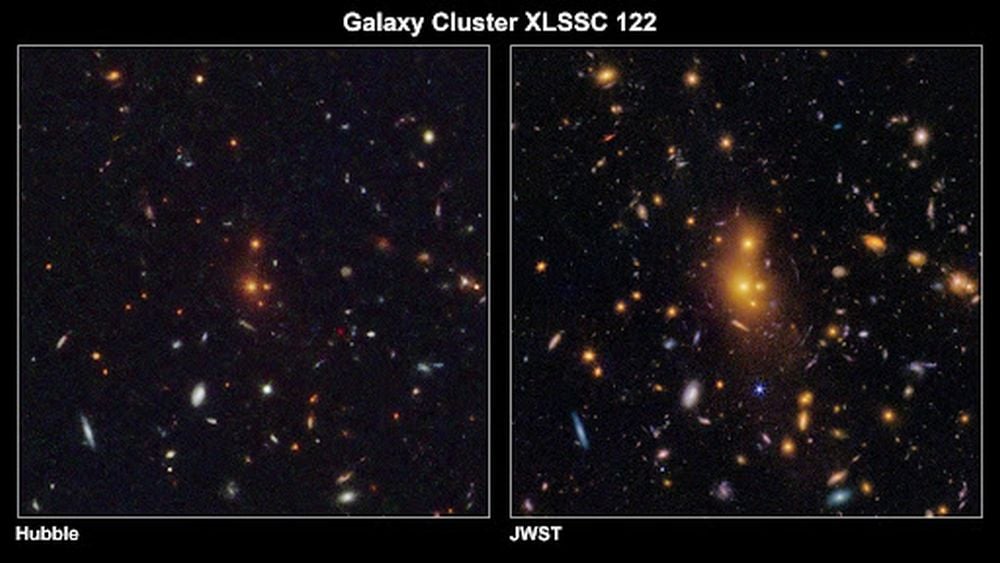
In a groundbreaking discovery, astronomers have utilized NASA's Chandra X-ray Observatory to capture a rare glimpse of a nascent galaxy cluster forming in the early universe, more than 11 billion light-years away. This observation provides one of the clearest views yet of a galaxy cluster in the making, offering significant insights into the conditions of the early universe.
Galaxy clusters, which consist of thousands of galaxies gravitationally bound together, are among the largest structures in the universe. They form through the gravitational collapse and mergers of smaller structures. A key component of these clusters is the intracluster medium (ICM), a reservoir of hot gas that fills the gaps between galaxies. This gas, primarily detected through its X-ray emission, can reach temperatures of tens to hundreds of millions of Kelvin through a process known as shock heating.
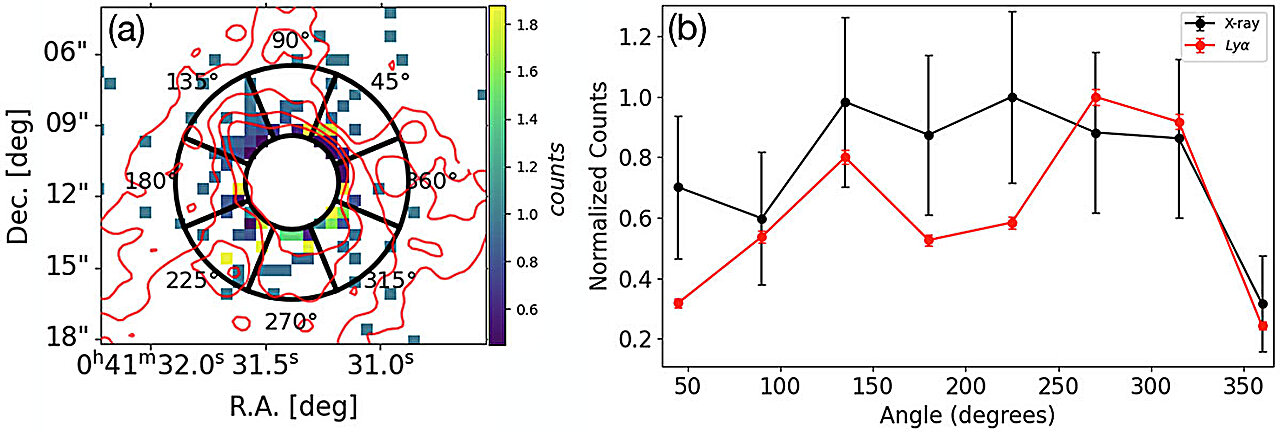
The current study focused on a dense concentration of galaxies surrounding a quasar, a bright and distant object powered by a supermassive black hole. Observations spanning over 600,000 seconds revealed diffuse, extended X-ray emission around the quasar, indicating the presence of an enormous cloud of gas with temperatures in the tens of millions of degrees. The study, published in the journal Astronomy & Astrophysics, highlights the proto-intracluster medium (proto-ICM) in its nascent stage of formation.
Detecting these young halos of gas in the early universe—when it was just 2 to 3 billion years old—poses significant challenges. The signals are faint and often obscured by instrumental limitations in sensitivity and resolution. However, the Chandra X-ray Observatory's advanced capabilities have allowed astronomers to overcome these hurdles, providing a unique window into the universe's formative years.
This discovery holds profound implications for our understanding of cosmic evolution. By unraveling the processes that lead to the formation of galaxy clusters, scientists can better comprehend the distribution of matter in the universe and how it has evolved over billions of years. The detection of the proto-ICM is a crucial step toward understanding when and how these hot gas envelopes first began to form.
Historically, astronomers have had a robust understanding of the hot gas in mature, nearby clusters. However, observing these phenomena in the early universe has remained elusive until now. This study represents a significant leap forward in bridging that gap, providing a snapshot of a critical phase in cosmic structure formation.
The implications of this research extend beyond mere observational achievements. The insights gained from these findings could inform theoretical models of galaxy formation and evolution. By comparing observed data with theoretical predictions, astronomers can refine their understanding of the mechanisms driving the growth of large-scale cosmic structures.
As technology advances, future observations may continue to uncover more about the early universe's conditions and the processes that led to the formation of the cosmic web. The Chandra X-ray Observatory's success in this endeavor underscores the importance of high-resolution, sensitive instruments in probing the universe's distant past.
In conclusion, the detection of a nascent galaxy cluster more than 11 billion light-years away marks a pivotal moment in our exploration of the cosmos. It enhances our understanding of galaxy cluster formation and provides a window into the universe's early days, offering tantalizing clues about the forces that shaped the cosmos as we know it today.