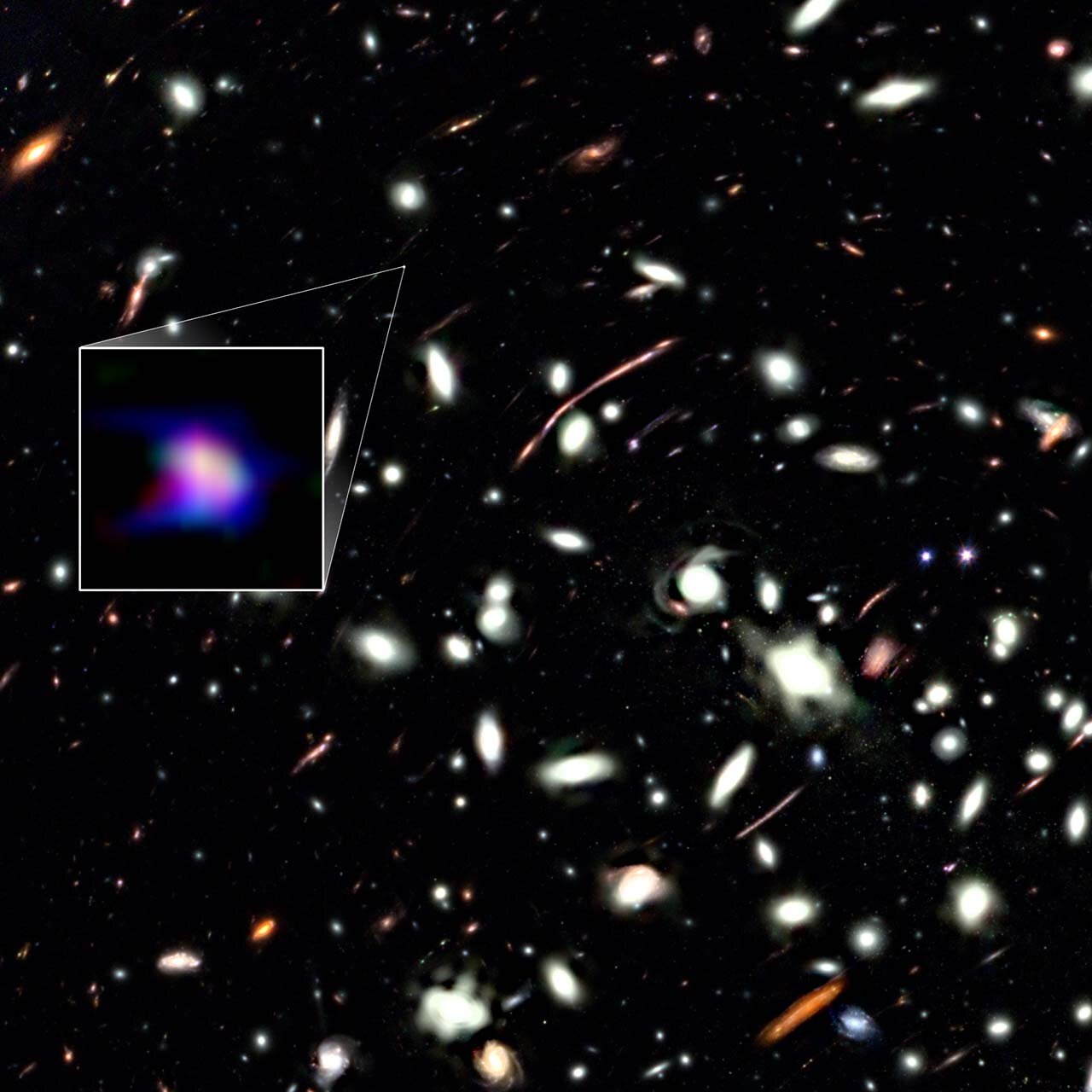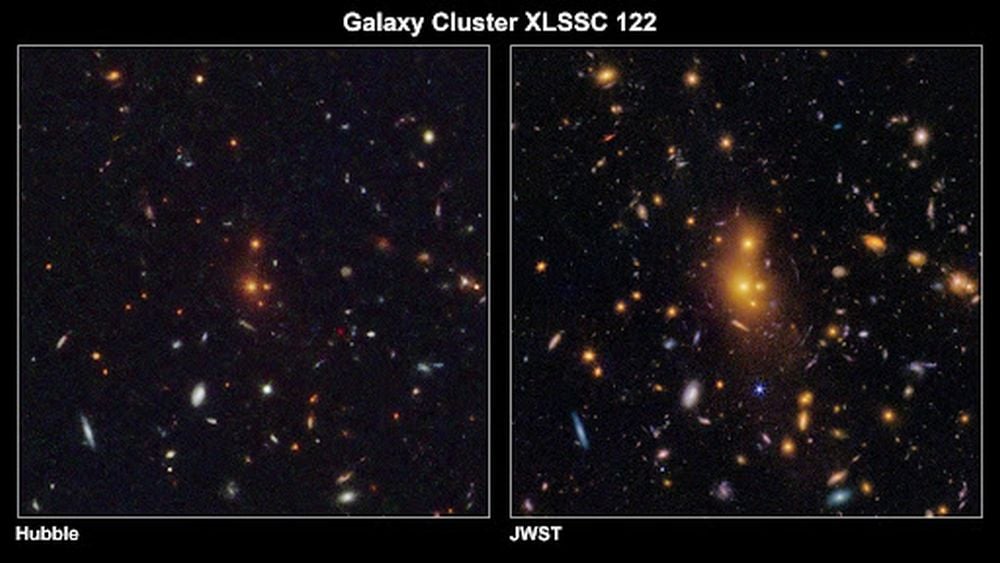
The James Webb Space Telescope (JWST) continues to transform our understanding of the universe, revealing unexpected findings that challenge existing cosmological models. One of its latest discoveries is the galaxy cluster XLSSC 122, located 10 billion light-years away, which presents a rare glimpse into the early universe.
Galaxy clusters are among the largest gravitationally bound structures known, often containing thousands of individual galaxies. These clusters are so massive that they can act as gravitational lenses, distorting and magnifying the light from more distant objects behind them. The newly studied XLSSC 122 is now the most distant known strong gravitational lens, providing astronomers with an unprecedented opportunity to study the mass and composition of this early universe structure.
Originally discovered in 2014 by the European Space Agency's XMM-Newton x-ray observatory, XLSSC 122 was noted for its massive amounts of heated gas. Subsequent observations by the Hubble Space Telescope estimated its distance at 10.4 billion light-years and hinted at its unusual maturity compared to other clusters from the same era.
The recent observations by the JWST have deepened our understanding of XLSSC 122. The telescope's advanced capabilities have revealed clear arcs of warped light — a signature of strong gravitational lensing — that were not visible in Hubble's images. These findings were presented in three new papers published in The Astrophysical Journal and discussed at the 248th meeting of the American Astronomical Society.
Kyle Finner, a staff scientist at the Infrared Processing and Analysis Center (IPAC) and lead author of one of the studies, expressed the significance of these observations. "When we got those first images back from JWST, we said, ‘wow, look at this, there's strong lensing coming from this cluster!’" he noted. The discovery has set a record for the most distant galaxy cluster displaying strong lensing, enhancing our understanding of the universe's early days.
One of the most intriguing aspects of XLSSC 122 is its maturity. While most galaxy clusters 10 billion years ago were just beginning to coalesce, XLSSC 122 appears more massive, concentrated, and organized, resembling modern clusters. This maturity suggests that galaxy formation processes in the early universe might have been more complex than previously thought.
The presence of dark matter within XLSSC 122 is a critical factor in its gravitational lensing capability. Dark matter, which forms the universe's large-scale structure, acts as a scaffold for galaxies and clusters. The JWST's observations provide new insights into dark matter's role in cluster formation and evolution.
The findings from XLSSC 122 open new avenues for research into the early universe's structure and composition. They prompt questions about how such a mature cluster could form relatively soon after the Big Bang, challenging existing models of cosmic evolution.
As the JWST continues its mission, astronomers anticipate further discoveries that will refine our understanding of the universe's formative years. Each observation offers a glimpse into the past, revealing the complex processes that shaped the cosmos we observe today.