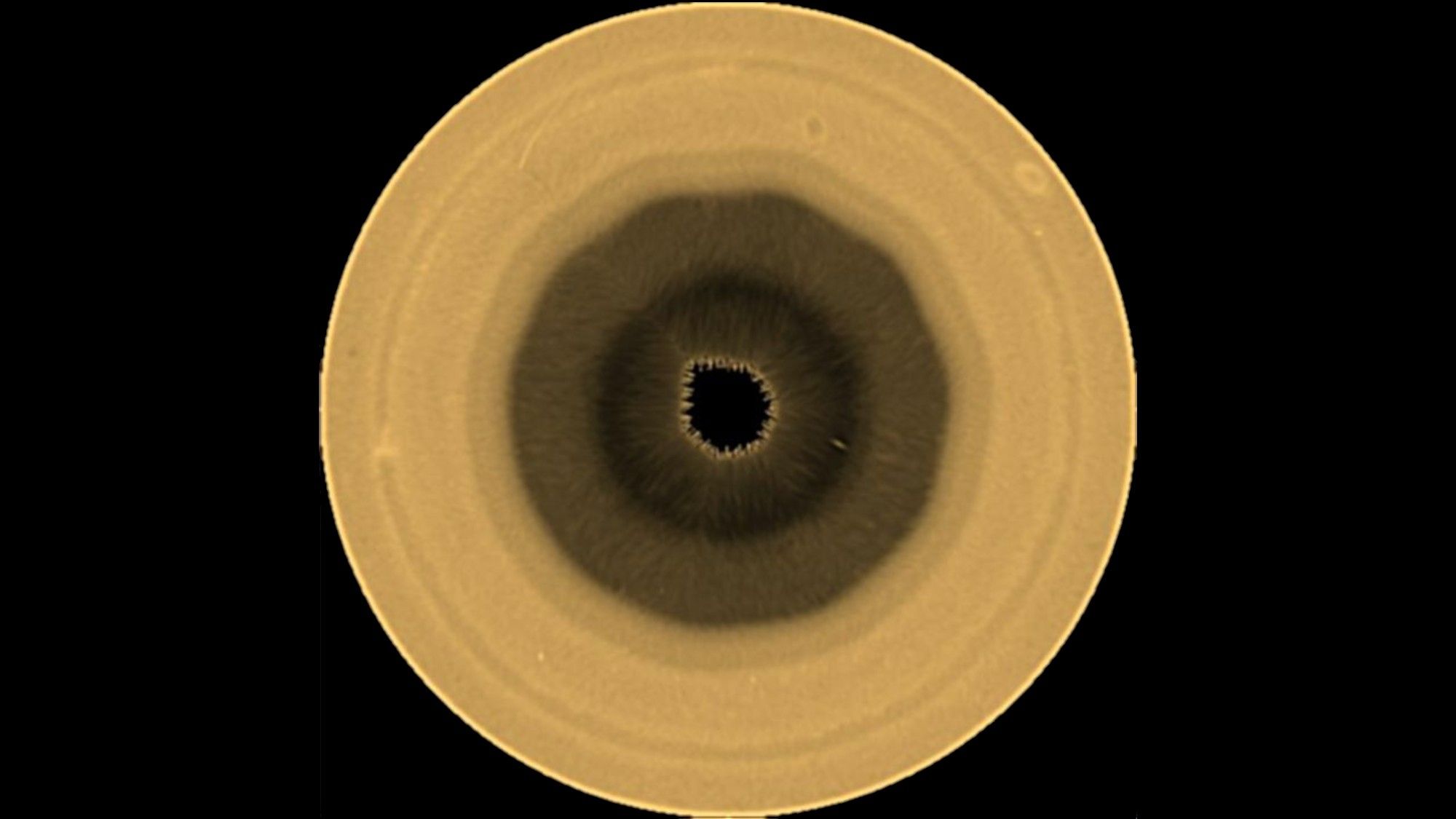
Hubble and ground-based observers identify a decagon circling Saturn’s south pole
NASA/ESA’s Hubble Space Telescope has detected a large, evolving 10-sided atmospheric wave encircling Saturn’s south pole, according to a study published in Science Advances and announced by the Hubble teams on 2 September 2026. The discovery is based on Hubble’s OPAL (Outer Planet Atmospheres Legacy) programme images combined with years of ground-based observations contributed to the Planetary Virtual Observatory Laboratory.
Researchers pieced together Hubble observations dating back to 2023 and cross-checked them with images collected by amateur and professional observers on Earth. Agustín Sánchez-Lavega of the University of the Basque Country, lead author of the paper, and colleagues, including OPAL principal investigator Amy Simon of NASA’s Goddard Space Flight Center, report that subtle undulations in 2023 images grew more distinct through 2024 and 2025 and are now visible as a coherent decagonal wave in Hubble data.
“We’ve never seen anything quite like this in Saturn’s southern hemisphere,” said Amy Simon (NASA Goddard), noting that the northern hexagon has been present in every observation for more than 40 years while a comparable southern polygon had not been observed by Cassini (2004–2017) or earlier Hubble searches. The new southern structure appears to be strengthening, providing an unusual opportunity to watch a large atmospheric pattern develop in near–real time.
The feature sits within one of Saturn’s jet streams and is visibly distinct from the long-lived northern hexagon. Hubble’s vantage above Earth’s atmosphere provided the spatial resolution and stable coverage necessary to confirm the decagon’s shape and persistence across multiple rotations of the planet. Image credits provided with the release list NASA, ESA, STScI, Agustín Sánchez-Lavega (University of the Basque Country), Amy Simon (NASA-GSFC) and Michael Wong (UC Berkeley), with image processing by Alyssa Pagan.
How the pattern emerged and how it was detected
The initial hints of the decagon came from ground-based images contributed to the Planetary Virtual Observatory Laboratory. Sánchez-Lavega, amateur astronomers Trevor Barry and Jean-Paul Oger first noticed a weak undulating band along the southern pole in images from 2024. Additional ground-based images from 2025 strengthened that interpretation and spurred a reanalysis of Hubble’s OPAL data. OPAL has photographed the outer planets annually for more than a decade, which allowed scientists to trace the structure back to faint signatures in 2023 Hubble images that were previously ambiguous.
Hubble’s OPAL programme was crucial because it provides high-resolution, full-rotation views of the giant planets without atmospheric blurring. The Hubble observations confirmed that the decagon was present at least as far back as 2023 and that it has become more clearly defined since then.
What the decagon might mean for Saturnian meteorology
The new decagon raises questions about how large-scale, regular-sided jet patterns form and persist in gas-giant atmospheres. The well-known northern hexagon was first seen by the Voyager spacecraft over 40 years ago and later studied extensively by the Cassini mission and Hubble; it has proven to be a remarkably stable feature. By contrast, Cassini’s observations between 2004 and 2017 showed no persistent southern polygon, making the current emergence of a decagon at the south pole especially notable.
Researchers are cautious about interpreting the phenomenon. The sequence of observations could indicate a genuinely recent formation of a large-scale wave, or it could reflect amplification of a pre-existing, previously too-weak undulation. The team has not yet identified a definitive cause for the strengthening.
Broader context, implications and next steps
The discovery demonstrates the value of coordinated, long-term observing programmes and the contributions of both professional and amateur astronomers. It also highlights how seasonal changes in Saturn’s orientation relative to Earth — bringing the southern pole back into view — enabled detection of features not seen during Cassini’s mission.
Future work will aim to track the decagon’s evolution, probe its vertical structure, and constrain the dynamics that maintain or amplify such polygonal waves. Hubble’s continued OPAL monitoring, supplemented by ground-based networks that feed the Planetary Virtual Observatory Laboratory, will give scientists time-series coverage needed to test hypotheses about wave generation in jet streams on giant planets.
Observing a developing large-scale pattern on Saturn’s south pole offers a new laboratory for comparative study with the northern hexagon and for advancing understanding of atmospheric dynamics under conditions very different from Earth’s. For now, the decagon provides a rare chance to watch a planetary atmospheric pattern emerge and evolve.