MeerKAT directly detects faint hydrogen signal from the distant universe
A team from the University of Manchester and the University of the Western Cape has used the South African MeerKAT radio telescope to directly detect an extremely faint radio signal from neutral hydrogen gas located billions of light‑years away, the institutions reported on 1 September 2026. The detection was made using roughly 96 hours of MeerKAT observations and demonstrates hydrogen intensity mapping applied with radio data alone.
Neutral hydrogen atoms emit a characteristic radio wave known as the 21‑centimeter line. As the universe expands, that emission is redshifted to longer wavelengths, so measuring the line at different frequencies maps hydrogen at different epochs. Hydrogen intensity mapping measures the combined radio emission from many unresolved galaxies rather than resolving galaxies individually, allowing astronomers to survey very large cosmic volumes more efficiently.
Previous robust detections of this large‑scale signal at comparable distances have commonly relied on cross‑correlating radio observations with optical galaxy surveys. In contrast, the new result from the University of Manchester and the University of the Western Cape used MeerKAT data alone to pick out the faint intensity‑mapping signature. The team reports detections corresponding to two epochs whose emissions travelled for approximately four to five billion years before reaching Earth.
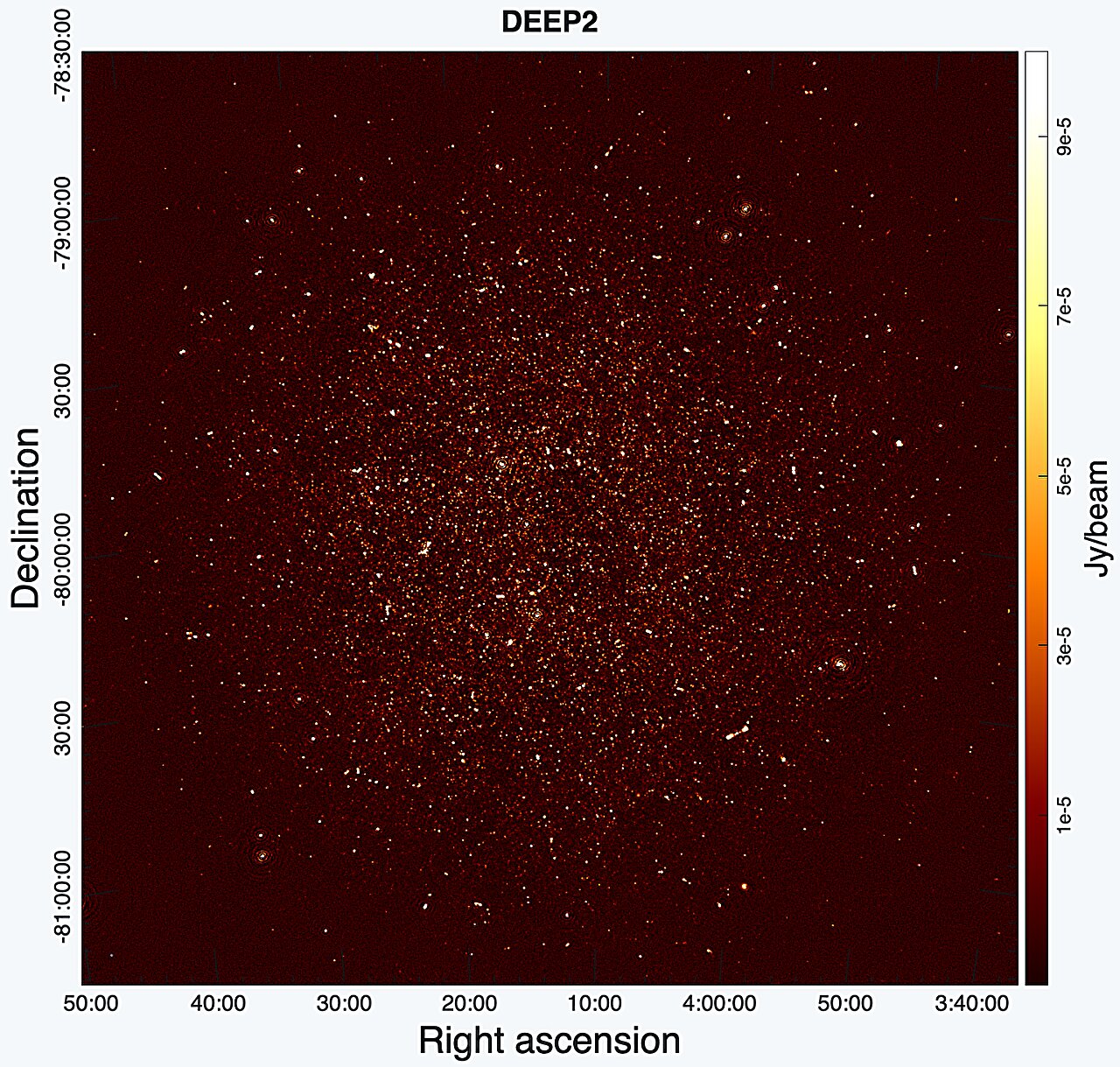
The analysis traces hydrogen over scales of several million light‑years — a length comparable to the distance between the Milky Way and the Andromeda galaxy. Extracting such a weak diffuse signal required isolating it from much brighter compact radio sources visible in MeerKAT images. The published work appears in The Astrophysical Journal Letters and has been reviewed through Science X's editorial process.
Hydrogen intensity mapping is of growing interest because it can build three‑dimensional maps of large‑scale structure without cataloguing individual galaxies. By measuring the aggregate 21‑centimeter emission in frequency slices, astronomers can reconstruct how hydrogen — and by proxy, matter — is distributed across millions of light‑years and across cosmic time. The MeerKAT detection demonstrates the technique's potential when applied to deep, high‑quality radio datasets.
The study used approximately 96 hours of observations with MeerKAT. The result provides a direct radio‑only measurement of the hydrogen intensity signal from the targeted redshift ranges, rather than relying on combined radio and optical methods. This achievement helps validate MeerKAT as a platform for intensity mapping experiments and offers a path toward surveys that probe larger volumes and different cosmic epochs.
Mapping neutral hydrogen through intensity mapping can inform multiple areas of cosmology and galaxy evolution research. By charting the large‑scale distribution of hydrogen, astronomers can test models of structure formation and study how gas traces underlying dark matter. While the new MeerKAT measurement is confined to two redshift slices corresponding to light that travelled four to five billion years, it shows that such studies are feasible with current radio facilities.
The result arrives as radio telescopes worldwide prepare more ambitious intensity‑mapping programs. MeerKAT, operated in South Africa, serves as a precursor and pathfinder for the Square Kilometre Array (SKA), which will dramatically increase sensitivity for similar studies when its arrays come online. Demonstrating radio‑only detections with MeerKAT helps refine observing strategies, data processing techniques, and foreground‑removal methods that will be critical for future SKA surveys.
It is important to note that hydrogen intensity mapping measures aggregate emission and does not provide observations of individual galaxies; it is a statistical technique for studying large volumes. The interpretation of intensity‑mapping results requires careful accounting for foreground radio sources and instrumental effects. The University of Manchester and the University of the Western Cape teams addressed these challenges in their analysis to extract the weak cosmological signal from the MeerKAT dataset.
Future work will seek to extend intensity mapping over wider sky areas, different frequency bands (probing other epochs), and longer integrations to improve signal‑to‑noise. Scaling up these measurements will enable more detailed three‑dimensional maps of hydrogen and matter across cosmic history, shedding light on how structures such as galaxy clusters and filaments evolved. The MeerKAT detection marks a step in that direction by establishing that radio‑only hydrogen intensity mapping can reach the distant universe.
Source: University of Manchester (reported via Phys.org), The Astrophysical Journal Letters.