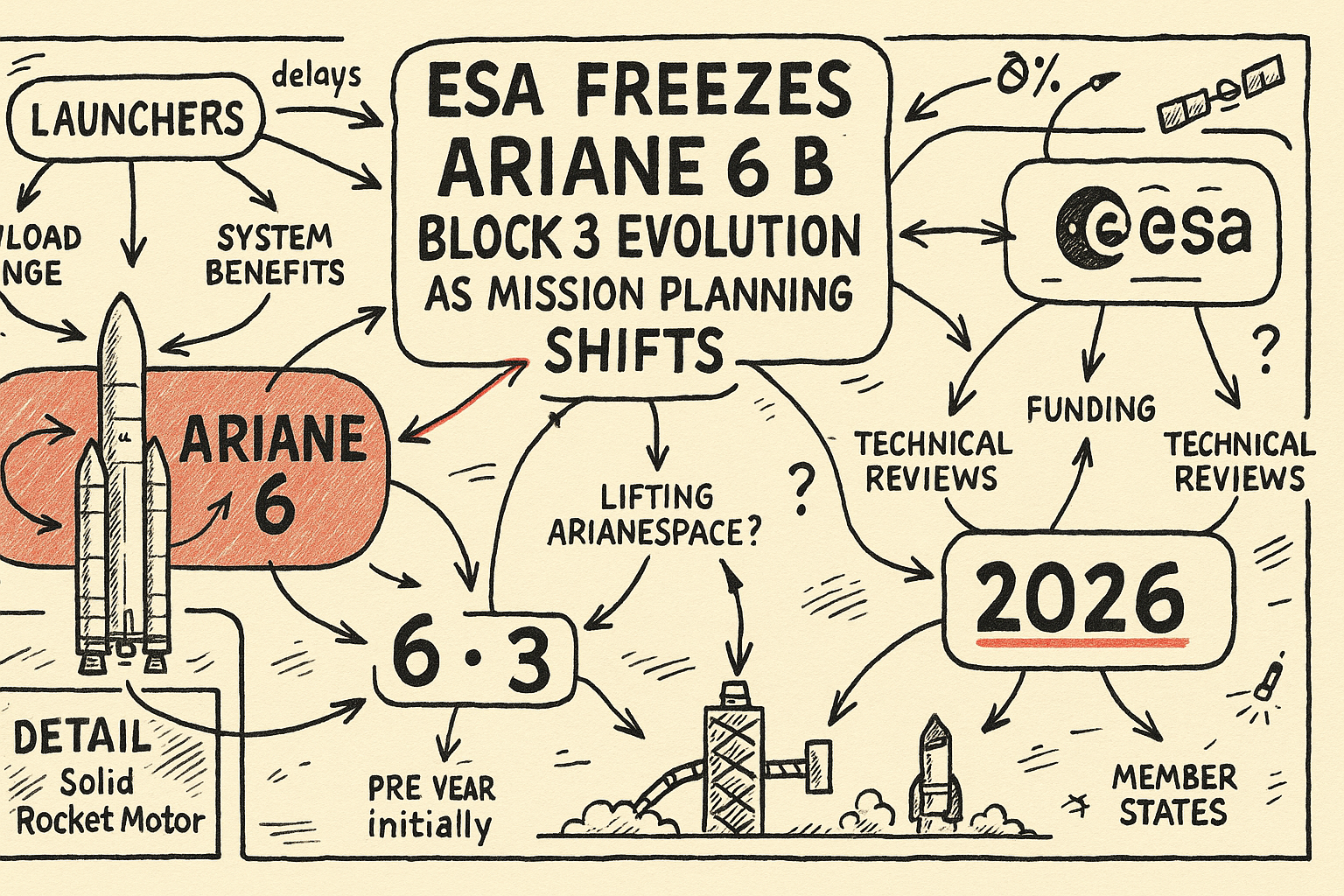
European Space Agency documents and reporting surfaced in August and September 2026 show ESA has decided not to proceed, for now, with development of the Ariane 6 Block 3 evolution. The decision effectively halts work beyond the second planned upgrade package and leaves the launcher at the current capability level until further notice.
The earliest public hint of the change came through a leaked presentation captured during the International Planetary Probe Workshop 2026 in Washington, D.C., reported by Space Scout and later discussed in Italian coverage. That slide indicated a decision made at the start of 2026 to stop development of the Ariane 6 evolution known as EVO and to shelve the Block 3 variant.
ESA subsequently provided a more measured public response to questions from the UK publication European Spaceflight. That response focused on the program known as the Upper Liquid Propulsion Module (ULPM), saying, "No evolution of the ULPM was approved during the last Ministerial Council (CM25), as currently none of the programmes requires such an evolution." The agency framed the decision in programmatic terms tied to current needs rather than as an absolute cancellation.
Implications for science missions
One immediate consequence highlighted in Italian reporting concerns mission planning for the proposed L4 mission to Enceladus. The coverage noted that, with Block 3 development paused, the L4 mission would need to be launched using the Ariane 6 Block 2 configuration, choosing between two possible mission architectures, or else use a higher‑performance non‑European launcher. The reporting ties the ULPM evolution to a specific technology effort, ICARUS, which would have used composite materials for the upper stage to increase payload by roughly two tonnes compared with an aluminum design.
Those technical details—presented in the Italian account—underscore what is at stake: the ICARUS concept, relying on carbon‑fiber composite construction for the upper stage, was expected to improve payload performance, and that capability will not be realized unless ESA revisits and approves ULPM evolution in a future ministerial decision.
What ESA said and what remains unclear
ESA's statement to European Spaceflight limited itself to the approval status of ULPM evolution at CM25 and the agency's assessment that no ongoing programmes currently require that evolution. The agency did not characterize the pause as a permanent cancellation in the quoted response, leaving open the possibility that the evolution could be revisited if program needs change or if a future ministerial council approves further work.
What is clear from the available reporting is that the Block 3 path is not moving forward now, and project teams and mission planners must account for that in near‑term planning. For missions with requirements that would have benefitted from the Block 3/ICARUS performance improvements, planners face a narrower set of launch options: use Ariane 6 Block 2 with revised architectures or select a more capable non‑European vehicle.
The reporting also illustrates how ministerial decisions at ESA influence technical roadmaps: without approval at CM25, the ULPM evolution—central to the Block 3 performance gain—was effectively put on hold. That linkage between program approval and technical development timelines will shape European launch capabilities and mission profiles until a new decision reverses or modifies the pause.
As ESA and European industry navigate these choices, mission teams currently planning for deep‑space targets such as Enceladus will need to finalize architectures compatible with Ariane 6 Block 2 performance or secure alternative launch services. Whether the ULPM/ICARUS work will be revived depends on future programme needs and ministerial approvals not yet recorded in the public domain.