The search for extraterrestrial life has long captivated scientific minds, with Mars often standing at the forefront of potential discovery sites. However, recent developments are shifting that focus to Enceladus, one of Saturn's icy moons. This shift is driven by groundbreaking research suggesting that Earth-like microbes could survive in the harsh conditions beneath Enceladus's icy crust, further compelling the case for life beyond Earth.
Since the Cassini mission first observed water plumes erupting from Enceladus in 2005, scientists have been intrigued by the moon's potential to harbor life. Recent studies have only intensified this interest. For instance, a team led by Frank Postberg at Freie Universität Berlin has provided new evidence that the ocean beneath Enceladus’s surface is more accessible for study than previously thought. This discovery is pivotal as it enhances our ability to analyze the ocean's constituents, thereby assessing its habitability.
Enceladus: A New Hope for Extraterrestrial Life
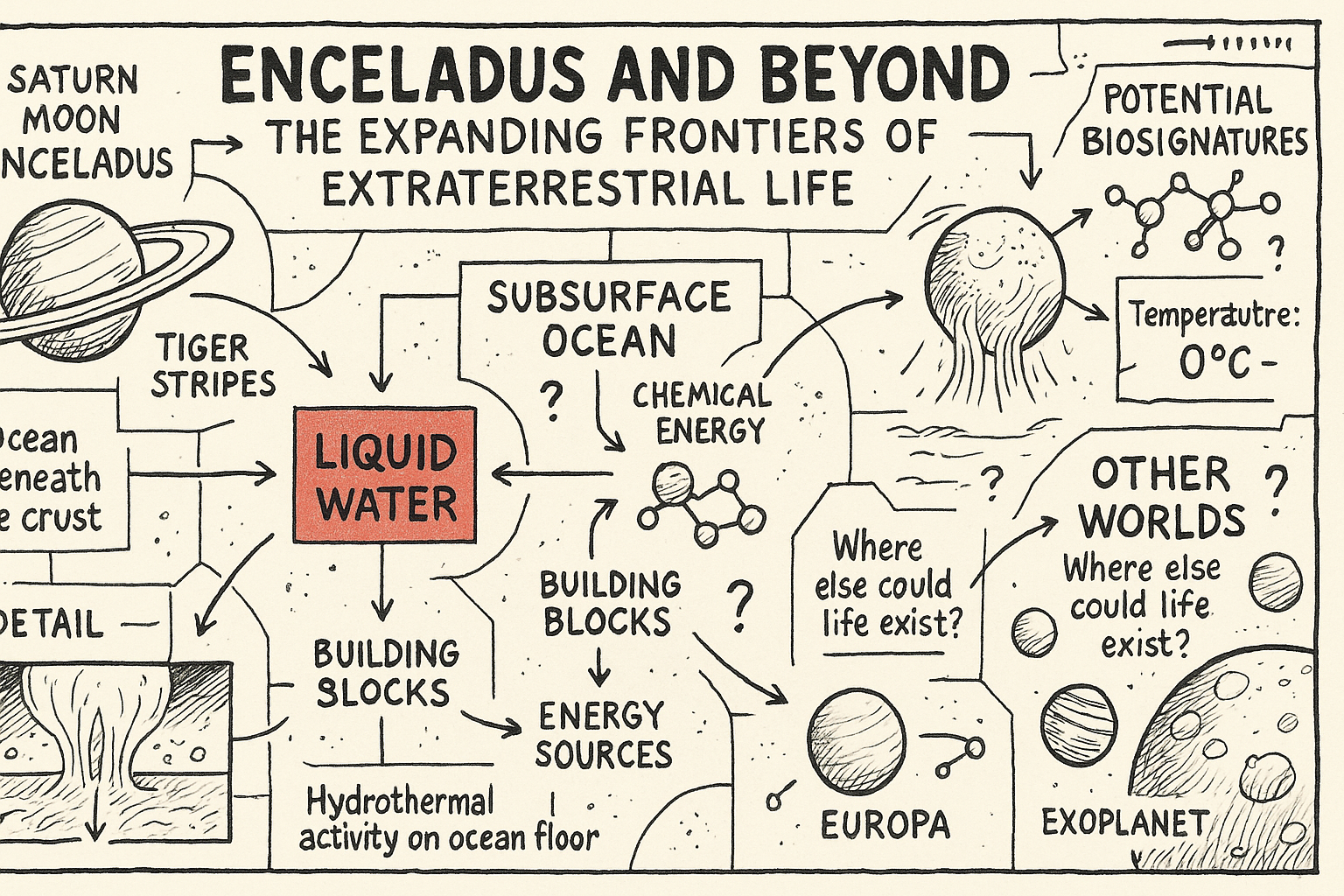
The fascination with Enceladus arises from its unique geological activity. It is one of the few places in our solar system where we see active geysers, spewing water vapor into space. This phenomenon provides a rare opportunity to study subsurface oceans without landing on the moon itself. Scientists have found that these plumes contain organic molecules, a critical component for life as we know it.
The recent experiments that exposed Earth microbes to simulated conditions of Enceladus's ocean have shown that these organisms could potentially survive there. This finding aligns with data suggesting that Enceladus’s subsurface ocean could have all the necessary ingredients for life: water, organic molecules, and an energy source.
Historical Context and Technological Advances
The pursuit of life in our solar system has historically centered around Mars, largely due to its proximity and the presence of historical water flow markers. However, Enceladus offers a compelling alternative. The advancements in space technology, such as the James Webb Space Telescope (JWST), allow us to detect complex molecules and atmospheric conditions of distant worlds with unprecedented precision.
For instance, the JWST recently identified water, methane, and ammonia in the atmosphere of a distant exoplanet, HATS-6 b. These findings highlight the telescope's capabilities and reinforce the potential of similar technologies to unravel the mysteries of Enceladus’s ocean.
Surprising Insights and Future Implications
Perhaps the most surprising insight from these developments is not just the potential for life on Enceladus but the relative ease with which we might study it from afar. The accessibility of Enceladus's ocean through its geysers is a game-changer, potentially allowing us to analyze its contents without the complex logistics of a landing mission.
As we look to the future, the implications are profound. If Enceladus does harbor life, it could reshape our understanding of life's distribution in the universe and prompt a reevaluation of where we search for life. The focus may shift from terrestrial planets like Mars to icy moons in the outer solar system, fundamentally altering our exploration strategies.
Furthermore, the discovery of life beyond Earth would have philosophical and ethical implications, challenging our understanding of life and its uniqueness. It would also drive technological advancements as we develop new tools to explore these frontier worlds.
In conclusion, while Mars has long been the poster child of extraterrestrial exploration, Enceladus is quickly emerging as a strong contender. The combination of recent scientific discoveries and technological advancements positions this icy moon as a key player in the ongoing quest to answer the age-old question: Are we alone in the universe?