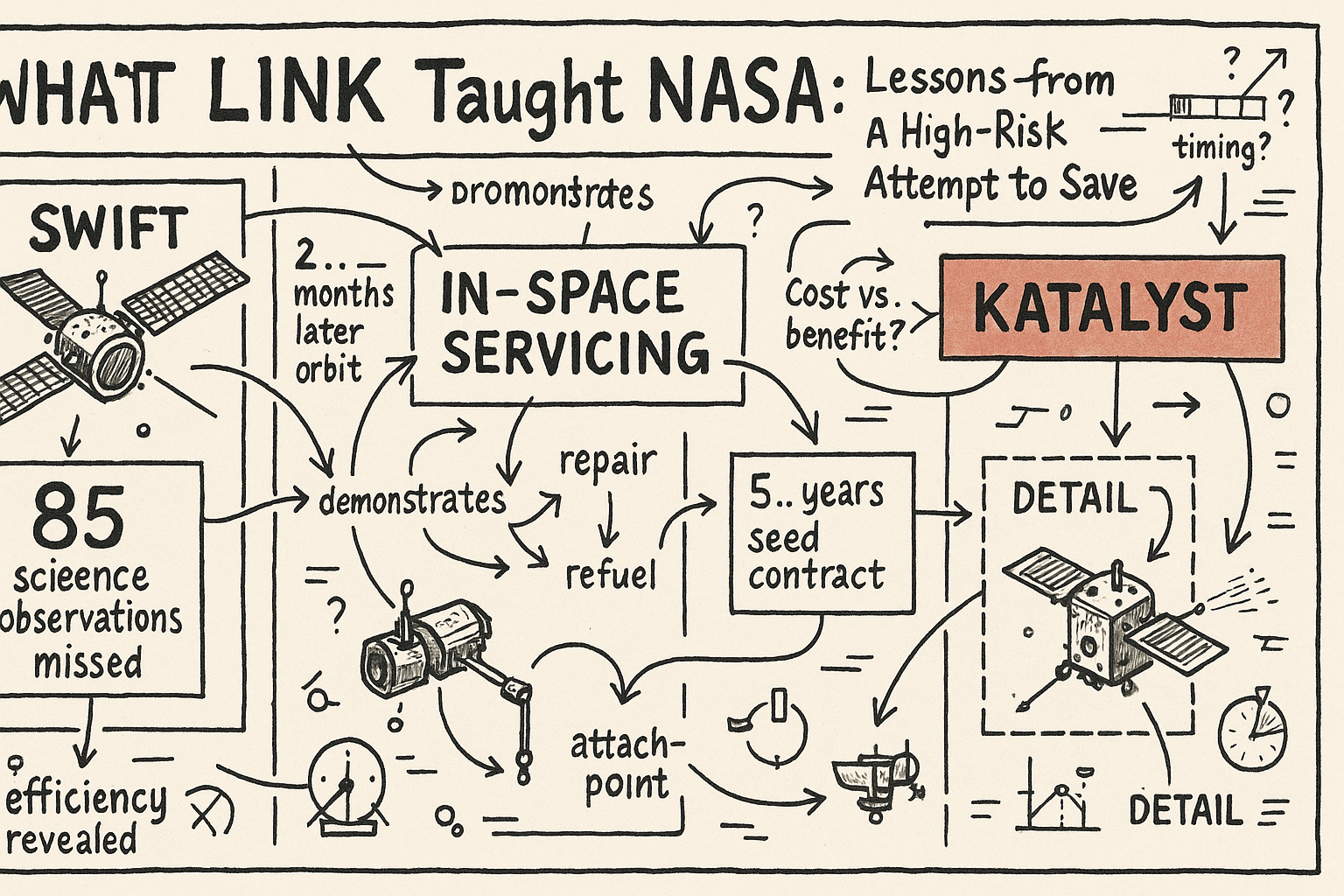
NASA’s effort to extend the life of its Neil Gehrels Swift Observatory ended without the intended orbital boost, but agency and industry officials say the short, intense mission produced tangible experience for future servicing efforts.
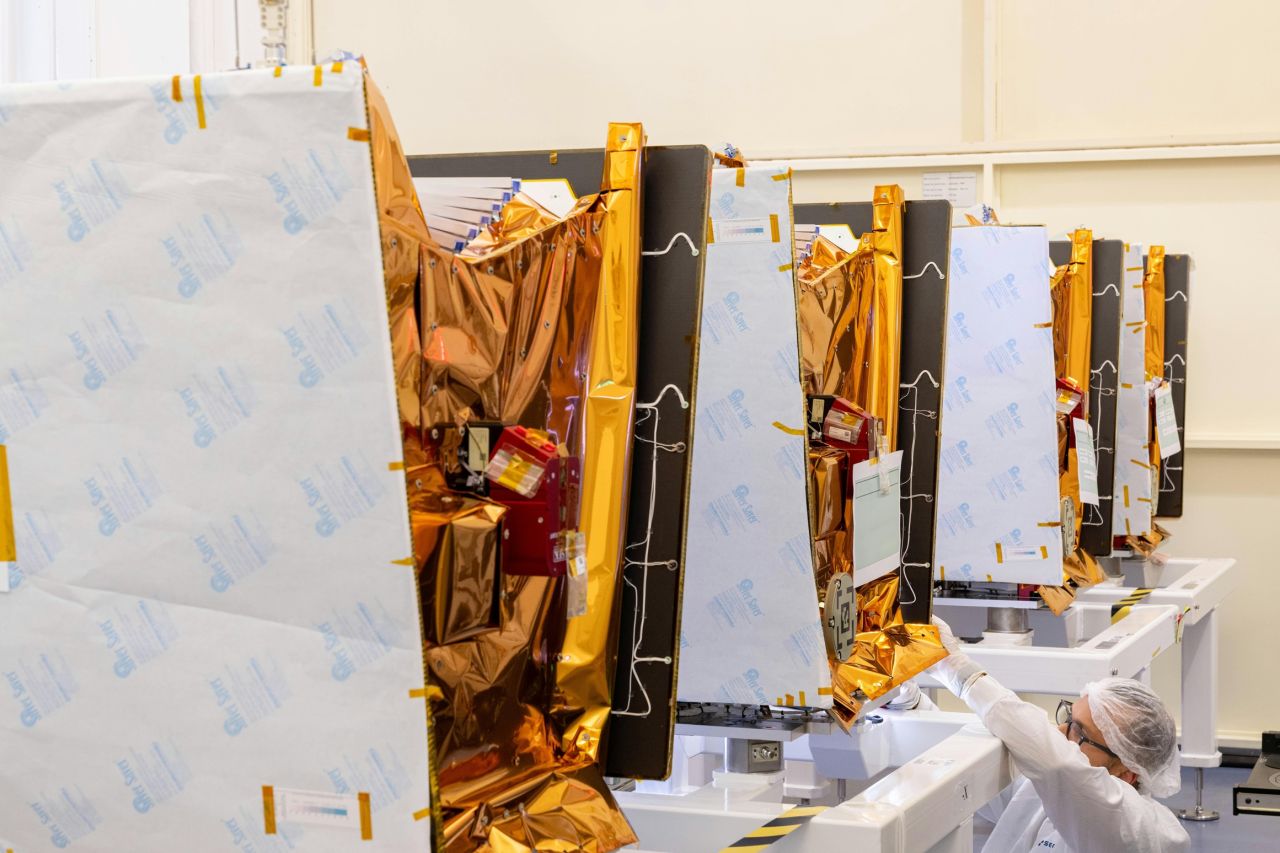
The commercial servicing vehicle, LINK, was developed by Katalyst Space Technologies under a $30 million contract NASA signed on September 25, 2025. Katalyst designed, built, tested and launched LINK in roughly nine months; according to reporting, the vehicle launched on July 3, 2026 on a Northrop Grumman Pegasus XL. LINK operated in orbit for 85 days before it reentered the atmosphere on September 25, 2026, following a final uncontrolled descent.
Mission context and objectives
NASA contracted LINK to grapple Swift and raise its orbit back toward the roughly 600‑kilometer altitude where the telescope had operated since its delivery in 2004. The agency had determined Swift’s orbit was deteriorating faster than expected due to unexpectedly intense solar activity, and without intervention Swift was expected to reenter the atmosphere by the end of 2026.
Because the boost effort was framed as “high‑risk, high‑reward,” NASA and Katalyst accepted that success was not guaranteed. The mission’s narrow goal—to perform a reboost to extend Swift’s operational lifetime—was not achieved before LINK itself began to decay and ultimately reentered.
What worked and what was learned
NASA and Katalyst characterize the campaign as a learning opportunity that advances U.S. spacecraft servicing capabilities. NASA’s Astrophysics Division director Shawn Domagal‑Goldman said the effort advanced spacecraft servicing technology, challenged the agency to meet unprecedented timelines, and tested operational approaches for extending satellite time in low Earth orbit. NASA’s public summary highlights that while the orbit increase was not achieved, the agency and the vendor gained experience that will benefit future in‑space servicing programs.
Katalyst leadership also discussed the mission publicly as the vehicle was approaching reentry. Kieran Wilson, identified as LINK’s principal investigator, noted his role continued until the vehicle’s reentry. Reporting from satellite tracker Jonathan McDowell provides a specific reentry time of September 24, 2026 at 14:38 UTC on a track from Tonga toward French Polynesia, while Katalyst reported LINK deorbited and reentered on September 25, 2026.
Commercial timelines and costs
The LINK campaign is notable for its compressed schedule and modest contract value relative to traditional government programs. From contract signature to orbital operations, Katalyst moved from award to launch in about nine months under a $30 million contract. That rapid development cycle was a deliberate part of the experiment: to test whether commercial vendors can deliver timely servicing responses to emerging threats to valuable science assets in low Earth orbit.
Aftermath for Swift
With LINK gone, NASA expects Swift’s orbit to continue decaying, and the telescope is likely to reenter the atmosphere later in 2026 without another intervention. Agency statements frame Swift’s loss as probable but emphasize the broader payoff: operational knowledge, technology maturation, and lessons for how industry and government can collaborate on short‑notice servicing missions.
The LINK campaign therefore stands as a case study in rapid commercial servicing: it did not achieve its stated technical objective of an orbital boost, but it provided a concentrated testbed for procedures, timelines and vendor‑government coordination that NASA and Katalyst say will inform future missions.