Swift X-ray monitoring links a powerful X-ray outburst to a delayed radio-jet flare in NGC 1275
A team of astronomers combined almost 20 years of X-ray observations from NASA's Swift X-Ray Telescope with radio monitoring to trace a rare sequence of events in NGC 1275, the central galaxy of the Perseus Cluster. They report the strongest X-ray flare ever observed from this galaxy, beginning around February 2023, followed by a significant rise in radio emission roughly 300 days later. The analysis, submitted to the arXiv preprint server on Aug. 13 and accepted for publication in the Astrophysical Journal Letters, provides one of the clearest observational examples of a connection between the accretion disk of a supermassive black hole and the relativistic jets it launches — a relationship astronomers refer to as disk–jet coupling.
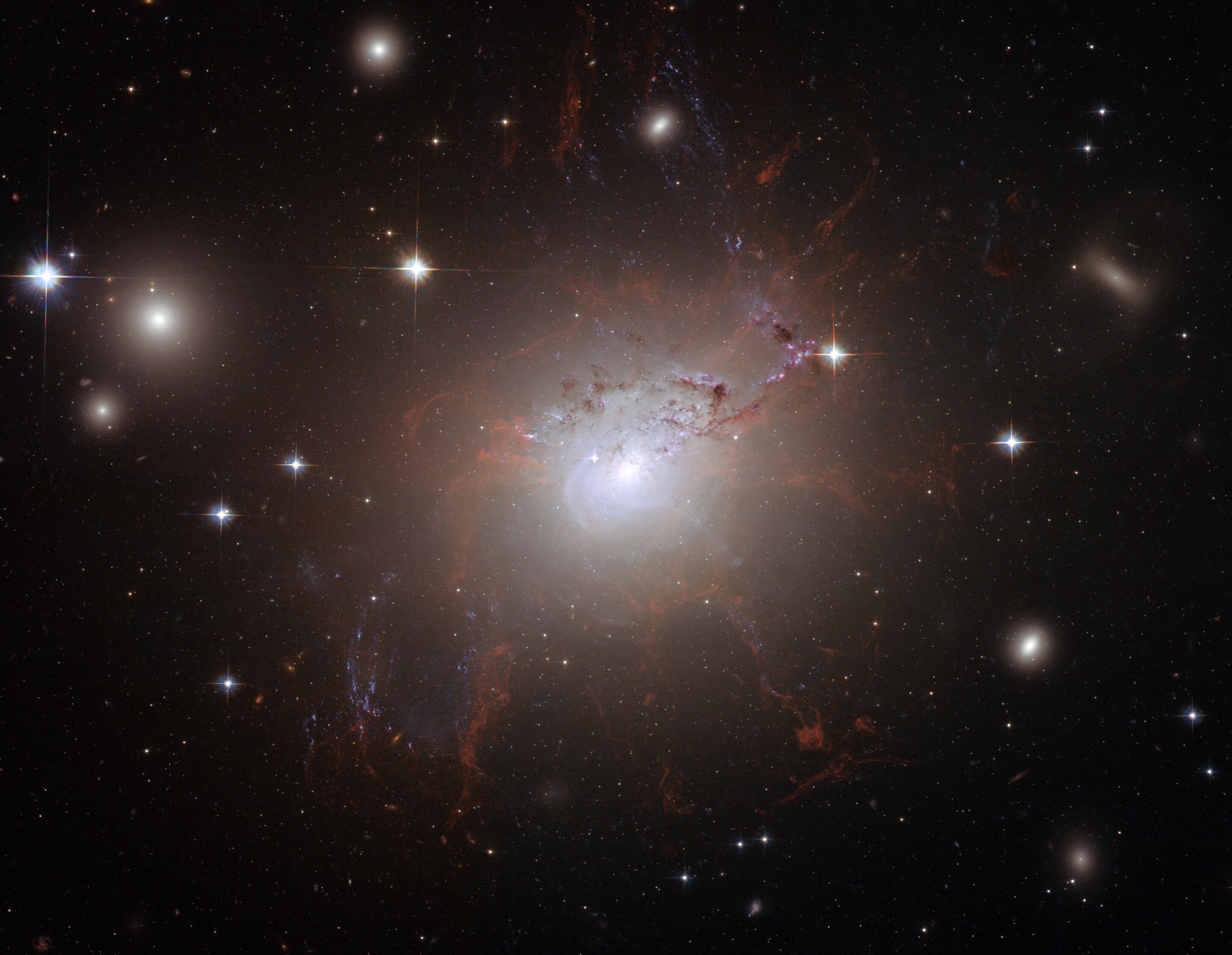
NGC 1275 sits at the center of the Perseus Cluster and is its brightest member. The galaxy is described as "chaotic and complicated," showing evidence of an ongoing merger and extended filaments of gas. These filaments trace the influence of bubbles blown outward by activity from the galaxy's central black hole, making NGC 1275 a natural laboratory for studying how black-hole feeding and jet production interact — processes that are important for understanding how active black holes regulate galaxy growth.
High-resolution X-ray observatories such as Chandra cannot observe NGC 1275 frequently enough to follow rapid changes over long intervals. To overcome this limitation, the research team used Swift, a less powerful but much more regularly available X-ray telescope, compiling its nearly two decades of monitoring to map long-term X-ray variability. The Swift data revealed a record-setting flare in X-rays, starting around February 2023, when the galaxy's X-ray brightness increased dramatically.
Crucially, radio monitoring of NGC 1275 showed that its powerful radio emission flared about 300 days after the X-ray event. That delay provides a temporal link between changes in the accretion flow close to the black hole — traced by X-rays from the disk and its corona — and the larger-scale radio jets that propagate outward. The timing supports models in which disturbances or increased accretion near the black hole first manifest as enhanced X-ray emission and later lead to stronger jet activity observable at radio wavelengths.
The study emphasizes both the promise and the difficulty of studying disk–jet coupling. One complicating factor for NGC 1275 is that the black hole's mass remains uncertain: published estimates span nearly two orders of magnitude. This uncertainty affects dynamical timescales and theoretical interpretation. The authors therefore relied on observational timing and long-term variability as a more model-independent probe of causal relationships between disk and jet.
Long-term, high-cadence monitoring in multiple bands is essential to catch such sequences. The Swift telescope's extensive X-ray record was key to identifying the February 2023 flare, while radio programs provided the follow-up needed to detect the delayed jet response. The result demonstrates the value of sustained monitoring programs and multiwavelength coordination for studying active galactic nuclei in cluster environments.
NGC 1275's environment — as the central galaxy of a rich cluster with visible gas filaments and cavities carved by past activity — gives additional context for the impact of black-hole feedback. Jet-driven bubbles and filaments seen in the Perseus Cluster have been studied for decades as a prime example of how energetic output from a central black hole can heat and redistribute intracluster gas. The new timing result links a discrete X-ray outburst to subsequent jet brightening, offering an observational handle on how episodic accretion events might drive episodic jet activity that in turn shapes the surrounding medium.
Uncertainties remain and are acknowledged by the authors. The mass of the central black hole is not well constrained, and the precise physical mechanism translating a disk outburst into a delayed jet flare requires further investigation. Nevertheless, the combination of nearly 20 years of Swift monitoring and contemporaneous radio observations produced one of the clearest temporal connections yet reported between disk and jet behavior in a brightest-cluster galaxy.
Future work will benefit from continued long-term, multiwavelength monitoring of NGC 1275 and similar systems. Such campaigns can map recurrent cycles of accretion and jet launching, and help quantify how often disk flares lead to delayed radio responses. By connecting small-scale accretion physics to large-scale feedback in cluster cores, these studies contribute to a broader effort to understand how supermassive black holes regulate their environments over cosmic time.
Sources: Phys.org summary of the accepted Astrophysical Journal Letters paper, posted Sept. 1, 2026; NASA Swift X-Ray Telescope archival monitoring referenced in that report.