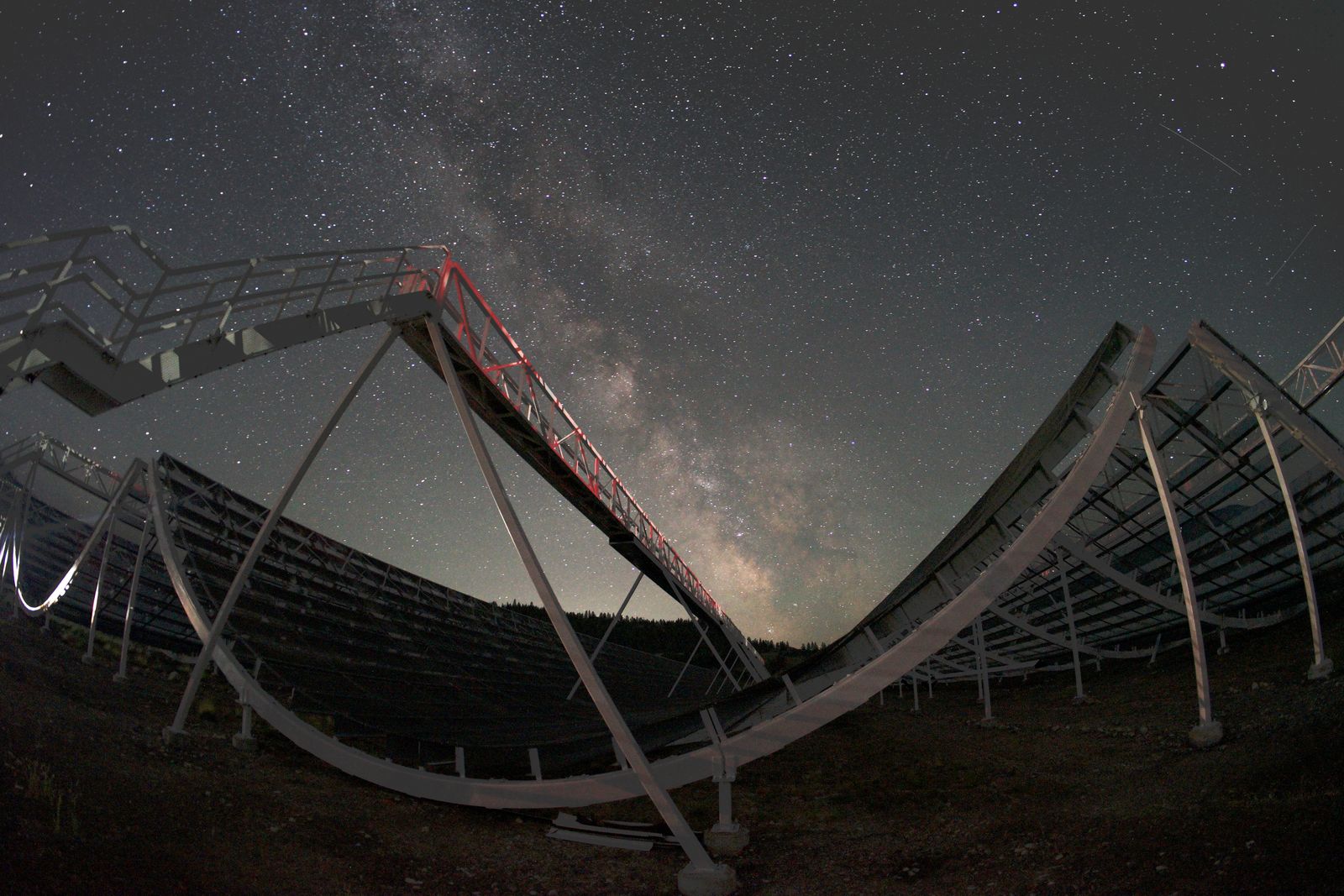
CHIME detects 21-cm hydrogen signal in autocorrelation after 94 nights of observation
The Canadian Hydrogen Intensity Mapping Experiment (CHIME) has, for the first time, detected the cosmological 21-centimetre emission of neutral hydrogen using only its own data. A team led by researchers at the University of British Columbia analysed 94 nights of CHIME observations from 2019 and — after extensive data processing and verification lasting over a year — confirmed the presence of the faint cosmological signal. The results were published in The Astrophysical Journal and reported by Media INAF on 6 October 2026.
What the 21-cm line represents. The 21-cm spectral line is produced when the relative orientation of the spins of an atom's electron and proton flips, releasing a photon with a frequency near 1420.4 megahertz, corresponding to a wavelength of about 21.1 centimetres. Because neutral atomic hydrogen is the most abundant element in the universe, mapping this emission provides a way to trace the large-scale distribution of matter and to reconstruct aspects of the universe's expansion history. Such maps are also valuable for studies of dark energy.
CHIME and intensity mapping. CHIME was designed specifically for 21-cm intensity mapping: rather than resolving individual galaxies, the instrument measures the combined emission of neutral hydrogen across patches of sky at specific frequencies. Before this work, CHIME had detected the cosmological 21-cm line only through cross-correlation with galaxy maps from other surveys. Cross-correlation reduces some types of contamination because it looks for patterns common to independent datasets.
Autocorrelation detection — what changed. The new result demonstrates that the cosmological 21-cm signature can be isolated using CHIME's own data alone, an approach called autocorrelation. Extracting this intrinsic signal is considerably more challenging because it requires separating a very weak cosmological emission from much stronger radio foregrounds, human-generated radio-frequency interference (RFI), and instrument noise. The team put CHIME’s antennas “in listen mode” for 94 nights in 2019, then applied sophisticated analysis techniques to remove contaminants and to test that the recovered signal is cosmological rather than a residual of foregrounds or instrumental effects.
Data processing and verification. According to the Media INAF summary, the effort included isolating the weak 21-cm emission from sky radio sources, RFI, and the instrument's own noise. The researchers spent more than a year on checks and validations before confirming the detection. The publication in The Astrophysical Journal provides the detailed analysis and statistical tests supporting the claim.
Scientific implications and context. An autocorrelation detection of the 21-cm line from a single instrument is an important methodological milestone for intensity mapping. It demonstrates that, with careful instrument characterization and foreground mitigation, a standalone radio survey can produce cosmological measurements of neutral hydrogen. These measurements can contribute to mapping matter on large scales and to constraining models of cosmic expansion and dark energy.
Historical perspective: The 21-cm line has been a cosmological target for decades. Early detections of neutral hydrogen in emission and absorption established the line's astrophysical utility; more recently, intensity mapping became a promising route to survey huge cosmological volumes efficiently. CHIME itself is well known for other achievements, including fast radio burst discoveries, but this result highlights the instrument’s role in low-frequency cosmology.
Limits and uncertainties. The Media INAF report notes that the detection required sophisticated analysis to separate the cosmological signal from foregrounds and RFI, and that the team carried out extensive verification over more than a year. Separating hypothesis from fact, the claim is that CHIME identified the cosmological 21-cm signal in autocorrelation; full assessment of cosmological constraints derived from this detection will rely on the detailed figures and statistical confidence reported in The Astrophysical Journal paper.
Future directions. Demonstrating autocorrelation detection with CHIME opens avenues for other radio intensity-mapping efforts to aim for independent detections without cross-survey correlation. Continued improvements in instrument calibration, RFI mitigation, and analysis methods will be essential to turn such detections into precise cosmological measurements. The result also motivates further long-duration observations and cross-checks with other experiments to build a consistent picture of neutral hydrogen across cosmic time.
Credit: The findings were reported by Media INAF on 6 October 2026 and are based on a paper led by a team at the University of British Columbia and published in The Astrophysical Journal.