Introduction
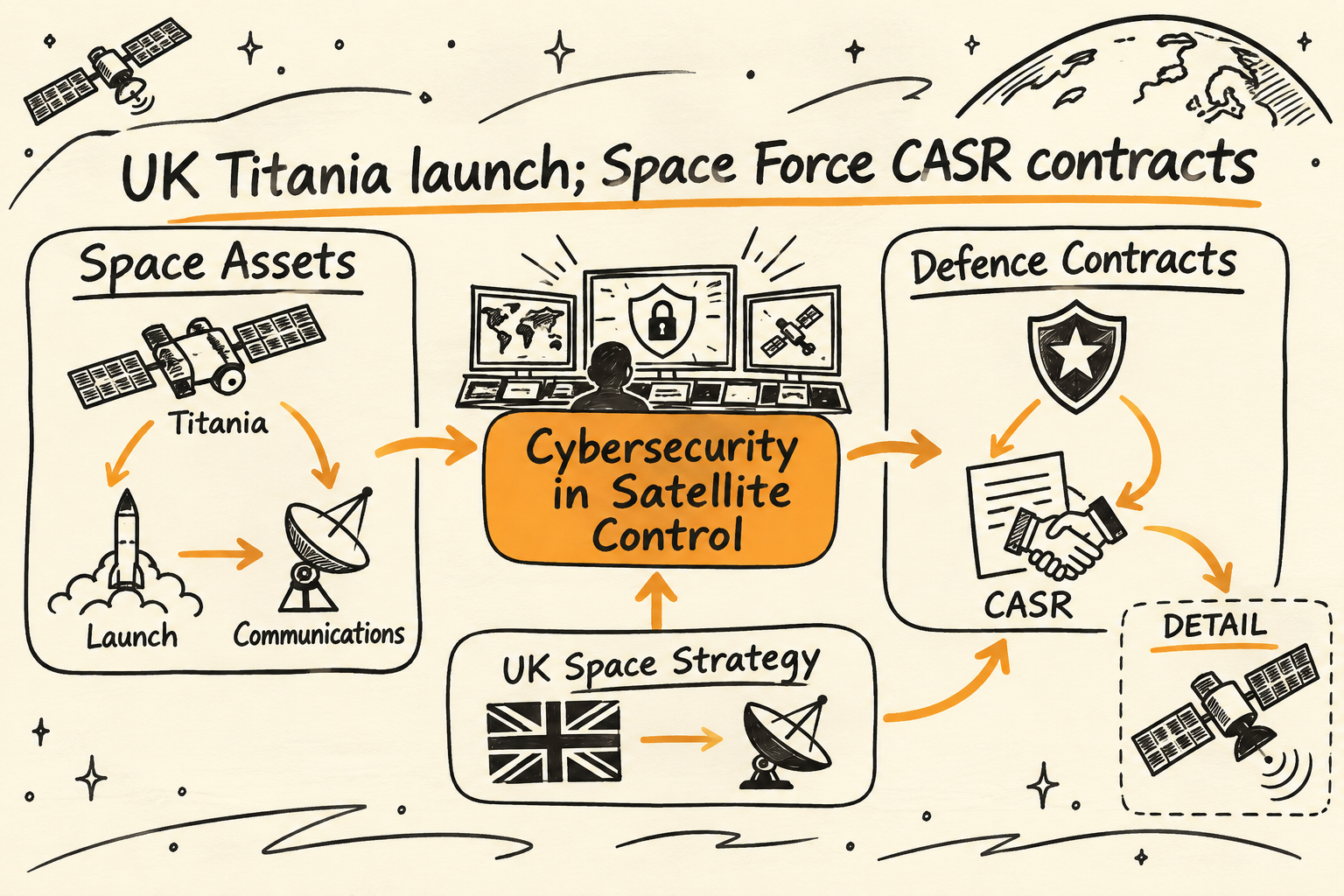
In the space of a few weeks in late 2026, several developments made clear that the geopolitical and industrial contours of space are consolidating around three linked trends: defense actors are buying and launching purpose-built capability (the UK’s Titania); military organizations are formalizing commercial backup and surge arrangements (the U.S. Space Force’s Commercial Augmentation Space Reserve, CASR); and governments and firms are investing in operational testing and cyber-hardening before and after launch. Taken together, these moves are producing an ecosystem in which operational resilience, legal clarity, and commercial appetite are being stress‑tested simultaneously.
From demonstrators to doctrine: Titania and militarized procurement
Britain’s Titania satellite — developed by BAE Systems with the Defence Science and Technology Laboratory as part of the ISTARI program — is the most visible sign that national defense organizations increasingly treat space systems as integral, sovereign capabilities rather than ancillary add-ons. The UK’s procurement reflects a broader policy shift: Western states are accelerating fielding of dedicated defense satellites and embracing an industrial base that must deliver quickly and iteratively.
Historically, defense space programs were long, bespoke, and stovepiped; the result was high cost and slow refresh. Titania belongs to a new generation: shorter development cycles, tight industry–government partnerships, and a focus on modular payloads that can be reconstituted or augmented in orbit. That modularity is attractive politically — it looks like capability — but it also raises operational questions about resilience and escalation when satellites are weaponized, degraded, or commandeered.
Commercial reserve fleets and the problem of rights during conflict
The Space Force’s initial CASR contracts for civil reserve support in space monitoring give commercial providers a formal role in augmenting national situational awareness. On paper this is sensible: commercial constellations already provide much of the data that governments use. Practically, CASR exposes a profound governance gap. Contracts address service provision but leave unresolved thorny legal and ethical questions: can the U.S. lawfully deny commercial customers access during a conflict? Who compensates a commercial operator whose satellite is lost while providing reserve services?
Those questions matter because contracting arrangements create dependencies. If the government can unilaterally commandeer commercial capacity without clear liability or compensation terms, private investment will reprice risk and potentially withdraw. Conversely, if commercial providers retain full customer autonomy, governments must weigh their limited ability to deny hostile actors access to commercial sensing or communications during crises. The early CASR awards signal that the U.S. is moving from ad hoc cooperation to institutionalized reliance — but not yet resolving the legal plumbing.
Testing, autonomy and cyber: lowering the risk in orbit
Parallel to procurement and contracting are investments in testbeds and operational autonomy. ESA‑backed cyber ranges and national programs that let developers run code aboard CubeSats, plus university programs teaching space cyber security, reflect a hard lesson: you cannot bolt cybersecurity onto a spacecraft after launch. TalTech’s hands‑on masters program and Spaceit’s cyber range show a more pragmatic, industrialized approach — simulate attack scenarios, run experiments, and give students and companies the chance to harden systems using real hardware.
Autonomous maneuvering experiments, like those cleared for EraDrive on NASA’s Starling ride, compound the urgency. Autonomy reduces latency and operator workload — vital in contested environments — but it also creates decision‑making nodes in orbit that could be exploited or misinterpreted. The more actors test autonomous software in operational settings, the quicker the community will surface both valuable operational doctrines and the need for new normative guardrails about fail‑safe behaviours, verification, and transparency.
Implications for industry strategy and policy
For commercial providers, the policy landscape offers both market opportunity and risk. Firms such as AST SpaceMobile joining Space Force programs show defense budgets are fungible business opportunities. But the CASR and Titania stories suggest companies must now factor in policy contingencies — potential tasking by governments, insurance implications, cross‑border denial scenarios, and reputational risk should their systems be visible in a crisis.
For policymakers, the imperative is twofold. First, create contractual frameworks that balance operational needs with compensation and liability rules so the commercial market remains investible. Second, invest in pre‑launch and in‑orbit testing and certification regimes for cyber and autonomy. Those investments reduce the chance that a tactical advantage suddenly becomes a strategic vulnerability.
Where this could go next
Expect three accelerators in the next 12–24 months: expansion of commercial reserve contracts and formal service-level clauses; broadened access to cyber ranges and university training to create a workforce fluent in space‑specific cyber and autonomy concerns; and more demonstrator launches marrying modular payloads with in-orbit code‑testing. The risk is that legal frameworks lag behind — sparking a market correction if insurers pull back or if states assert rights over commercial capacity in ways that fracture multinational customers.
Conclusion
The current policy moment stitches together doctrine, industrial strategy, and operational experimentation. Titania, CASR, and the proliferation of testing regimes together represent a maturing of space policy — one where capability generation, commercial integration, and cyber‑autonomy collide. Managing that collision will define whether space becomes a stable domain of layered resilience or a cascade of contested dependencies.