Overview
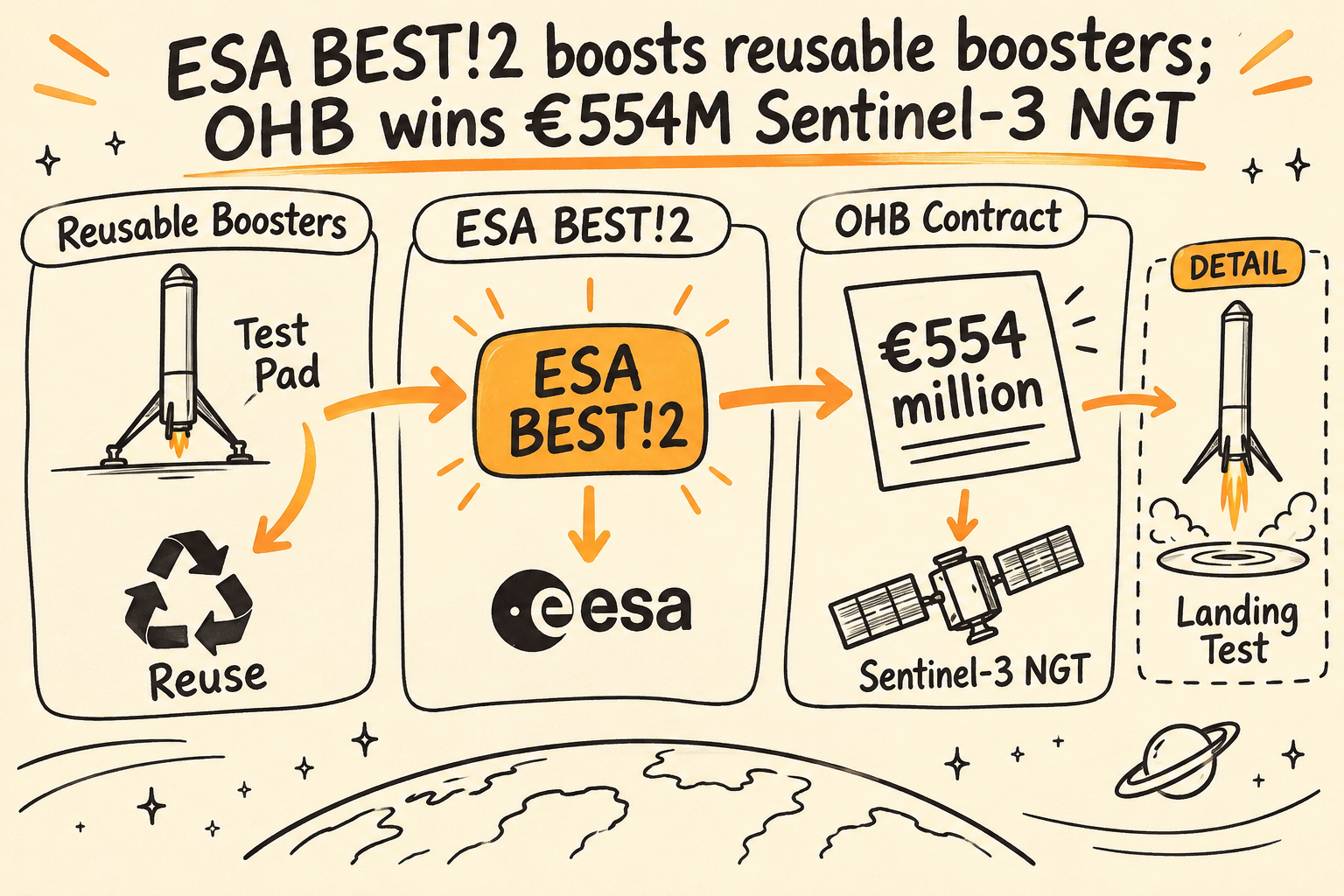
Europe's launch landscape is experiencing a cautious but consequential rearrangement. In recent weeks several related developments — ESA's BEST!2 call to support industry-led reusable booster flight demonstrations, the agency's explanation for delayed contracting with MaiaSpace in the European Launcher Challenge, the awarding of a €554 million contract to OHB for the first Sentinel-3 Next Generation Topography (NGT) satellite, and continued Prometheus hot-fire tests — form a coherent narrative about how Europe is balancing innovation, industrial policy and mission assurance.
Where the pieces fit
ESA's BEST!2 initiative marks a clear tactical shift: instead of trying to singularly pick a European reusable-first-stage winner, the agency is explicitly funding industry-led flight demonstrations to reduce development risk across multiple contenders. That push comes alongside public friction in procurement — exemplified by the delayed MaiaSpace contract, where an alternative funding approach chosen by MaiaSpace complicated negotiations. Put together, these developments reveal an agency trying to rationalize support for nascent commercial players while protecting established timelines and mission commitments.
Meanwhile, the €554 million OHB award for the Sentinel-3 NGT satellite under the Copernicus programme demonstrates that ESA still places large, dependable contracts with established primes at the center of Europe's space infrastructure strategy. Those long-lead, high-value Earth-observation programmes underpin policy priorities (climate, maritime surveillance, land monitoring) and require predictable delivery. The contrast — enthusiastic, targeted support for demonstrators plus large traditional contracts — is the core tension of the current era.
Historical context
European launch and space industry policy has long balanced two goals: sustaining sovereign access and enabling a competitive industrial base. Historically, ESA and national agencies have used flagship programmes (Ariane, Sentinel) to anchor capabilities while seeding new technology through R&D programmes. What is new is the scale and formality of de-risking for reusable tech: BEST!2's flight-demonstration emphasis echoes early U.S. DARPA-style prizes and private funding models from the 2010s but now sits inside formal ESA funding streams. At the same time, engine programmes like Prometheus — a reusable methane/oxygen design led by ArianeGroup — connect these policy threads by aiming to lower unit costs for both new and existing launchers.
Analysis: strategy, industrial politics and timelines
There are three interlinked dynamics at work.
1) Experimental pluralism — ESA is willing to fund multiple flight-demonstration paths rather than pick a single technical approach. That hedging reduces the chance of technological lock-in but elongates the period before a mature, low-cost European reusable booster emerges.
2) Procurement friction — MaiaSpace's pursuit of a different funding arrangement and the resulting contract delay underline how divergent commercial models (grants, equity, blended finance) can clash with ESA's traditional contracting frameworks. Smaller firms seeking venture-style terms can run up against institutional risk controls and large integrators that dominate prime awards.
3) Mission assurance priority — awarding €554M to OHB signals that mission-critical programmes retain priority in ESA's budget and timeline calculus. When national and European users depend on continuity of data (Copernicus stakeholders), ESA cannot afford experimental disruption. That drives conservative scheduling for operational systems even as ESA funds disruptive demonstrations in parallel.
Implications and likely outcomes
First, expect a bifurcated schedule: demonstrator reusable flights funded under BEST!2 over the next 3–6 years, with incremental operational gains; and separate, steady cadence deliveries of large satellites and classical launchers tied to programmes like Sentinel-3. Second, industry consolidation pressures are likely. Firms that navigate ESA procurement norms and can offer hybrid funding solutions will gain an edge; those that insist on non-standard financing risk slower access to agency contracts. Third, Prometheus continuing tests — while explicitly separated from Themis hop preparations — shows technical progress that will feed both new Ariane-class vehicles and future reusable demonstrators.
Two surprising insights
1) The agency's support model is now explicitly pluralistic rather than winner-takes-all: ESA prefers several smaller flight demonstrations to increase the odds of a usable reusable booster, even if that approach delays a single mature product.
2) Large, expensive Earth-observation contracts like the €554M Sentinel-3 NGT still act as the fiscal backbone that enables risk-taking elsewhere; the presence of big, reliable programme spending is what lets ESA underwrite higher-risk, industry-led flight demonstrations.
What to watch next
Key near-term indicators will be announced BEST!2 awardees and timelines, final resolution of MaiaSpace's contract negotiations, subsequent Prometheus test results, and how OHB's NGT schedule interfaces with launch availability. Together those datapoints will show whether Europe can thread the needle: nurture commercial innovators without jeopardizing essential operational services.
Conclusion: Europe's launch strategy is balancing experimentation and stewardship. By funding multiple demonstrators while continuing large satellite procurements, ESA is buying optionality — a pragmatic, if slower, route toward cheaper, possibly reusable European access to space.