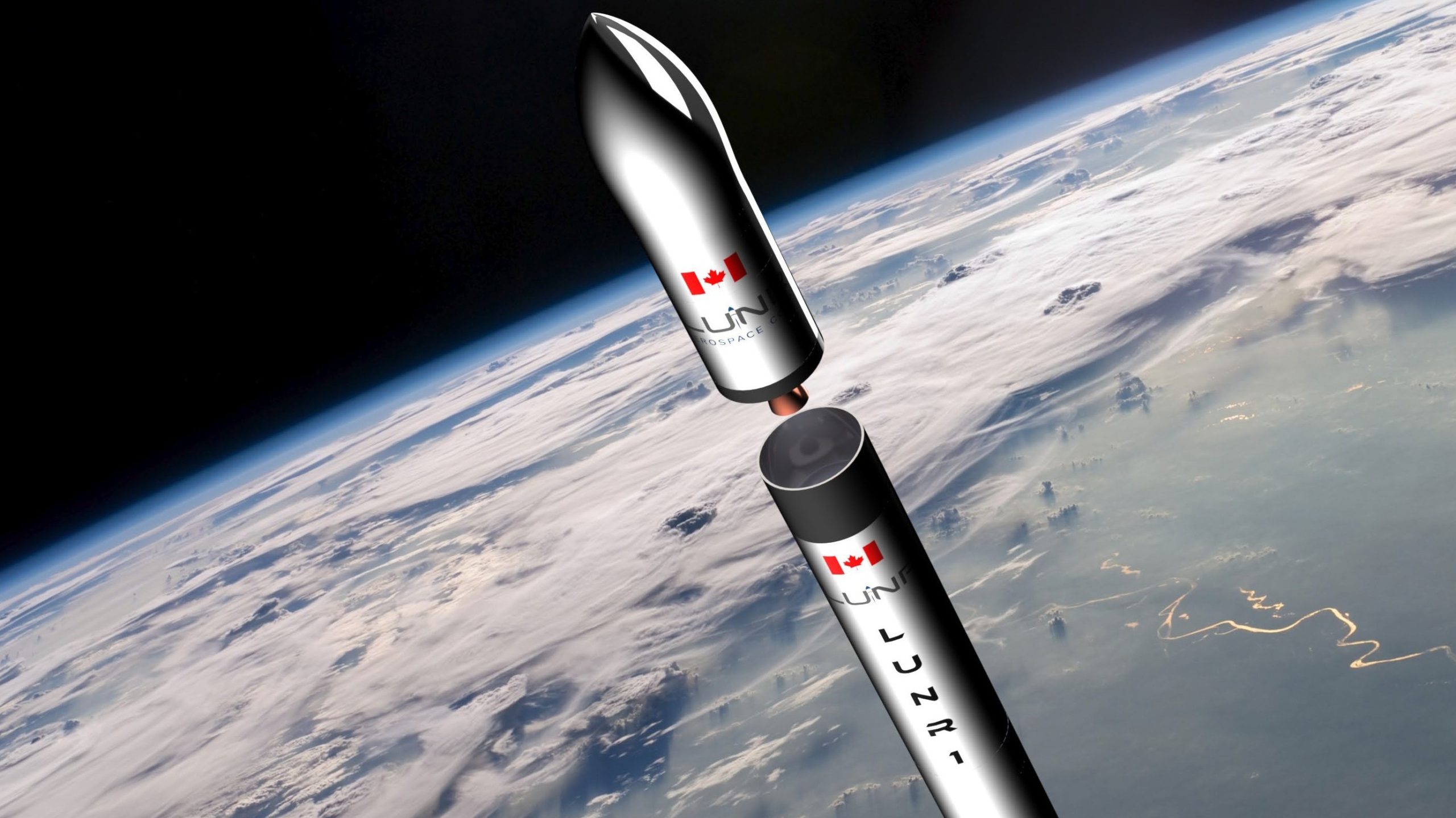
LUNR Aerospace, a Toronto-based startup that aims to place small satellites into low Earth orbit by 2029, began trading on the Canadian Securities Exchange (CSE) under the ticker FLY on Oct. 27, 2026, even though it has not yet conducted its first engine hot-fire test, the company disclosed in a prospectus and investor materials.
The company completed a direct listing rather than a capital-raising offering: it filed a prospectus but did not sell new shares, and its private funding rounds were raised without a broker, the prospectus says. LUNR hired Hampton Securities in August to review and sign the prospectus as agent. In the company’s listing release, chief executive Jeanue Chung said the public listing “provides LUNR with greater visibility” and “broadens our reach among investors.”
LUNR was founded from a student idea by Chung while he studied astronomy and astrophysics at the University of Toronto. Chung incorporated LUNR Innovations Inc. federally on April 1, 2025, and renamed it LUNR Aerospace in June 2025. The company’s advisers include former federal industry minister Tony Clement and Dean Misterek, an engineer who spent 18 years at Blue Origin; advisers receive no salary but may be granted stock options. The board includes three Vancouver-based directors: Nima Bahrami, Thomas O’Shaughnessy and Calvin Chan.
In an October investor presentation, LUNR outlined a two-stage, roughly 20-metre LUNR-01 rocket that would use liquid methane and liquid oxygen. The first stage would carry five electric-pump-fed engines and be designed for recovery and reuse; the upper stage would use a single pressure-fed vacuum engine. LUNR-01 is planned to place 250–350 kilograms into low Earth orbit, and the company sets a 2029 target for orbital launch. LUNR also presented a larger vehicle, LUNR-02, projected to lift more than 2,000 kilograms and targeted for 2032.
The prospectus compares LUNR’s planned LUNR-01 with Rocket Lab’s Electron, listing Electron as an “aspirational comparator.” The presentation lists first-stage thrust for LUNR-01 at about 300 kilonewtons and Rocket Lab’s Electron at 190 kN at liftoff. LUNR’s materials state Electron has flown 99 times as of Nov. 8, 2026; LUNR’s status line in the investor presentation notes its first engine test is planned but not yet completed.
LUNR’s near-term milestone is a hot-fire test scheduled sometime between November 2026 and February 2027, according to the prospectus. The company licenses farmland in the Township of Amaranth, Ontario, north of Orangeville, where it has fabricated a test stand and put the combustion chamber into fabrication; the injector remained under design at the prospectus date. Site grading and foundations for propellant tanks were under way, with plumbing and electrical systems to be connected and leak-tested. Of the $420,000 budgeted for this milestone, about $290,000 had been spent, and the township has approved the testing, which LUNR says is the only approval required at this stage.
LUNR has no employees and relies on contractors; propulsion lead Eligh Corchis-Scott provides roughly 75 percent of his time to the company. The prospectus shows LUNR has raised about $4.8 million privately since formation. About $1.5 million of that came through the purchase of Vertical Partners, a cash-only vehicle that LUNR acquired in October 2025 in exchange for roughly 6 million LUNR shares at $0.25 each. Initial outside investors paid $0.04 per unit in June 2025, and subsequent private rounds increased in price to $0.27 in June 2026.
NovΔ mAInd's launch database: Intuitive Machines — 0 launches tracked