Introduction
Two concurrent threads run through this autumn’s batch of launch and mission news: the hardening of services to sustain and protect space operations, and a widening set of launch-linked investments that extend from Earth orbit to the lunar surface. Taken together, ESA’s award to OHB for ClearSpace-1 and NASA’s series of contracts supporting a lunar base—including the PROMISE nuclear rover and delivery services—show how launch activities increasingly bind together operational logistics, sustainability and strategic capability.
From demonstration to operational service: ClearSpace-1
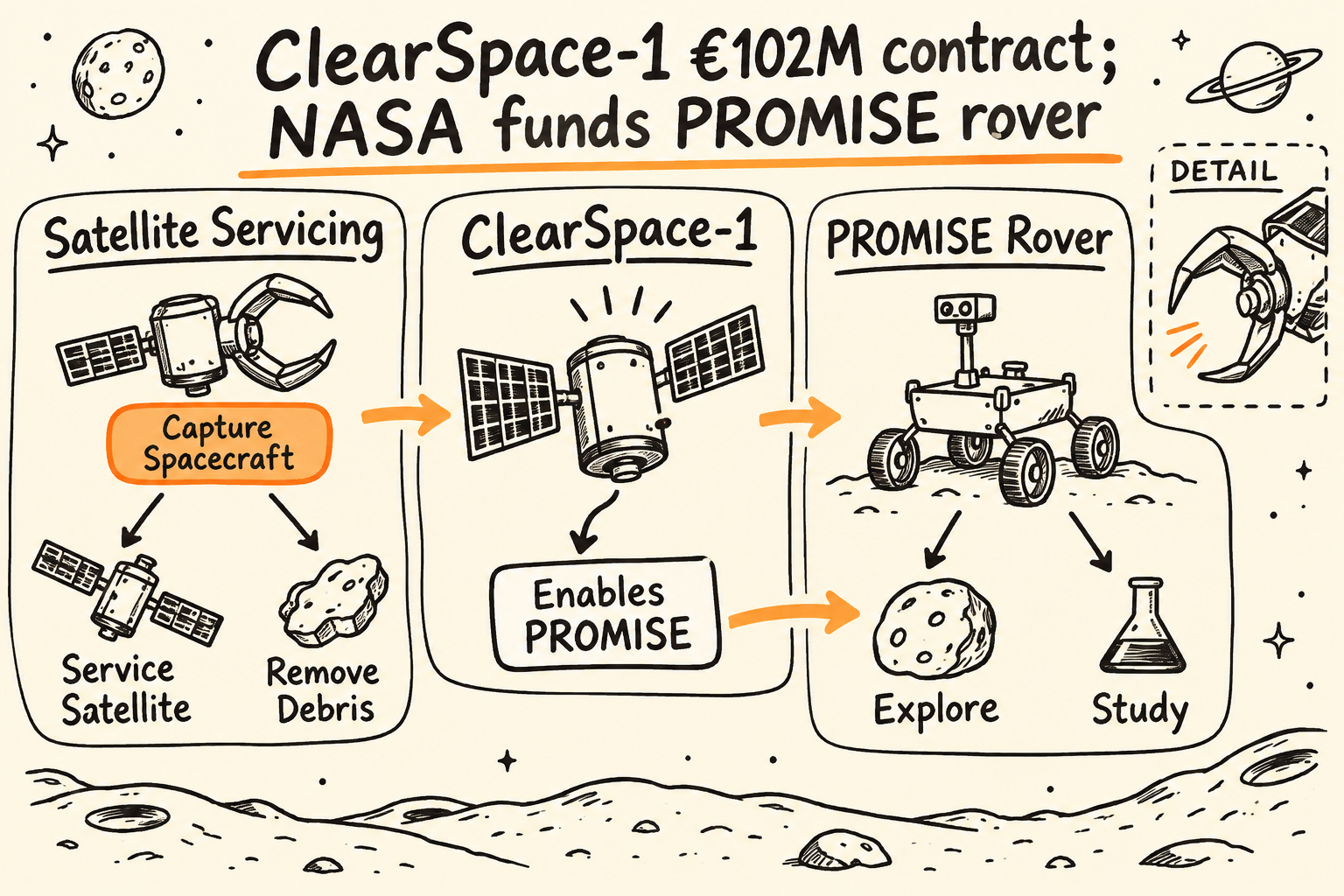
On 17 November, ESA signed a €102 million prime contract with OHB to build ClearSpace-1, the agency’s flagship active debris removal (ADR) demonstrator. ClearSpace-1 will rendezvous with and capture Proba-1, an ageing ESA technology satellite, then de-orbit it. ADR has been a laboratory of engineering ideas and regulatory arguments for a decade; the ClearSpace-1 award is one of the clearest moves yet to convert demonstration into procured service.
Historically, debris removal efforts were hampered by two obstacles: the cost of rendezvous-capable spacecraft and the absence of a customer prepared to pay for disposing of an object they do not own. ESA’s path—funding a prime contract and framing the mission as an agency responsibility to preserve orbital environment—sidesteps those obstacles. It also signals to industry that governments will underwrite the risk and cost of removing large, uncontrolled objects from crowded orbits.
Launch as logistics: NASA’s lunar investments
Meanwhile, NASA’s recent contract slate supporting lunar base capabilities—robotic logistics, orbital transfer services and long-duration asset transport such as the PROMISE nuclear-powered rover—reframes launches as pieces of a distributed supply chain. Launches are no longer single-point events that send a satellite into an isolated orbit; they are scheduled elements in a larger choreography that moves mass, power and personnel across gravitational wells.
That choreography matters because cost-per-kilogram to the Moon remains high, and mission planners are now optimizing for system-level outcomes: reusability of landers, orbital tugs for flexible phasing, and nuclear mobility on the surface. The implication for launch providers is clear—those that can offer predictable, cadence-friendly services with integrated orbital-transfer options will be preferred partners for long-term exploration campaigns.
Emerging themes and cross-cutting effects
Three themes link the stories in play.
1) Services over hardware. ClearSpace-1 is not primarily about a single satellite; it’s about creating a template for a recurring service—remove debris, protect infrastructure. NASA’s procurement patterns show the same preference: fund the capability (robotic supply, nuclear rovers) and let commercial partners supply the delivery. Launch is becoming the back-end of service contracts, not merely a product sold by the kilogram.
2) Risk tolerance and insurance. Governments are increasingly absorbing early-stage risk to jump-start markets. ESA underwriting a €102M prime contract and NASA paying for high-risk lunar systems both reduce the commercial perceived risk, attracting private capital. That will reshape launch insurance markets and underwriting models—insurers will price missions not only by launch failure but by downstream operational risk managed by providers.
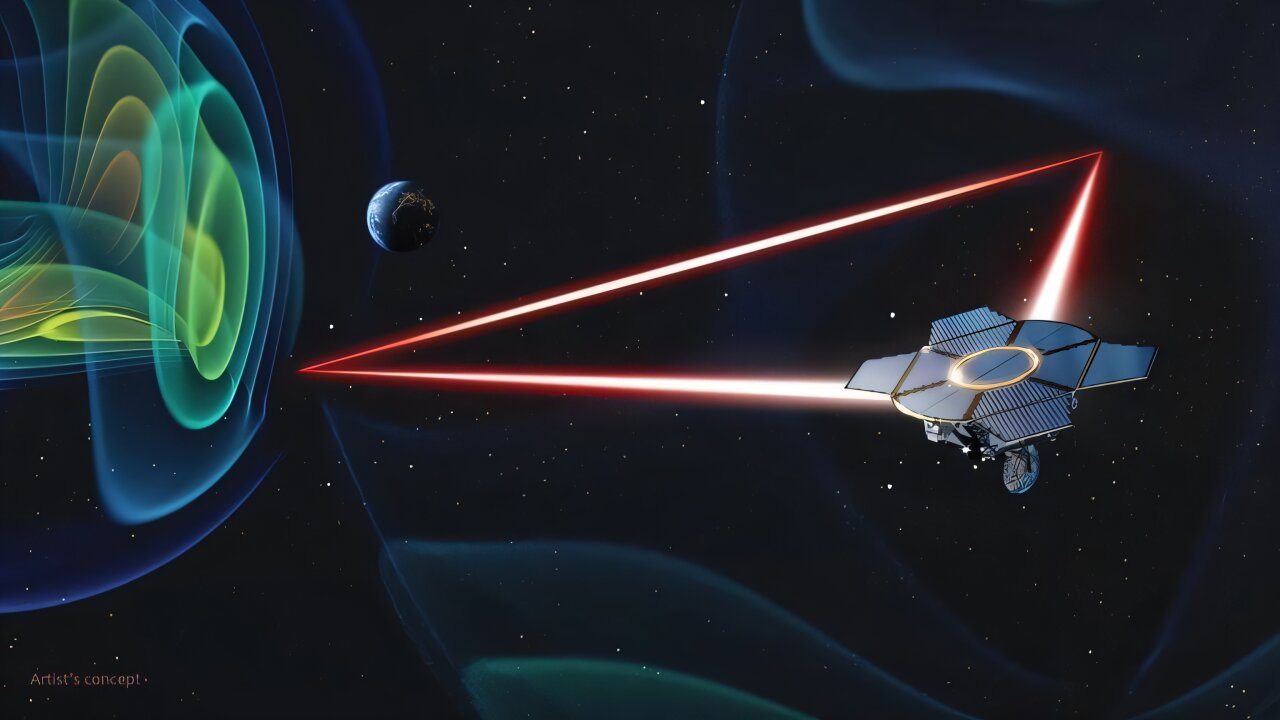
3) Strategic normalization of in-orbit operations. Clearing debris, operating multi-satellite plasma observatories, and supplying lunar bases are all about normalizing activity in previously peripheral domains of space. The launch sector will be evaluated on cadence, reliability and the ability to integrate with complex in-space operations—orbital tugs, robotic servicers, and de-orbiters.
Two counterintuitive insights
1) Government contracts can lower prices by reducing risk. It sounds paradoxical: governments spending hundreds of millions can make services cheaper. But by underwriting first-of-kind missions and absorbing development risk, agencies create scale opportunities that bring down unit costs. ESA’s ClearSpace-1 could seed a market that ultimately reduces the per-object cost of debris removal—if a predictable pipeline of missions follows.
2) More launches can mean safer space. The common perception sees more rockets as more clutter. Yet targeted launches that deliver inspection, removal, or resilience capabilities (like PROMISE-enabled power systems) can reduce systemic collision risk. It’s not launch volume alone that matters, but the purpose and integration of what’s launched.
Future implications for launch providers and policymakers
For launch companies, the lesson is to move beyond pure-lift metrics. Reliability, schedule certainty, and the ability to couple with in-space servicing architectures will be the differentiators in the next five years. Large prime contracts and agency-led procurement will continue to set market signals; private operators that can fit into government-sponsored service chains will win steady revenue.
Policymakers must think holistically: regulating orbital sustainability, incentivizing ADR, and clarifying liability rules around servicing and de-orbiting. Funding demonstration missions is necessary but not sufficient—creating predictable follow-on contracts, liability frameworks and insurance products will turn demonstrations into durable markets.
Conclusion
Recent awards and contracts show launch evolving from point-to-point access into a logistics layer for an expanding space economy. ClearSpace-1 and NASA’s lunar investments are early but decisive signals that launches will be judged by how well they plug into services that sustain and extend operations—on orbit and on the Moon.