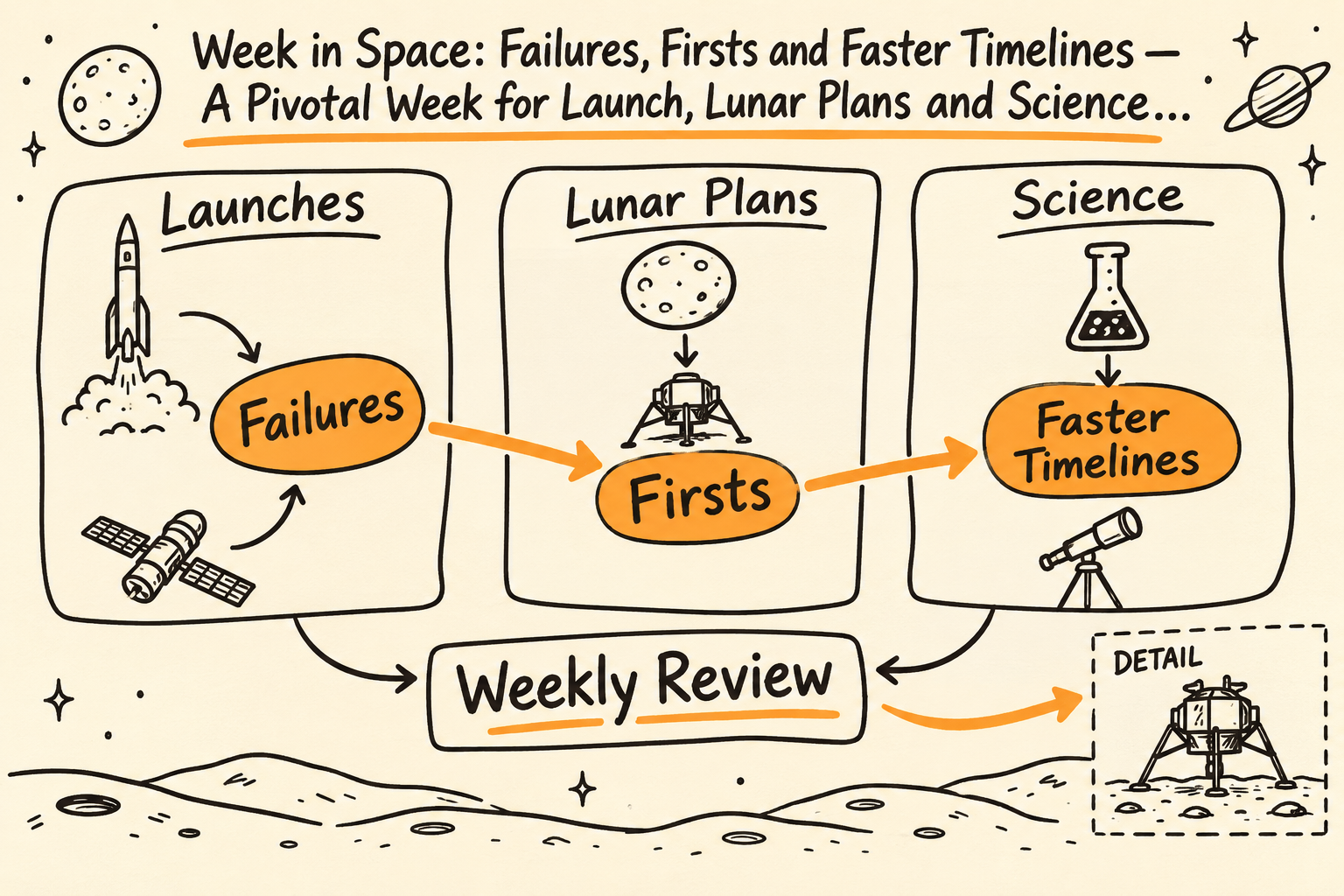
When a launch vehicle goes wrong, the ripples run far beyond a single mission. This week the space domain felt that reality sharply: United Launch Alliance’s Vulcan Centaur suffered a catastrophic failure roughly ten minutes after liftoff on 15 November, destroying 40 Amazon LEO broadband satellites and delivering the first total mission failure in ULA’s two‑decade history. The loss was a headline grabber not only for its scale but for what it signaled about the maturation of launch markets, the fragility of large rideshare commitments, and the shifting calculus of risk now that more governance, defense and commercial services ride atop constellations.
Launch Activity: a week of contrasts — catches and collapses
Launches this week read like a microcosm of modern space: one company demonstrating audacious operational progress while another confronted a sobering systems‑engineering lesson. SpaceX continued to push operational boundaries with Flight 15 of Starship. On 14 November the program executed a milestone catch of the Starship upper stage with the tower’s mechanical arms — the so‑called "chopsticks" — a maneuver that moves reusability from risky experiment toward routine tactic. The success matters because it shrinks the cost and cadence constraints on extremely large vehicles. Yet even as SpaceX iterates on complex recovery choreography, the booster for Flight 15 was lost at sea, a reminder that iterative loss is still part of the process for heavy‑lift recovery at scale.
Less than 48 hours later, ULA’s Vulcan Centaur failed in flight from Cape Canaveral. Initial and subsequent integrated reviews converged on a fuel‑supply shortfall to the BE‑4 engines as the proximate cause: not engine thrust degradation but insufficient propellant fed into the powerplants. The result was insufficient first‑stage performance that the Centaur’s RL10 upper stage could not compensate for. Forty Amazon satellites, built to expand a broadband LEO constellation, were lost. ULA framed the failure as a systems and supply problem — a sobering diagnosis that will demand scrutiny along the fuel delivery chain, tank pressurization, feed systems and operational protocols.
The juxtaposition is instructive. SpaceX’s publicized success with a novel recovery method and ULA’s rare full mission loss underline a maturity paradox in today’s launch ecosystem: technologies are advancing rapidly, but scaling them reliably, repeatedly and across diverse architectures is still hard. For customers, the math of redundancy and schedule risk is changing. Amazon, which contracted multiple rockets across providers to deploy their broadband tranche, now confronts gap management, customer‑facing timelines and insurance layers. For national customers and defense users, the event revives debates over resilience and the need to diversify launch suppliers and orbital insertion strategies.
Across the Atlantic, Ariane 64 is poised to take the stage on 23 November to loft 36 Amazon satellites from French Guiana, a mission that suddenly carries amplified political and commercial weight. That flight will be watched as part technical validation, part reputational repair for Europe’s heavy‑lift ambitions, and part risk mitigation for a major constellation client. If successful, Ariane 6 will have provided an immediate hedge against the Vulcan loss; if delayed, the constellation operator’s contingency plans will get tested.
Exploration & Science: steady progress amid high drama
Even as launches dominated headlines, scientific milestones this week provided perspective on the long arc of exploration. ESA’s Hera spacecraft arrived at the Didymos binary asteroid system and began an early characterization phase 25–30 kilometers from the body struck by NASA’s DART mission. Hera’s first images of Didymos and the shadowed Dimorphos bring home the value of long‑lead planetary defense experiments: DART’s kinetic impact left a system ripe for follow‑up, and Hera’s presence now transitions the research from demonstration to detailed forensic analysis of impact physics and surface evolution. Hera’s work will reverberate through planetary‑defense planning, informing how future mitigation systems are sized and validated.
Mars missions continue to deliver layers of narrative. Curiosity’s extensive drilling portfolio — now totaling 49 drills — and Perseverance’s Singita sample are reframing questions about Mars’ wet past and volatile inventory. Together with reports of robot‑built structures and autonomous on‑orbit construction demonstrations, the week suggests that exploration is increasingly bifurcated: rich scientific discovery at the planetary level and a new engineering choreography for in‑space assembly and logistics. That architectural shift matters because science is beginning to depend on robust in‑space infrastructure: telescopes with modular servicing, large in‑orbit rapid manufacturing, and on‑demand compute for data‑heavy instruments.
Closer to home, Voyager 1 passed a symbolic threshold — one light‑day from Earth on 18 November — a moment that reminded the sector of the long endurance of robotic probes and the temporal scales at which some space endeavors operate. That milestone brings a human dimension to deep‑space persistence as radio round‑trip times now measure in days, not minutes.
Agricultural experimentation also produced heartening — if early — results. Oregon State University reported that potatoes completed a life cycle in lunar regolith simulants amended with 30 percent vermicompost. No significant increase in glycoalkaloids was detected. If robust in follow‑on trials, this line of research strengthens arguments for in‑situ resource use on the Moon and, more prosaically, for the potential of local food production to support sustainable surface campaigns.
Industry & Policy: consolidation, sovereign bets, and operational resilience
The Vulcan failure had immediate and structural consequences beyond lost satellites. It strained commercial launch confidence and sharpened political attention to launch reliability and resilience. The European and U.S. markets are in the middle of a pragmatic consolidation: firms like ICEYE weighing major acquisitions, venture rounds closing in Europe, and sovereign procurement blending commercial launches with government orders to ensure access. ICEYE’s reported €2 billion bid for Avio and a string of funding rounds — notably NeuralSat’s €2.9 million and other capital flows — indicate that investors are still betting on a vertically integrated, sensor‑rich future.
Policy responses are already emerging. The Artemis Accords grew this week as Vietnam became the 78th signatory, signaling the broadening diplomatic architecture underpinning lunar activity. NASA’s conversion of longtime Stennis contractors to civil servants underscores the agency’s attention to institutional knowledge retention for Artemis propulsion testing, where continuity and technical depth matter. Meanwhile, Europe’s ClearSpace‑1 contract and NASA’s PROMISE rover funding reflect a shift from demonstration to nascent operational markets in servicing, debris removal and lunar prospecting.
At the same time, national security considerations are reshaping procurement. OBRIA NANO and ERMIS‑3 developments in Europe and Ukraine, coupled with GomSpace’s lunar prospecting contract — which the company links to a North American client with Blue Origin ties — reveal a growing appetite for national and allied capabilities in comms, sensing and lunar domain awareness. The emergence of Iridium’s NTN Direct NB‑IoT service into commercial operation compounds the picture: resilient, standards‑based direct‑to‑device connectivity in L‑band lowers barriers for ubiquitous telemetry and remote sensing applications with clear defense and commercial implications.
On the commercial coordination front, the rideshare and logistics market continues to harden. SEOPS Waymaker’s expansion, Stoke deals and an uptick in services’ complexity point to a market reshaped by heavy rideshare needs, in‑orbit servicing aspirations, and the increasing desire of operators to own lifecycle options beyond simple launch slots. Policy frameworks will need to catch up: launches that carry mass amounts of customers’ assets amplify the downstream economic and international relations costs of failures. Regulators and insurers will need to refine liability models and resilience incentives — perhaps through mandatory redundancy, clearer manifest disclosure rules, or incentive structures for rapid reflight and spare capacity.
Commercial architecture and the race for orbital intelligence
Beyond constellation deployments, the week illustrated the rise of onboard compute, edge intelligence and relay networks. SpaceComputer’s announcement that its Space Fabric secure‑compute payload will fly on a D‑Orbit ION mission in 2027 to connect with Aptos Orbital’s cEDGE over Iridium is emblematic of this trend. Customers increasingly demand verifiable in‑orbit processing — not only to reduce latency for time‑sensitive tasks but to protect sensitive data and enable new services. Google’s Project Suncatcher signing with Blue Origin for SSO launches in 2029 amplifies this: major cloud providers and hyperscalers are now explicit actors in orbital infrastructure planning, treating satellites as extensions of terrestrial compute fabric.
AI, autonomy and optical comms firms also attracted capital and contracts. Dcubed’s €27.2 million raise and Gama’s €15 million seed for high‑efficiency solar arrays show investors betting on technologies that amplify satellite capabilities without linear increases in launch mass. These technologies matter more after a week where the cost of losing dozens of satellites to a single launch failure became starkly obvious: any efficiency gain that reduces the number of required satellites or extends lifetime directly reduces systemic vulnerability.
Cross‑cutting analysis: what the Vulcan failure reveals about modern space systems
The Vulcan accident is not an isolated scorecard item. It exposes how modern space systems are bundles of interdependent technical, contractual and geopolitical choices. A single vehicle architectures’ failure cascaded into supplier scrutiny, insurance re‑pricing, schedules across continents and diplomatic ripples for clients relying on resilient global coverage. It highlights three structural realities.
First, launch is now a supply‑chain and systems‑integration problem as much as an engine or tank problem. ULA’s preliminary conclusion pointing to a fuel‑supply problem (not BE‑4 engine failure) shifts the investigative lens to feed lines, valves, sensors, and pre‑flight conditioning — systems that historically lived in the background but now sit at the center of reliability engineering.
Second, redundancy strategies at the constellation level must be realistic and executable. Historically, operators accepted phased deployments across multiple providers with the expectation of geographic and provider diversity to hedge risk. The speed and concentration of modern satellite manufacturing and rideshare scheduling means that single‑mission losses can create service black holes. Customers and insurers will press for faster reflight windows, spare satellites on held‑back manifests, and possibly new contractual mechanisms to price sovereignty and continuity into service-level agreements.
Third, policy and diplomatic frameworks will increasingly mediate purely commercial outcomes. The damage from a high‑profile launch mishap is not only commercial; it colors national conversations about supply chain sovereignty, dual‑use technologies and the strategic resilience of communications for defense and critical infrastructure. The Artemis Accords expansion and sovereign satellite programs in Europe and Ukraine are not coincidental — they are part of an ecosystem responding to perceived fragility.
Looking ahead: what to watch next week
The immediate calendar offers high‑leverage signals. Ariane 64’s Amazon satellite mission from French Guiana on 23 November will be a consequential test of European heavy‑lift responsiveness and an operational hedge for the Amazon broadband tranche. Its success would stabilize client confidence and demonstrate a credible alternative to U.S. launch providers; a delay or anomaly will compound schedule pressure and intensify market instability.
Investigations into the Vulcan accident will continue to publish findings that will influence certification, insurance rates and manifest planning. Watch for more granular telemetry analysis from ULA and supplier engagement from engine and propellant subsystem vendors. Regulators and insurers may begin to issue guidance or interim requirements for rideshare manifests and preventive checks.
On the exploration side, Hera’s detailed surveys of Didymos and Dimorphos will deepen our understanding of impact mechanics and small‑body geology; initial image sets will be parsed for crater morphology, ejecta distributions and the dynamical state of the binary. On Earth, incremental science from Mars landers and the first potato harvests in lunar regolith simulants feed into mission designs for long‑duration surface stays, including habitat planning and life‑support mass trades.
Commercially, keep an eye on consolidation moves and large procurement announcements. ICEYE’s bid activity, partnerships like Google’s Suncatcher deal with Blue Origin, and space computing demonstrations slated for 2027 will shape who controls critical layers of the emerging orbital infrastructure stack. And politically, the Artemis Accords’ continued expansion, coupled with sovereign procurement and defense contracts for lunar prospecting and resilient comms, will mark whether international governance can scale with the pace of commercialization.
The week closed with a contradiction that will define the next phase of space activity: the same industry that can choreograph a lightning‑fast catch of a 9‑story vehicle is also vulnerable to a single mechanical or supply‑chain shortfall that destroys dozens of satellites and reshapes a constellation’s timeline. Resolving that contradiction — by improving systems integration, diversifying launch capacity, and aligning policy with risk incentives — is the task ahead. The coming weeks will test whether operators and governments can translate lessons from failure into faster, safer and more resilient timelines for the space age.