The U.S. Federal Communications Commission on Nov. 25, 2026 granted SpaceX conditional authorization to deploy up to 1 million Starmind satellites, an optically linked constellation designed to operate as orbital data centers. If fully deployed, the constellation would increase the number of satellites in orbit roughly 50-fold. The decision was announced a day before the U.S. Thanksgiving holiday.
Starmind would come on top of the 42,000 Starlink broadband satellites SpaceX plans to deploy and the military version, Starshield. FCC Chairman Brendan Carr announced the approval as a “historic first.” SpaceX first revealed its plans for one million orbital data centers in January.
A 14-year runway, six orbits and one denied waiver
The order gives SpaceX seven years to deploy a single operational Starmind satellite. It has until November 2035 to deploy 100,000 operational satellites and until November 2040 for the full constellation. That is a 14-year regulatory runway. According to the authorization as reported, the license term is 15 years and begins when SpaceX first launches a Starmind satellite.
SpaceX proposed operating in six orbits ranging from 550 km to about 1,000 km. Primary communications run over optical inter-satellite links, and Ka-band reserved within Starlink’s authorization is limited to backup and emergency telemetry, tracking and control. The FCC granted a number of waivers for innovative operating approaches and told SpaceX to operate on an “unprotected and non-interference basis” in certain bands.
The FCC denied one waiver. SpaceX had asked to dispose of retired satellites above 600 km in “Earth disposal orbits or heliocentric orbits” rather than burning them up in the atmosphere. The commission said SpaceX “has not provided sufficient information for the Commission to determine whether its alternative disposal methods are compliant with the Commission’s requirements.” SpaceX must obtain a waiver before deploying any Starmind satellite not meant to be disposed of by atmospheric reentry.
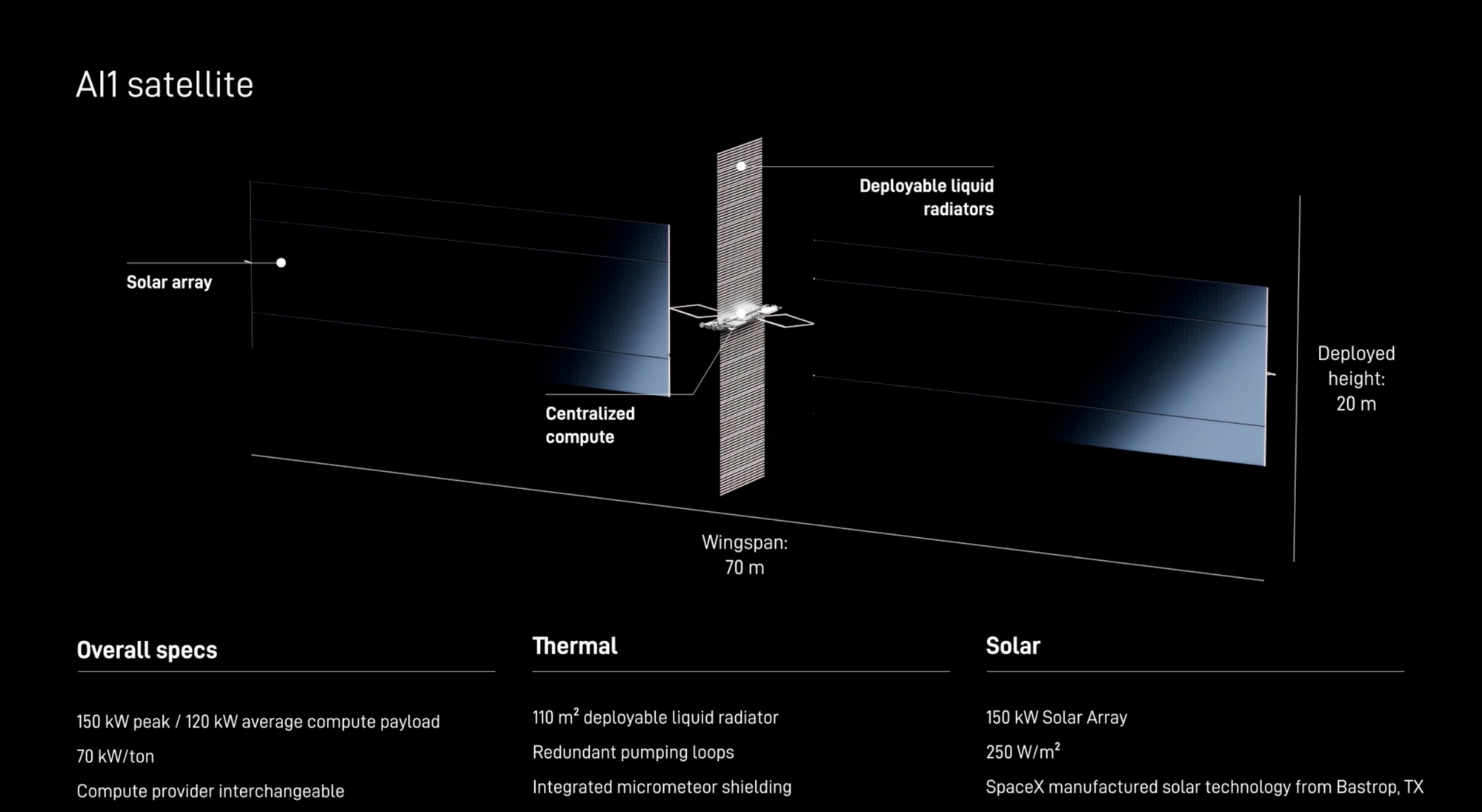
In its filings, SpaceX described Starmind satellites as having average compute power of 175 kW (up to 250 kW), deployable liquid radiators for heat rejection and solar arrays derived from Starlink. It told regulators it would use high-speed laser links to relay data between satellites and to Starlink for ground connectivity. It also filed demisability and collision-avoidance metrics. President and COO Gwynne Shotwell told investors in October that initial launches are planned for 2027.
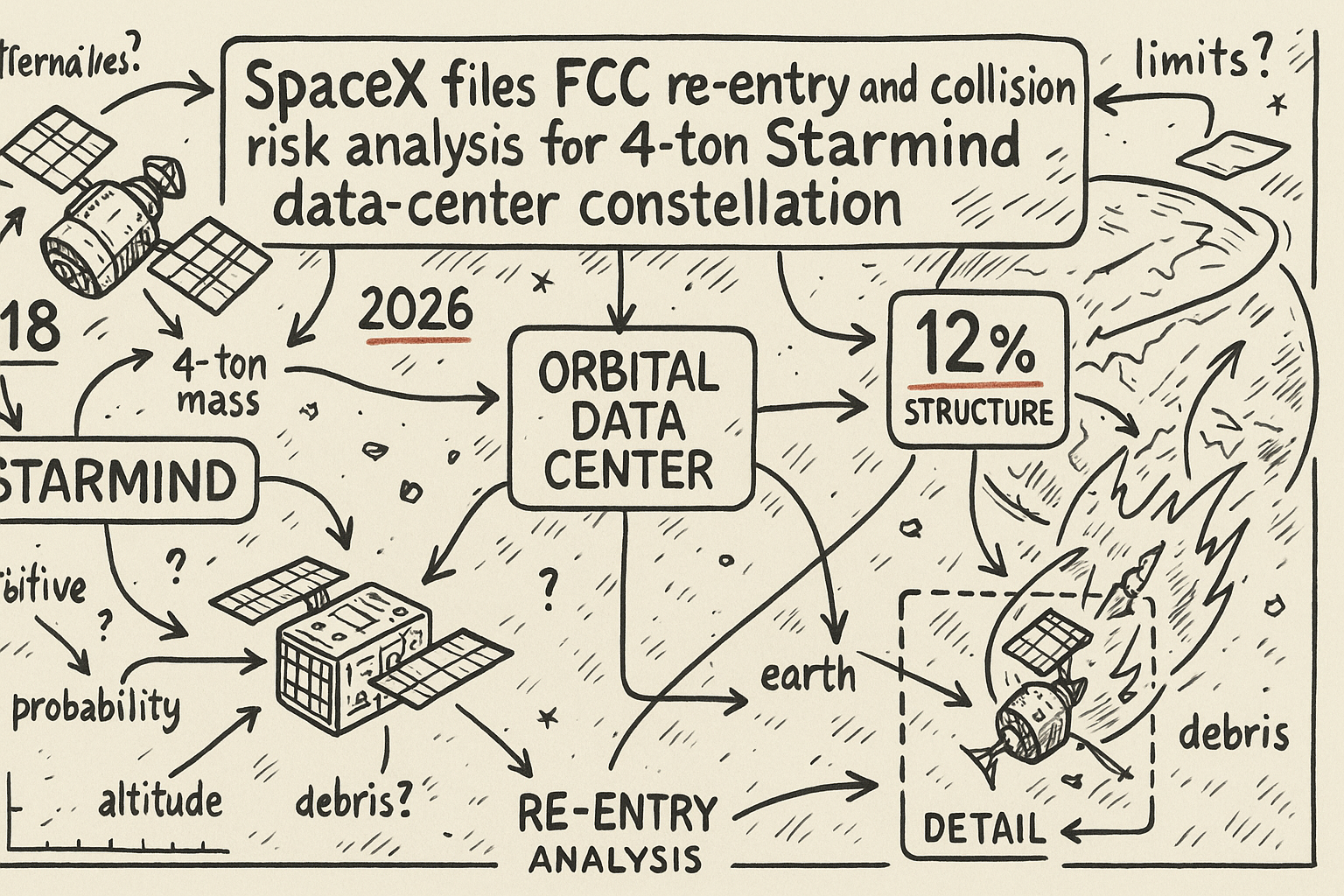
As NovΔ mAInd reported in its coverage of SpaceX’s Sept. 18, 2026 filing, the company told the FCC that each Starmind spacecraft may have a mass of up to 4,000 kg, nearly seven times a 575 kg Starlink V2 Mini. Spacecraft below 600 km would be de-orbited to ocean disposal zones, while higher units could go to graveyard orbits pending regulatory approval. SpaceX said the bus structure, primary propellant tanks and optical laser terminals should vaporize on re-entry. Its analysis found that AI compute modules, solar array segments and thermal management cooling loops could survive.
Environmental and astronomy objections set aside
Petitions to deny came from Amazon (Kuiper), Viasat and the American Astronomical Society (AAS). Half a dozen organizations, including the Secure World Foundation, raised concerns about collision risk, orbital debris, atmospheric pollution from reentries and effects on astronomy. The FCC also received about 1,500 public comments. Technical analyses circulated before the ruling modeled worst-case scenarios in which launch and re-entry emissions rise by up to 150×. Those studies stressed the difference between modeled outcomes and currently measured atmospheric data.
The Secure World Foundation called the wave of orbital data center applications “a qualitative shift in the scale of proposed satellite constellation operations” and asked for “robust technical review.” It said that review should cover launch-rate impacts, reentry effects and “cumulative impacts on dark and quiet skies.” The AAS said it is “disheartened and dismayed” and that the decision will “significantly undermine (i) decades of federal investment in astronomical facilities and (ii) the ability of astronomers and the public to enjoy and study the night sky.”
The FCC said many of these issues fall outside its remit. On launch emissions it wrote: “Potential concerns related to the emissions of rocket launches and the subsequent impacts on the human environment as an indirect result of the Starmind system are outside of the Commission’s purview.” It called reentry impacts “speculative and not supported in the record.” It cited an October policy change under which space-based activities generally fall outside its National Environmental Policy Act obligations, because they occur beyond U.S. territory and are not federal actions requiring review. The FCC therefore declined further NEPA review.
Carr said the action “opens a bold new frontier for the computing infrastructure needed to power America’s leadership and growth.” He also said moving compute beyond Earth helps sustain America’s role in “super intelligence.” Elon Musk replied on X that the decision would be “a great asset to America and the world.”
Feasibility questions and rival filings
The approval does not establish that orbital data centers are technically or economically viable. Critics point to open challenges: cooling in vacuum, manufacturing and launch costs, and automated traffic management. They urge phased, demonstration-based authorizations and better system-level disclosure. In orbit, solar arrays supply power and no water is needed for cooling. Satellites in Sun-synchronous orbits have continuous sunlight, and they can fly “dawn-dusk” or “dusk-dawn” orbits crossing the equator at 6:00 am and 6:00 pm, or the reverse. No global “Rules of the Road” agreement exists on which route millions of satellites should use. At a July 29, 2026 Secure World event, Matias Cava of the Commerce Department’s Office of Space Commerce urged operators to adopt responsible practices now.
Nine companies are on the Secure World Foundation’s list of orbital data center plans, and five are American and need FCC spectrum approval. Only SpaceX’s application has been approved so far. The FCC said it “intends to issue decisions on each expeditiously,” and competing filings include Starcloud’s 88,000-satellite plan and Blue Origin’s Project Sunrise request for 51,600 satellites.