Introduction
November 2026’s flurry of financings and industrial tie-ups marks more than routine fundraising: it signals a maturation of the commercial space economy into capital-intensive platforms with explicit dual-use and defense ambitions. Three threads run through recent items: the return of SPAC liquidity via Quantum Space’s public listing, blockbuster private rounds like CesiumAstro’s $730 million Series D for its Synchronicity constellation, and a parallel build-up of specialized enabling technology such as Ramon.Space’s $124 million raise for onboard computing. Together with coalition-style mission offerings from European suppliers, these moves show how the market is consolidating around vertically integrated, sovereign-friendly systems.
From SPAC fever to selective public exits
Quantum Space’s completed SPAC merger and NYSE debut—backed by roughly $300 million in committed investment—is noteworthy because SPACs were written off by many after the 2021–2022 cycle. The caveat this time is strategic: companies like Quantum Space are selling not just growth narratives but tangible defense and orbital-mobility capabilities. That reframes investor risk appetite. Instead of speculative broadband constellations or vague “space-as-a-service” pitches, public-market capital is now flowing toward firms that can point to governmental customers, classified applications, or hardware that meets defense procurement tolerances.
Private capital scales constellations—and valuations
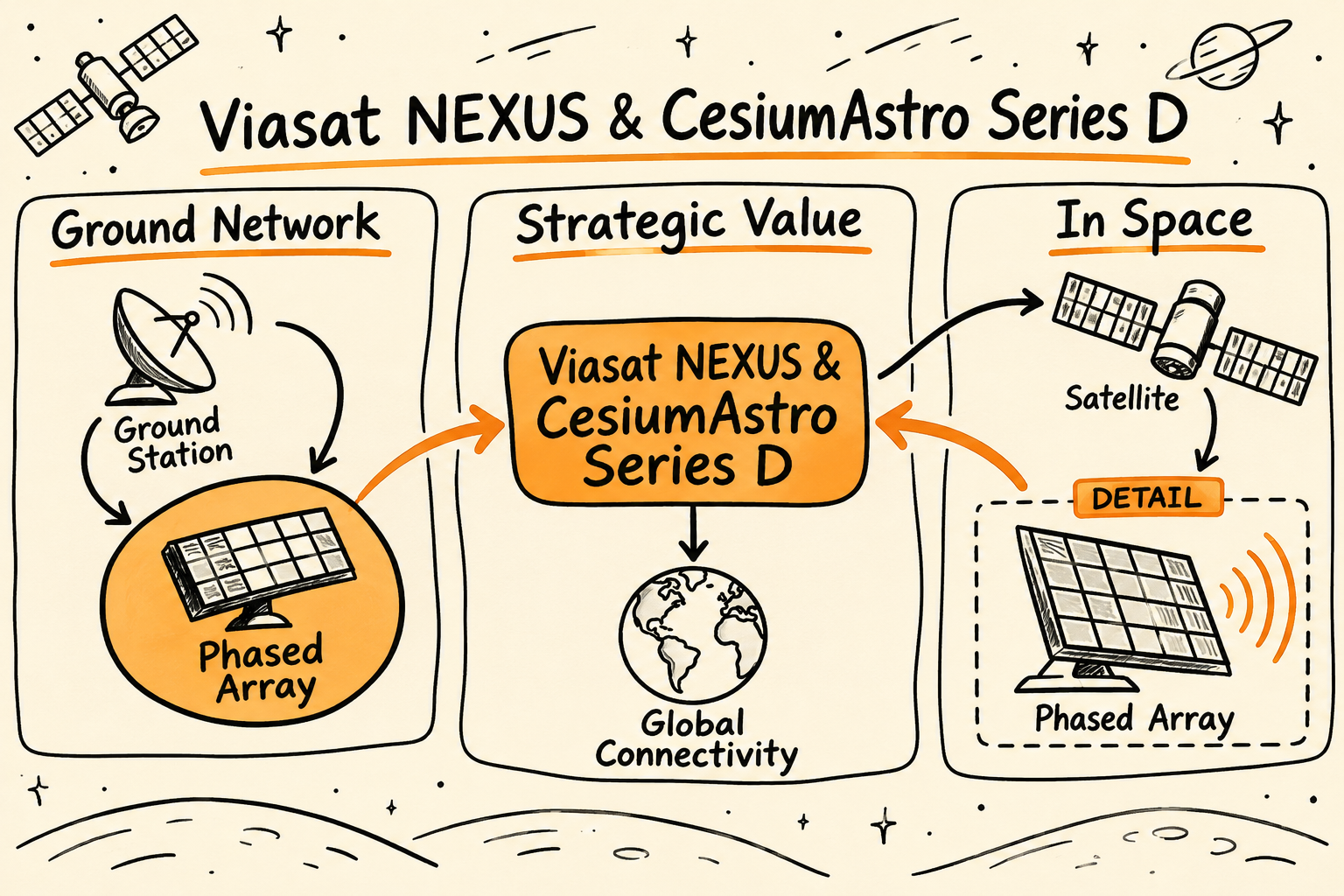
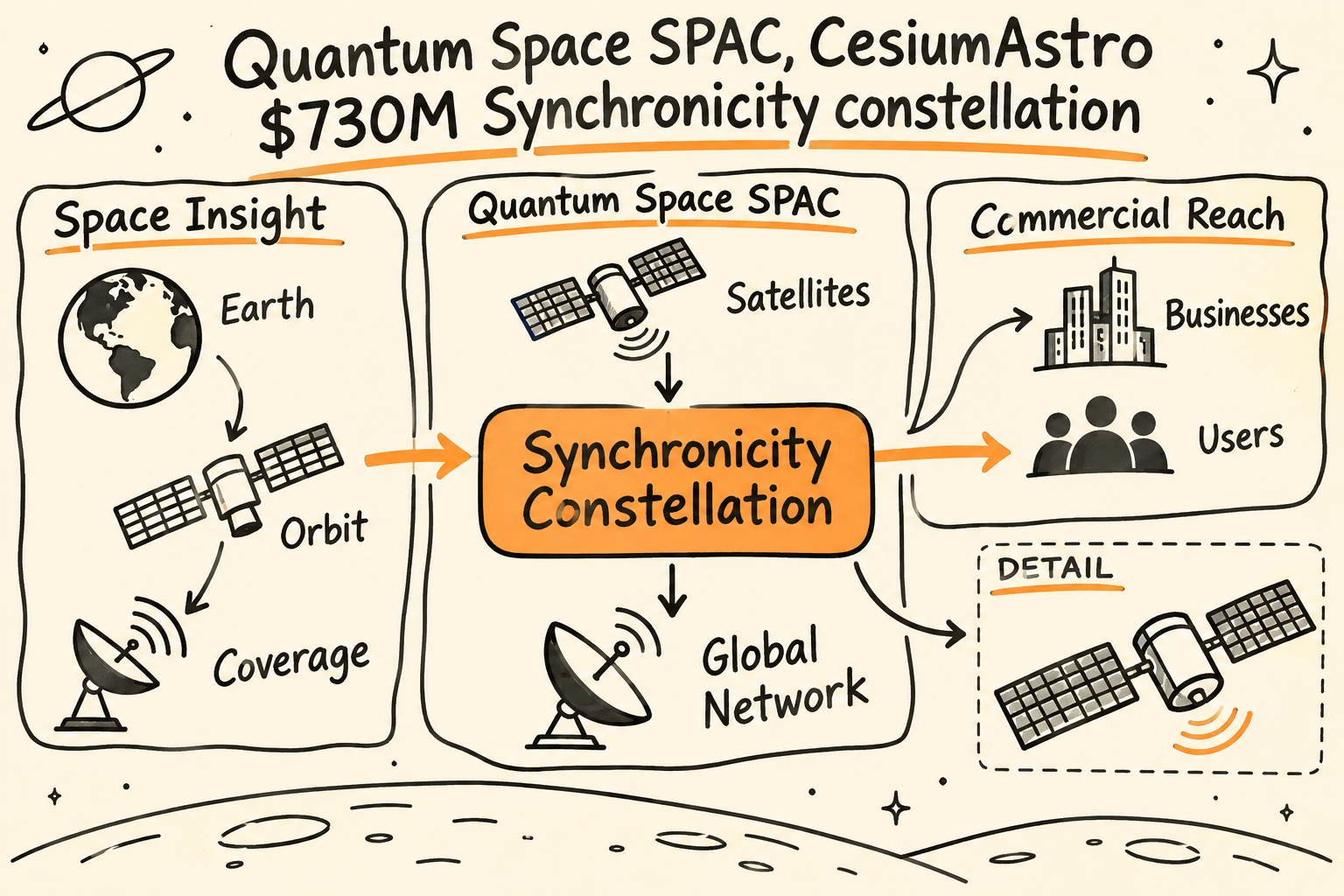
CesiumAstro’s $730 million Series D—valuing the company north of $4.5 billion—illustrates private markets’ willingness to underwrite end-to-end systems that promise recurring revenue: ground networks, hosted payloads, inter-satellite links and proprietary RF or optical technology. The Synchronicity constellation is not just another LEO connectivity play; it is structured to deliver synchronized timing, resilient comms and service-level guarantees attractive to commercial enterprises and national security buyers alike. The scale of the check signals that backers now expect multi-year capital plans and are comfortable funding hardware-heavy rollouts rather than software-only upstarts.
Enablers get funded: onboard compute and integrated mission teams
Ramon.Space’s $124 million Series B shows that investors recognize a second-order market: the brains and systems that run satellites. Onboard compute—accelerators, fault-tolerant processors, and software stacks for AI at the edge—are prerequisites for autonomous operations, in-orbit processing, and defended network operations. Funding compute specialists alongside constellation builders forms a natural hedge: if data is processed intelligently on board, downstream ground infrastructure and bandwidth needs change, altering business models from raw pipe to value-added services.
Industrial cooperation and dual-use offerings
In Europe, the memorandum between Simera Sense, Spacemanic, Zaitra and World from Space to offer end-to-end mission solutions speaks to a broader trend: instead of pure vertical integration within single firms, some regional ecosystems are knitting together specialists to present turnkey dual-use capabilities. That mitigates program risk for institutional buyers who want predictable delivery and helps smaller vendors access larger contracts without becoming conglomerates.
Two counterintuitive implications
1) SPACs returning can be a sign of market discipline, not mania. The quality of candidates—firms with defense-relevant tech, recurring revenue potential, or government-aligned roadmaps—matters. Investors are no longer broadly tolerating speculative plays; they are underwriting mission-capable hardware and services.
2) Heavy private fundraising can accelerate, not delay, consolidation. Large rounds (CesiumAstro) and specialized bets (Ramon.Space) increase bar-to-entry. That encourages smaller suppliers to consolidate into partnerships—like the Bremen coalition—or to pursue acquisition targets, sharpening the divide between scale players and nimble niche specialists.
Historical context
The present funding pattern echoes earlier aerospace cycles: a first wave of democratised launch and smallsat entrepreneurship (late 2010s) produced numerous experiments. By the mid-2020s, investors pivoted toward survivable, contract-backed revenue—mirroring 1980s–90s telecom platform consolidation where scale and regulatory alignment mattered more than novelty. What differs now is the speed of iteration and the role of software-defined satellites, which lets constellation owners adapt services post-launch—increasing the value of onboard compute and flexible partnerships.
What to watch next
Expect three near-term outcomes. First, more SPAC and direct-listing attempts—but selectively; the bar is higher. Second, strategic partnership announcements that package hardware, compute and ground services as single procurements for defense and critical infrastructure customers. Third, M&A among specialists as giants and sovereign-backed firms scoop up technology that shortens deployment timelines. Regulators and export controls will shape which consortia can sell into sensitive markets, making geopolitical alignment a commercial asset.
Conclusion
November’s deals show capital flowing toward durable, integrated space systems rather than speculative payload counts. The winners will be firms that pair robust engineering with procurement-friendly business models—and the financiers who recognize that in-space advantage increasingly depends on compute, partnerships, and political acceptability as much as raw satellite numbers.