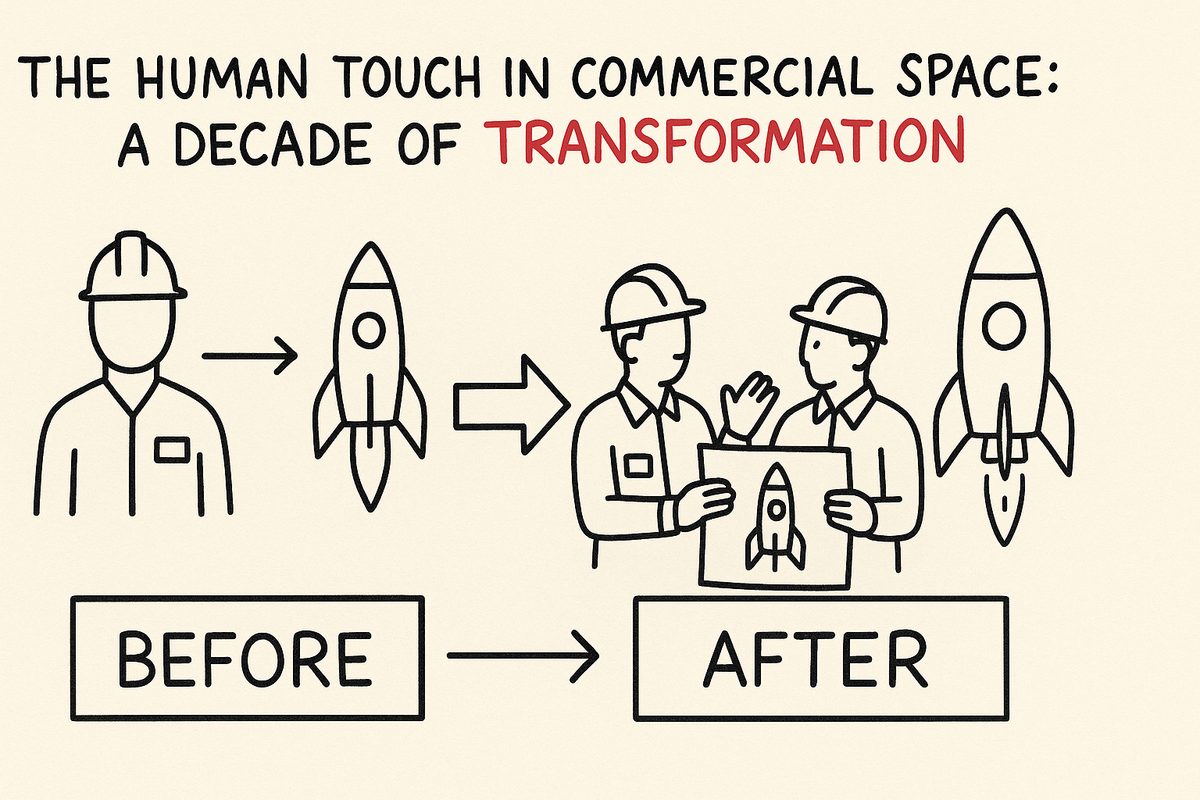
The commercial space industry is undergoing a fascinating transformation where the integration of human talent and technology is reshaping its landscape. This shift is evidenced by recent developments across the globe, where startups and established companies alike are placing a renewed emphasis on human expertise over artificial intelligence (AI) and automation in critical areas of space technology.
Impulse Space, a rocket engine startup, recently raised $500 million with a notable focus on hiring skilled engineers rather than investing heavily in AI. According to Eric Romo, president of Impulse Space, the engineering of physical systems still relies heavily on human talent. This move may seem counterintuitive in an era dominated by AI, but it underscores a broader industry trend towards valuing human ingenuity in solving complex engineering challenges.
In a similar vein, Unastella, a South Korean rocket startup, has successfully secured $24 million in funding to develop its own launch vehicles and engines. This startup, which began its journey from a home-based setup, exemplifies the entrepreneurial spirit driving innovation in the space sector. The emphasis on proprietary development and human-led innovation is a testament to the enduring value of human creativity and problem-solving.
Simultaneously, the in-orbit servicing market is gaining traction, as evidenced by Revolv Space's collaboration with Infinite Orbits. Their partnership to utilize Solar Array Drive Assemblies (SADAs) marks a significant step in enhancing satellite longevity and functionality, further elevating the role of human expertise in maintaining and optimizing space assets.
Moreover, the strategic significance of space infrastructure is becoming increasingly apparent. The recent collaboration between Mbryonics and NTT to build optical communications infrastructure reflects the growing need for robust, high-speed communication networks to support the expanding constellation of satellites and space operations. This collaboration highlights the dual-use potential of space assets, balancing commercial applications with strategic resilience, particularly in regions like Australia, which is capitalizing on its southern geography and partnerships under AUKUS.
While the shift towards human expertise is evident, it is not without challenges. The House Armed Services draft bill's proposal to realign the Space Development Agency and the Space Rapid Capabilities Office under a portfolio-based acquisition structure could streamline operations but may also lead to disruptions in existing workflows and innovation paths.
In parallel, the mission planned by Infinite Orbits and Open Cosmos, involving two satellites named 'Tom & Jerry,' aims to conduct maneuvering and inspection in Low-Earth Orbit (LEO). This mission illustrates the innovative spirit that permeates the commercial space sector, where creative problem-solving and strategic partnerships drive advancement.
These developments collectively indicate a nuanced approach to space exploration that balances the benefits of AI with the irreplaceable value of human expertise. The commercial space sector is not merely a playground for technological advancement but a domain where human creativity and technological prowess converge to tackle some of the most demanding challenges in modern engineering.
Looking ahead, the implications of these trends are profound. As the demand for skilled space professionals rises, educational institutions and industry leaders must collaborate to nurture the next generation of aerospace engineers and scientists. Furthermore, the strategic use of space assets will undoubtedly play a crucial role in shaping geopolitical landscapes and international cooperation in space.