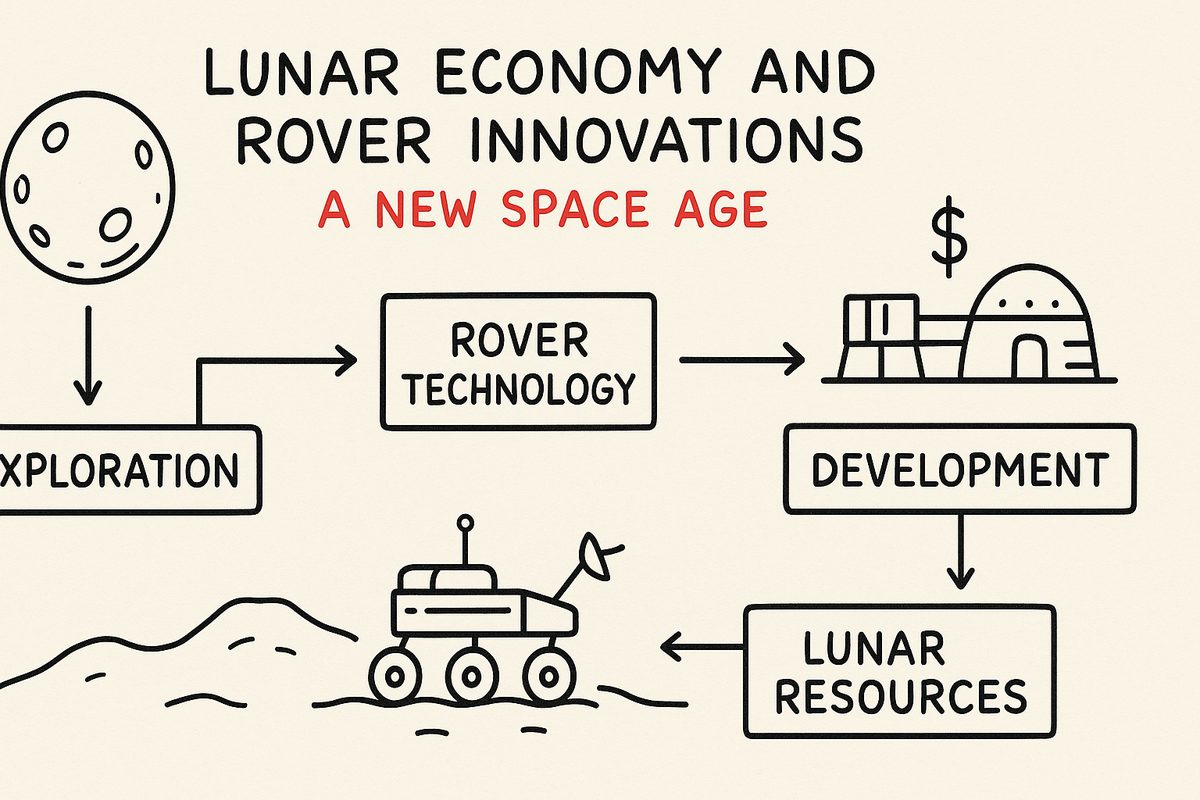
As we stand on the brink of a new era in space exploration, the convergence of economic prospects and technological advancements is reshaping our celestial ambitions. A recent PwC report projects that the lunar economy could generate up to $127 billion by 2050, signaling a pivotal shift in our approach to space as a commercial frontier.
The Lunar Economy: A New Frontier
The report underscores the growing interest in the Moon as a hub for both scientific exploration and economic activity. With the potential for mining lunar resources, such as helium-3 and rare earth elements, the Moon is poised to become a cornerstone of space-based industries. This economic promise is driving both governmental and private entities to invest in lunar missions, aiming to establish a sustainable presence.
Historically, the Moon has been a symbol of human achievement, marked by the Apollo missions of the 1960s and 70s. However, today's lunar aspirations are fundamentally different, characterized by a blend of national pride and economic opportunity. The emerging lunar economy is not just about reaching the Moon but about leveraging its resources to fuel further exploration and technological innovation.
Rover Innovations: From Mars to the Moon
In tandem with economic interests, technological advancements are playing a crucial role in shaping the future of space exploration. Recent innovations in rover technology, exemplified by student-powered 'moon' rovers and bio-inspired designs that navigate challenging terrains, are enhancing our ability to explore extraterrestrial surfaces. These innovations are crucial for developing sustainable operations on the Moon and beyond.
The recent success of a Mars rover concept, which 'swims' through sand using curved wheels, highlights a significant leap in rover mobility. Such technologies are not only vital for Mars exploration but can be adapted for lunar missions, offering enhanced maneuverability in the Moon's regolith.
Connecting the Dots: Economic and Technological Synergy
The synergy between economic potential and technological innovation is creating a feedback loop that accelerates space exploration. As the lunar economy promises substantial returns, more resources are funneled into developing advanced technologies. In turn, these technologies reduce the cost and increase the feasibility of lunar missions, attracting further investment.
Moreover, this dynamic is not limited to lunar exploration. The lessons learned and technologies developed can be applied to other celestial bodies, such as Mars, potentially transforming our approach to planetary exploration. The ripple effects could extend to other sectors, including Earth-based industries, through spin-off technologies and new economic models.
Future Implications and Opportunities
The implications of these developments are far-reaching. The lunar economy could serve as a blueprint for future space economies, where celestial bodies are integrated into Earth's economic system. This vision raises important questions about space governance, resource management, and international cooperation.
Furthermore, the success of rover technologies could redefine our approach to robotic exploration. As we continue to push the boundaries of what is possible, the gap between science fiction and reality narrows, opening up new avenues for exploration and discovery.
In conclusion, the intersection of economic potential and technological innovation is setting the stage for a new space age. As we look to the Moon and beyond, the journey is as much about redefining our relationship with space as it is about achieving new milestones. The future of space exploration is not just about reaching new destinations but about creating a sustainable and interconnected celestial economy.