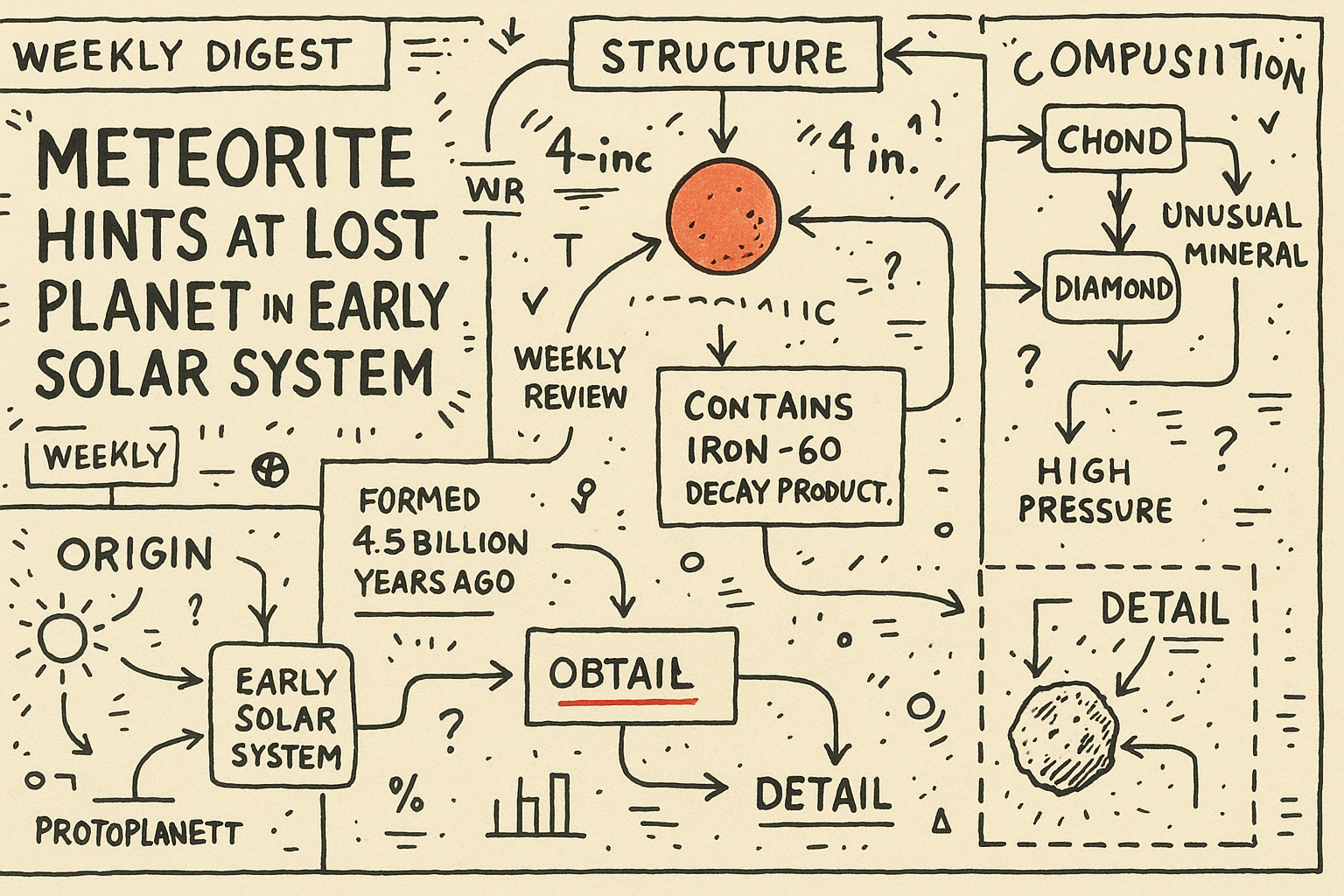
A meteorite found in the icy expanse of Antarctica may hold clues to a chapter of our solar system's history long thought lost. Researchers from the University of Colorado Boulder have uncovered evidence suggesting that this meteorite originated from a Mars-sized planet that once existed in the early solar system but has since vanished. This discovery not only adds a new dimension to our understanding of planetary formation but also challenges existing scientific models that have guided astronomers for decades. The implications of such a finding are profound, as it suggests that the early solar system was a dynamic and possibly chaotic environment, where planets could form and disintegrate under conditions that we are only beginning to comprehend.
The study, published in mid-June, indicates that the chemical composition of this meteorite does not match any known celestial bodies currently orbiting our sun. Instead, the isotopic signatures point to a body that formed and differentiated like a planet, suggesting that the early solar system may have been more chaotic and crowded than previously believed. The presence of such a planet implies that there were more bodies in the early solar system than the current models account for. This raises intriguing questions about the processes that led to the formation and eventual disappearance of such a planet, and how those processes might have shaped our current planetary arrangement. Could interactions with other nascent planets or the gravitational influence of larger bodies like Jupiter have played a role in its demise?
These findings have profound implications for our understanding of how planets form and evolve. If a Mars-sized planet could exist and then disappear without a trace, it could mean that our current models are missing critical elements of planetary dynamics, such as interactions with gas giants or cataclysmic collisions. The current models of planetary formation, which often emphasize gradual accretion and stability, might need to be re-evaluated to account for periods of intense dynamism. As scientists delve deeper into this mystery, they may need to rewrite the narrative of our solar system's history, one meteorite at a time. This discovery also opens up possibilities for the existence of other lost bodies, prompting a reassessment of the solar system's historical population.
Lunar Exploration and Galactic Archaeology
While the tale of a long-lost planet captivates researchers, exploration efforts closer to home continue unabated. A team from Tokyo Metropolitan University recently launched a lunar orbiter equipped with a compact X-ray telescope, setting out to map the Moon's chemical composition over the next two years. This mission aims to provide unprecedented insight into the Moon's elemental makeup, potentially unlocking secrets about its formation and evolution. By understanding the Moon's composition, scientists hope to draw parallels with Earth, given the theorized shared origins due to a massive collision between Earth and a Mars-sized body.
The orbiter represents a significant technological achievement, given its compact design and ambitious objectives. By examining the X-ray emissions from the lunar surface, the mission will identify the abundance and distribution of elements like magnesium, aluminum, and silicon. This data could illuminate not just the Moon’s history, but also offer clues about early Earth. Understanding the Moon's chemical makeup could also enhance our knowledge of the conditions that were present during the early solar system, providing a comparative benchmark against which to measure other celestial bodies.
Meanwhile, the European Space Agency is gearing up for its Arrakihs mission, which will delve into what scientists refer to as "galactic archaeology." The mission's focus is on the faint halos surrounding galaxies, which contain the remnants of past collisions and mergers. These halos are like ghostly fingerprints of cosmic events that have shaped the galaxies over billions of years. By studying these halos, researchers hope to piece together the evolutionary history of galaxies, offering insights into the forces that shape the cosmos on a grand scale. This mission could redefine our understanding of galaxy formation and evolution, much as the study of ancient ruins informs our understanding of human history.
Launches: Expanding Communication and Exploration
In the realm of satellite launches, SpaceX has once again made headlines, deploying 24 Starlink satellites into orbit just before its much-anticipated Nasdaq IPO debut. This launch represents another step in SpaceX's aggressive expansion of its satellite broadband network, aiming to provide global internet coverage. As the constellation grows, so do concerns over space debris and light pollution, topics that satellite operators must increasingly address. The proliferation of satellites necessitates a dialogue about sustainable space practices, as unchecked expansion could lead to long-term repercussions for both astronomical observations and the safety of orbital operations.
Japan's H3 rocket also marked a critical milestone, successfully returning to flight after a previous failed attempt. This mission saw the deployment of six small satellites into orbit, signifying a triumphant moment for JAXA in the face of past setbacks. The success of the H3 is vital not only for Japan's space ambitions but also for the global launch market, which relies on a diverse array of reliable launch vehicles. With the H3, Japan reaffirms its position as a key player in the international space community, demonstrating resilience and commitment to innovation.
China continues to expand its own satellite capabilities, having recently conducted dual satellite launches. These included both classified payloads and a direct-to-device communications satellite intended to enhance its communication infrastructure. The strategic importance of these satellites is clear, as they bolster China’s position in the competitive arena of space-based communications. The dual launches signify China's intent to maintain a significant presence in space, reflecting broader geopolitical strategies where space dominance is increasingly seen as a component of national security.
Industry and Innovation: New Frontiers and Challenges
As the industry landscape evolves, Quantum Space has announced plans to merge with a SPAC to go public, with a focus on developing spacecraft for national security missions. This move underscores the growing intersection between commercial and defense sectors in space, as companies increasingly cater to government needs while exploring civilian applications. The merger highlights the increasing trend of private companies becoming integral players in national defense strategies, illustrating how economic and security interests are intertwined in space endeavors.
Innovation continues to drive technological progress, as demonstrated by Axiom Space and Prada's collaboration on the new Artemis lunar spacesuit design. This partnership highlights the merging of high fashion with high function, aiming to provide astronauts with suits that are both ergonomic and stylish for future lunar missions. The spacesuit's debut is eagerly anticipated as part of NASA's Artemis program, which seeks to return humans to the Moon. This collaboration symbolizes a broader trend where aesthetic and functional considerations are being balanced in technological advancements, reflecting changing priorities in space exploration where human experience is increasingly taken into account.
Meanwhile, Juno Propulsion's recent success in securing $1.4 million for its rotating detonation engine promises to revolutionize propulsion technology. This dual-mode CubeSat engine, which combines chemical and electric propulsion, could dramatically enhance the capabilities of small satellites, allowing them to carry heavier scientific instruments and travel further distances. Such propulsion systems could redefine the logistics of satellite deployment, opening new possibilities for scientific missions and commercial applications alike. The success of this technology could herald a new era of exploration, where smaller, more efficient missions become the norm.
Policy and the Future of Space Observation
On the policy front, the FCC has begun reviewing Amazon's acquisition of Globalstar, a move that could significantly impact the satellite communications landscape. While this acquisition promises to enhance Amazon's constellation capabilities, it also raises concerns among astronomers about increased light pollution from bright satellite fleets. The debate over balancing technological advancement with environmental and observational impacts continues to be a contentious issue. As more companies enter the satellite business, the need for regulatory frameworks that protect both commercial interests and the environment becomes increasingly urgent.
In Europe, the ESA has awarded a substantial €700 million contract for the development of next-generation Sentinel-1 Earth observation satellites. These satellites are integral to monitoring environmental changes on our planet, providing crucial data on everything from deforestation to ice melt. As climate concerns grow, the role of such satellites in informing policy and action becomes ever more crucial. The Sentinel-1 program exemplifies the commitment to using space technology to address global challenges, reflecting a growing recognition of the interconnectedness of space exploration and planetary stewardship.
Finally, NASA's Artemis III mission progresses with the arrival of the final SLS booster segments at Kennedy Space Center. This crucial step marks an intensification of preparations for humanity's next lunar landing. The Artemis program not only aims to return astronauts to the Moon but also lays the groundwork for future Mars exploration, underscoring the enduring human spirit of exploration and discovery. The progress of Artemis III serves as a reminder of the aspirations that drive space exploration and the collaborative efforts required to achieve such ambitious goals.