As humanity sets its eyes on long-term lunar habitation, the question of how to construct infrastructure on the Moon becomes increasingly pertinent. NASA has ambitious plans for a Moon base, but the logistics of transporting construction materials from Earth to the lunar surface have always been a formidable challenge. Enter Lunar Forge, a startup that has recently emerged from stealth with a pioneering solution: using the Moon's own dust, or regolith, to create construction materials for lunar infrastructure.
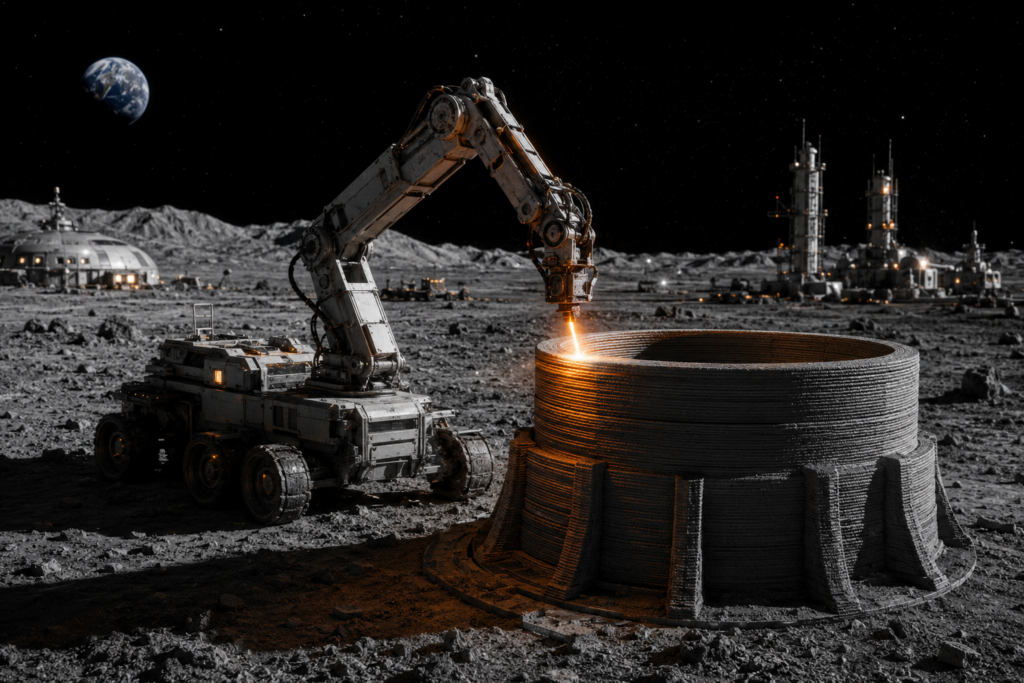
Lunar Forge's approach centers on laser sintering, a technology that fuses powdered materials into solid masses using high heat, without melting them into a liquid state. This method could potentially revolutionize lunar construction by utilizing the Moon's abundant natural resources to build essential structures, such as housing and shielding for lunar fission reactors.
The cost of transporting materials from Earth is astronomical, estimated at approximately $1 million per kilogram with current launch economics. Alex Bell, CEO of Lunar Forge, explains that constructing a single reactor housing using materials shipped from Earth could cost hundreds of millions just in launch mass. By contrast, sintering lunar regolith in-situ could nearly eliminate this mass penalty, making it a financially viable option for building on the Moon.
In practical terms, the sintering process involves collecting raw regolith, filtering and sieving it to control particle distribution, and then using lasers to heat the particles until they fuse together. The Moon's regolith is rich in minerals such as iron, aluminum, and titanium—all crucial for building reactor shielding. However, the variability in the regolith's composition requires the system to adapt in real time, ensuring the structural integrity of the output.
In laboratory tests, Lunar Forge demonstrated the compressive strength of their sintered material, achieving results that exceed 200 MPa, with some samples reaching as high as 345 MPa. For comparison, consumer-grade concrete has a compressive strength of 20 to 30 MPa, while 350 MPa steel is used for extreme load-bearing applications on Earth.
The next phase of Lunar Forge's plan involves miniaturizing their lab technology to fit into a lunar lander. The company has outlined a three-step plan to start demonstrating this technology on the lunar surface beginning in 2027. The first demonstration will involve deploying a solar- and battery-powered sintering unit on the Moon, although the specific lander for this mission has not yet been announced.
Lunar Forge is not alone in exploring the potential of lunar regolith for construction. Other companies, such as Redwire's Mason technology and ICON Prime, are also investigating similar approaches. Redwire has received NASA support for creating off-world landing pads and roads, while ICON Prime uses lasers to melt 3D-printed regolith for building structures.
The implications of Lunar Forge's technology are significant. By reducing the need to transport materials from Earth, it could make lunar habitats more sustainable and economically feasible. This approach aligns with the broader goal of leveraging in-situ resources to support long-term human presence in space.
As the world watches and waits, Lunar Forge's developments could mark a turning point in lunar exploration, opening new possibilities for science, commerce, and even the future of humanity's presence beyond Earth.