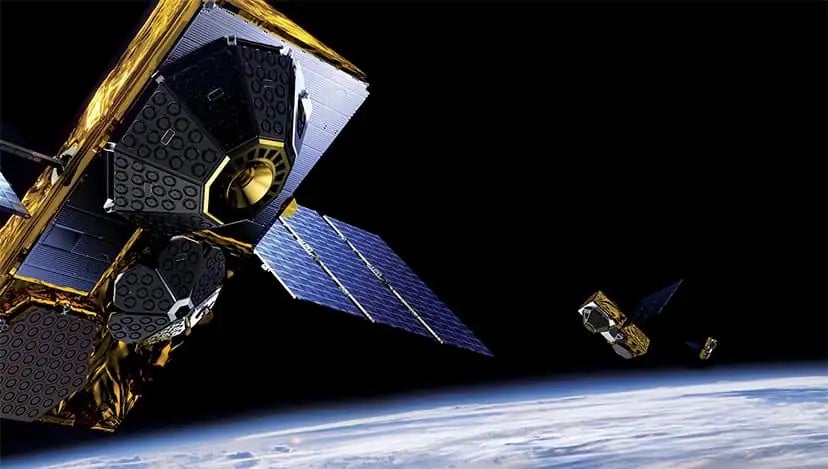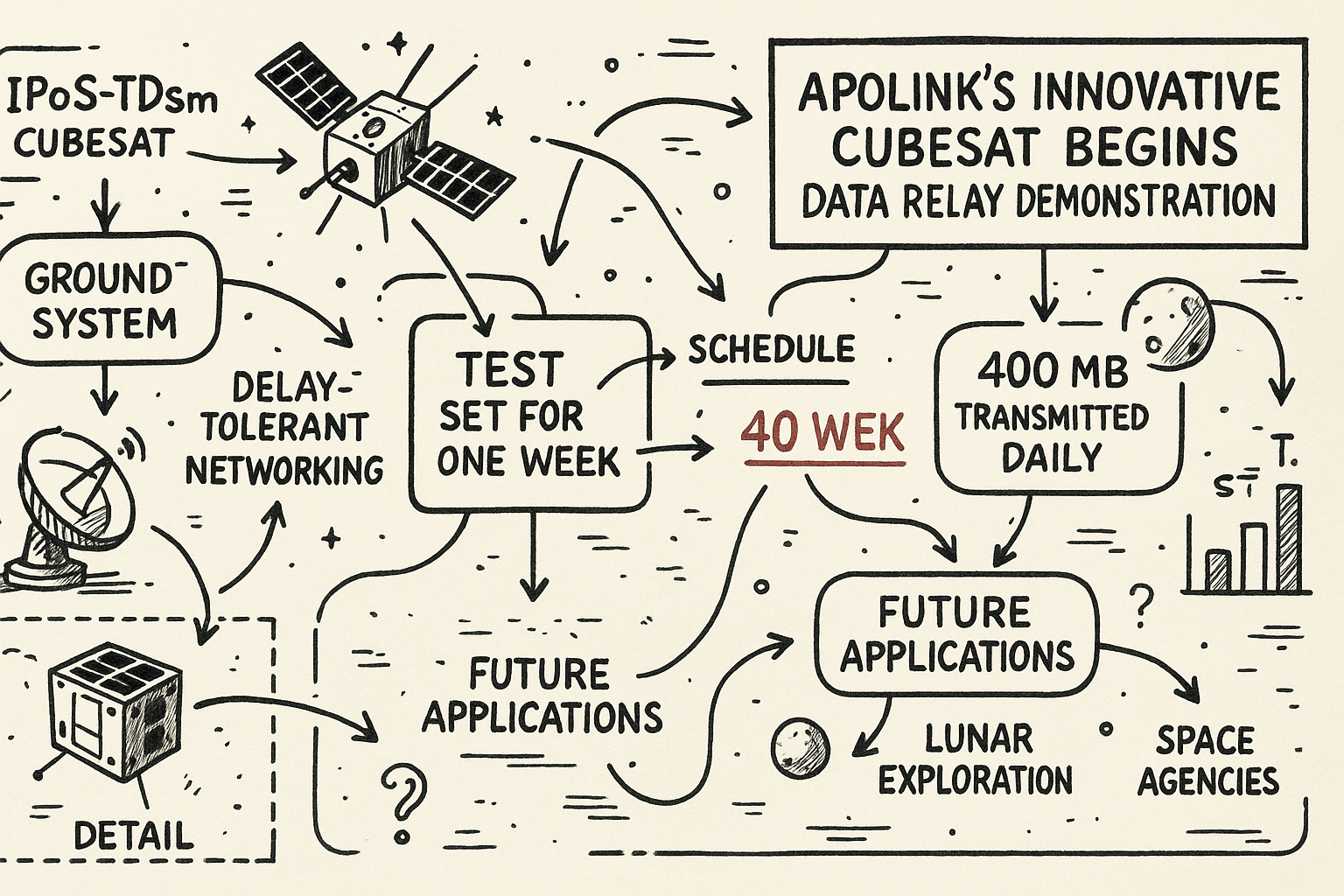
Apolink has made a significant leap in satellite communications with the successful launch and establishment of contact with its first relay cubesat, IPoS-TDsM (Interoperability Protocol over Satellite – Technology Demonstration Mission). This milestone was achieved as part of SpaceX’s rideshare mission that took off on July 7 from Vandenberg Space Force Base, California.
The mission represents a groundbreaking development in the field of satellite communications, facilitated by a unique experimental license from the Federal Communications Commission (FCC). This license permits Apolink to conduct S-band inter-satellite link operations, allowing the IPoS-TDsM cubesat to receive and relay signals from other satellites in low Earth orbit (LEO) without interference.
According to Apolink CEO Onkar Batra, the satellite is designed to operate by receiving data from partner satellites, digitizing it, and transmitting it to ground stations without compromising signal integrity. This innovative approach aims to serve as a 'transparent relay layer', enabling operators to communicate with their satellites without the need to wait for a direct ground pass.
Apolink's primary partner for this demonstration mission is Singapore-based NuSpace. The collaboration involves using the NuLink-1 and NuLink-2 satellites, which were launched in May, as part of the data relay demonstration. Prior to this, Apolink conducted lab simulations and tests using an active beacon from NuLink-2, which validated their capability to handle signals from various transceivers. The current mission is set to demonstrate these capabilities in an operational space environment for the first time.
The IPoS-TDsM cubesat, a 3U-sized satellite, is capable of closing low-power links at distances up to approximately 150 kilometers during line-of-sight passes. This ability is expected to be demonstrated through various conjunction windows starting this July and continuing until November. The ultimate goal is to develop a robust relay network comprising 32 interconnected satellites, which could revolutionize how data and command signals are transmitted between satellites and ground stations.
Looking towards the future, Apolink is actively seeking additional partners whose satellites are backward-compatible to further test and refine their technology. In February, the company announced a partnership with Canadian startup Galaxia on a future satellite slated for launch in 2027, which aims to enhance Apolink's in-orbit data relay technology.
The launch itself was part of a larger mission involving 81 payloads aboard a Falcon 9 rocket, highlighting the increasing trend of shared missions in space exploration and satellite deployment. This approach not only reduces costs but also fosters collaboration among various entities in the space sector.
As Apolink progresses with its demonstration mission, the implications of its work could be far-reaching. By reducing the need for ground stations and enabling continuous satellite communication, the technology holds the potential to increase the efficiency of satellite operations and expand the possibilities for real-time data transmission across the globe.
The success of Apolink's initiative could pave the way for more innovative solutions in satellite communications, further integrating space technology into everyday applications and enhancing global connectivity.