As the quest to discover habitable exoplanets intensifies, astronomers and engineers are continually seeking innovative solutions to overcome the challenges of space observation. A recent development by researchers at Xidian University and the Beijing Institute of Control Engineering proposes a 'smart ruler' that could significantly enhance our ability to image exoplanets using space-based interferometry.
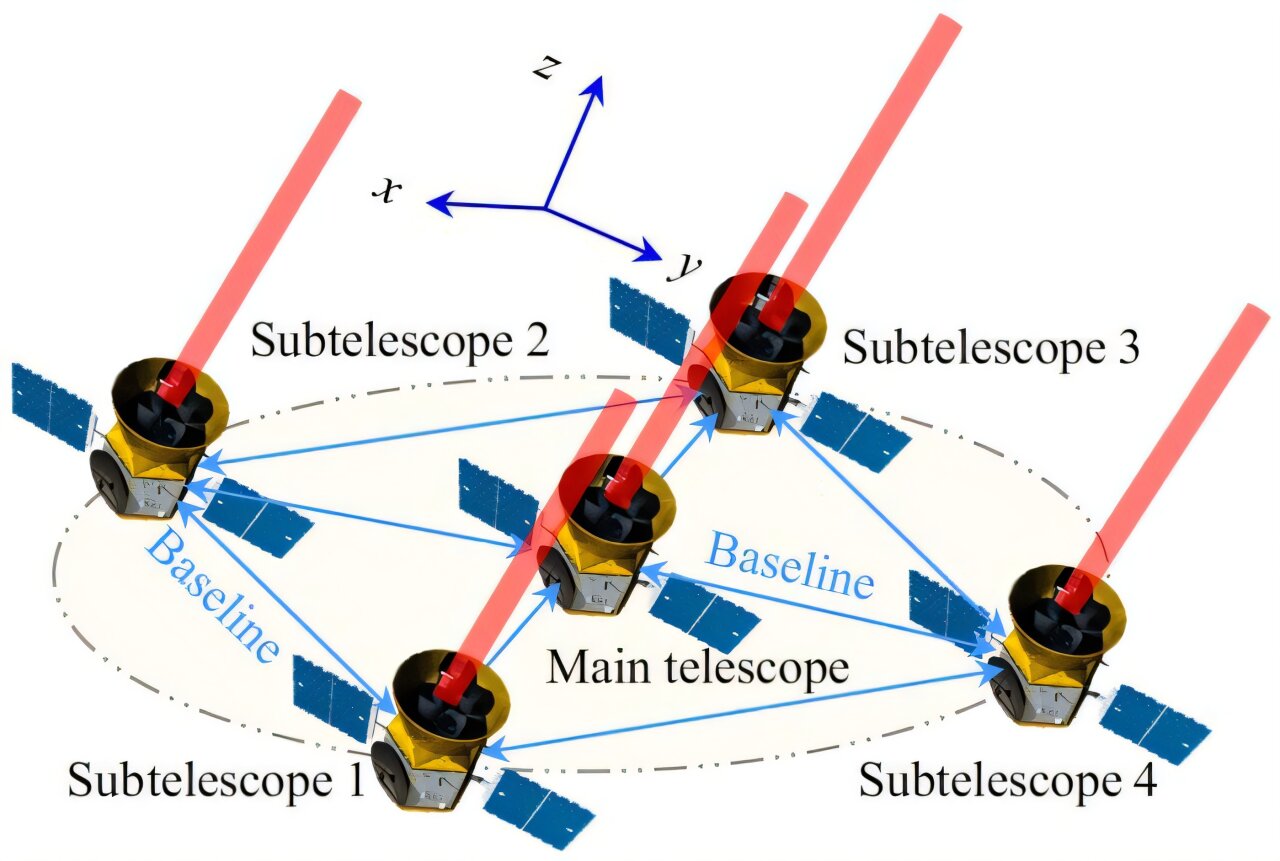
Interferometry, a technique that combines the observations from multiple telescopes to act as a single, larger telescope, has long been considered a promising solution for space observation. It allows for high-resolution imaging without the need for a single colossal mirror, which is currently infeasible to launch due to size constraints of rocket fairings. By arranging multiple satellites in space to function as a giant mirror, interferometry can potentially provide the detailed images needed to study distant exoplanets.
However, implementing interferometry in space is fraught with technical challenges. A primary hurdle is accurately measuring the distance between free-floating satellites to ensure precise alignment. This is where the 'smart ruler' comes into play. The system, described in a paper published in Space: Science & Technology, utilizes frequency-sweeping interferometry (FSI) to measure inter-satellite distances. FSI works by sending a laser with a continuously varying frequency towards a target satellite and measuring the frequency of the reflected light.
The technique faces two significant obstacles in space: the Doppler effect, which amplifies measurement errors due to satellite movement, and inaccuracies in the laser frequencies themselves. To address these issues, the research team, led by Wenjun Chen, has introduced a method called Double-Sideband FSI (DSB-FSI). This approach employs a Mach-Zehnder modulator to emit two laser frequencies simultaneously—one increasing and the other decreasing. By averaging the results, this method effectively cancels out errors induced by satellite movement.
To tackle laser frequency inaccuracies, the team incorporated a Fabry-Pérot etalon into the system. This optical cavity, featuring two parallel reflecting mirrors, allows only specific frequencies to pass through. By analyzing when the laser frequency matches the desired frequency, the system can identify and correct any offsets in the frequency sweeping process. This dual approach of using both DSB-FSI and the Fabry-Pérot etalon could significantly improve the accuracy of satellite positioning in an interferometric array.
This advancement in interferometry technology is crucial as astronomers aim to answer one of humanity's most profound questions: Are we alone in the universe? Current telescopes, such as the James Webb Space Telescope, have made strides in studying exoplanetary atmospheres, but the resolution required to detect signs of life remains out of reach. The proposed swarm of telescopes equipped with this 'smart ruler' could bridge this gap, offering the precision and clarity needed to explore these distant worlds in greater detail.
As exciting as this development is, it is set against a backdrop of growing concerns in the astronomical community. The increasing number of satellites being launched into orbit threatens to obstruct Earth-based observations. A study by the European Southern Observatory warns that the deployment of more than 1.7 million satellites could have catastrophic consequences for ground-based astronomy. Hence, while space-based solutions like the proposed interferometric swarm hold promise, they must be balanced with sustainable orbital management practices.
Looking ahead, the integration of these technologies could redefine our approach to space exploration and observation. By overcoming the technical hurdles of interferometry, the 'smart ruler' may pave the way for a new era of discovery, where the mysteries of distant exoplanets become more accessible to scientific inquiry.