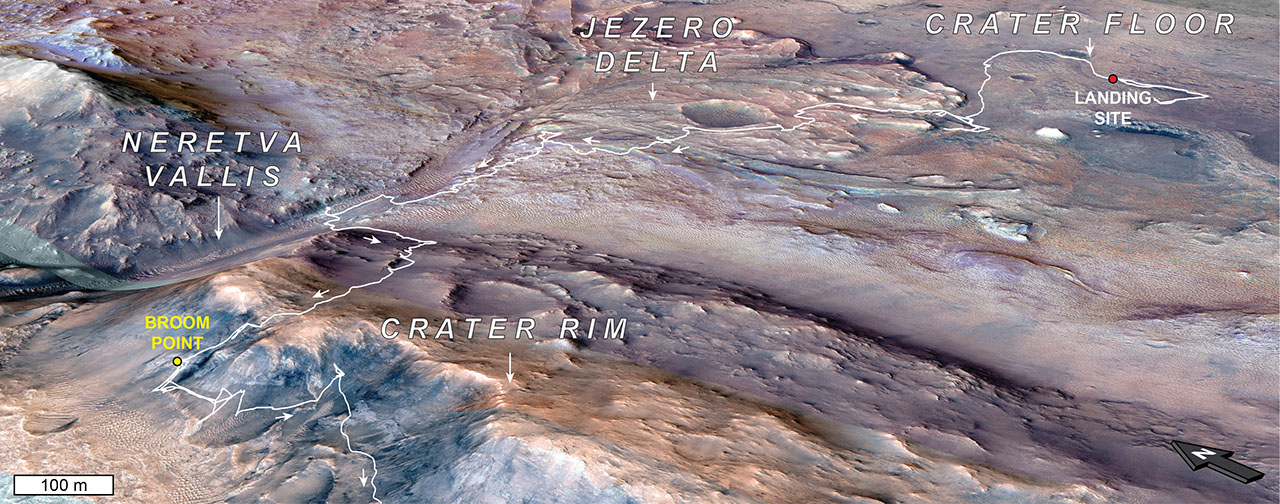
The Perseverance rover, NASA's latest robotic explorer on Mars, has made a groundbreaking discovery that provides insights into the planet's ancient geological history. On the rim of Jezero Crater, Perseverance has uncovered a 245-foot-thick (75-meter-thick) sequence of layered rocks, dubbed the 'Broom Point member,' which appears to have been shaped by repeated asteroid impacts. These findings, published in the Journal of Geophysical Research: Planets, offer a rare glimpse into a tumultuous era of the solar system that is over 3.9 billion years old.
The Broom Point member stands as one of the oldest terrains ever examined by a Mars rover. Ken Farley, the deputy project scientist for Perseverance at Caltech, emphasized the significance of this discovery, noting that "on Earth, our earliest geologic history has been fundamentally broken up, deformed, and erased by plate tectonics." In contrast, Mars, which lacks such tectonic activity, has preserved its ancient crust, allowing scientists an unprecedented look into the planet's past.
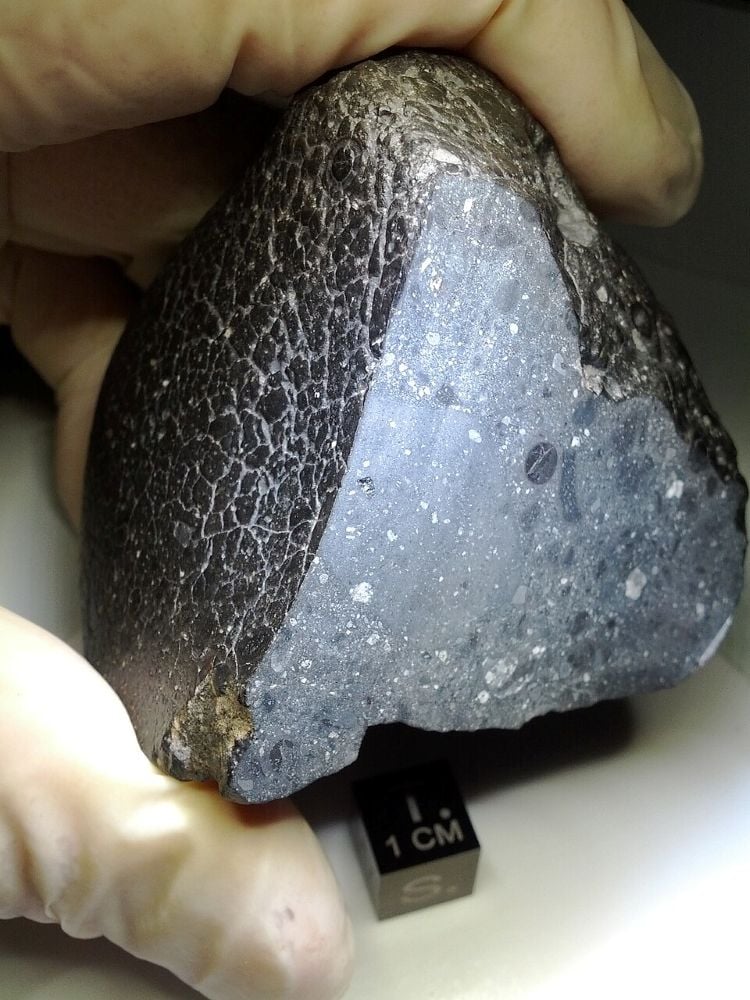
Since ascending the western rim of Jezero Crater in late 2024, Perseverance has been using its array of scientific instruments to study various geological features. The data collected at Broom Point has revealed six distinct types of rock, including breccias, which are composed of angular rock fragments. These rocks alternate with layers of fine-grained, pulverized dust. The presence of gas-bubble cavities within the rock fragments suggests they were once molten, further supporting the hypothesis of a violent history marked by asteroid impacts.
One of the most intriguing elements found within these layers are tiny, dark, glassy beads. While volcanic activity can produce similar formations, the abundance of these beads points to asteroid impacts as the primary genesis. Some of these beads are comparable in size to those produced by the asteroid impact that led to the extinction of the dinosaurs on Earth, known as the Chicxulub impact.
The implications of these findings extend beyond understanding Mars's geological history. They provide a comparative framework for studying early Earth, where much of the ancient crust has been recycled through tectonic processes. By studying Martian rock formations, scientists can infer the conditions of early solar system impacts and their potential role in shaping planetary surfaces and atmospheres.
Perseverance's mission continues to unravel the mysteries of Mars, with the rover now exploring new terrains beyond Jezero Crater. This ongoing exploration not only enhances our understanding of Mars but also holds the potential to uncover clues about the early solar system's history, including the conditions that may have been conducive to life.
As Perseverance continues its journey, each discovery adds a new piece to the puzzle of Mars's past and the solar system's formative years. The data collected from Broom Point will be instrumental in shaping future missions and research, potentially guiding efforts to uncover signs of past life on Mars and furthering our understanding of planetary evolution.