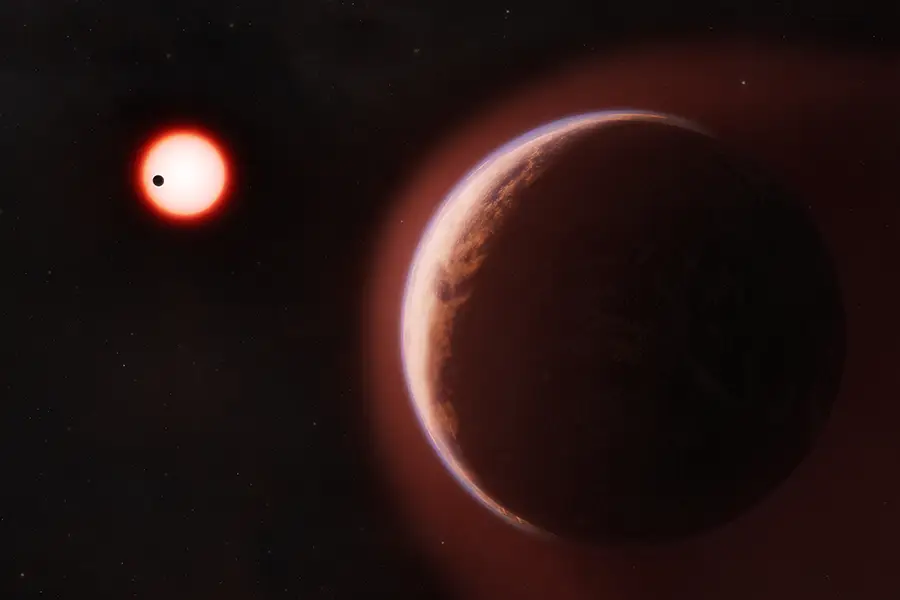
Astronomers have achieved a significant breakthrough in the search for habitable worlds beyond our solar system with the first detection of an atmosphere around a rocky exoplanet located in its star's habitable zone. This exoplanet, LHS 1140 b, resides 48 light-years from Earth and orbits a red dwarf star significantly cooler and smaller than our Sun.
The study, led by Collin Cherubim from Harvard University and published in the journal Science, marks a milestone in exoplanetary science. “This is the first time anyone has found an atmosphere on a rocky planet in the habitable zone of another star,” Cherubim stated. This discovery opens up exciting possibilities for the existence of Earth-like conditions on other planets.
Measuring more than five times Earth's mass and 1.7 times its radius, LHS 1140 b is a so-called 'super-Earth.' Its rocky composition suggests the presence of a thin atmosphere and possibly liquid water, making it a prime target for studying habitability. The detection of helium in its atmosphere provides the first direct evidence of atmospheric retention on a rocky planet in the habitable zone.
Historically, astronomers have detected atmospheres primarily on large, gaseous exoplanets, often referred to as 'hot Jupiters.' These findings have been limited to planets with extreme environments, making them unsuitable for life as we know it. The detection on LHS 1140 b, however, represents a significant departure from this trend, focusing on a planet that is more Earth-like in size and environmental conditions.
Robin Wordsworth, a co-author of the study, remarked on the significance of this discovery: “Twenty years ago we wondered whether other terrestrial-type planets even existed. Then we learned they're common, and found some in the habitable zone. The next question was whether any of them had managed to keep an atmosphere. Now we know at least one has.”
The presence of helium in the atmosphere of LHS 1140 b was predicted by Cherubim's computer models, which suggested that certain rocky planets could lose their hydrogen while retaining helium, creating what he calls 'helium worlds.' This class of planets had only been hypothesized until now.
The detection was made possible through observations conducted in September 2024 using the Magellan Clay telescope in Chile. These observations revealed helium escaping from the planet’s upper atmosphere, suggesting the presence of heavier compounds below. Such an atmosphere could potentially support liquid water and protect the planet from harmful radiation, enhancing its potential for habitability.
While the discovery of an atmosphere is a promising step, it is essential to note that having an atmosphere does not guarantee the presence of life. The next steps in this research will likely focus on identifying the specific composition of the atmosphere and searching for signs of biological activity.
The implications of this discovery are vast. It not only advances our understanding of exoplanetary atmospheres but also refines the criteria by which we search for habitable worlds. As astronomers continue to refine their techniques and technologies, the quest to find life beyond Earth becomes increasingly promising.
In conclusion, the detection of an atmosphere around LHS 1140 b represents a significant advancement in the search for habitable planets. It underscores the potential for finding Earth-like conditions elsewhere in the universe, bringing us one step closer to answering the age-old question of whether we are alone in the cosmos.