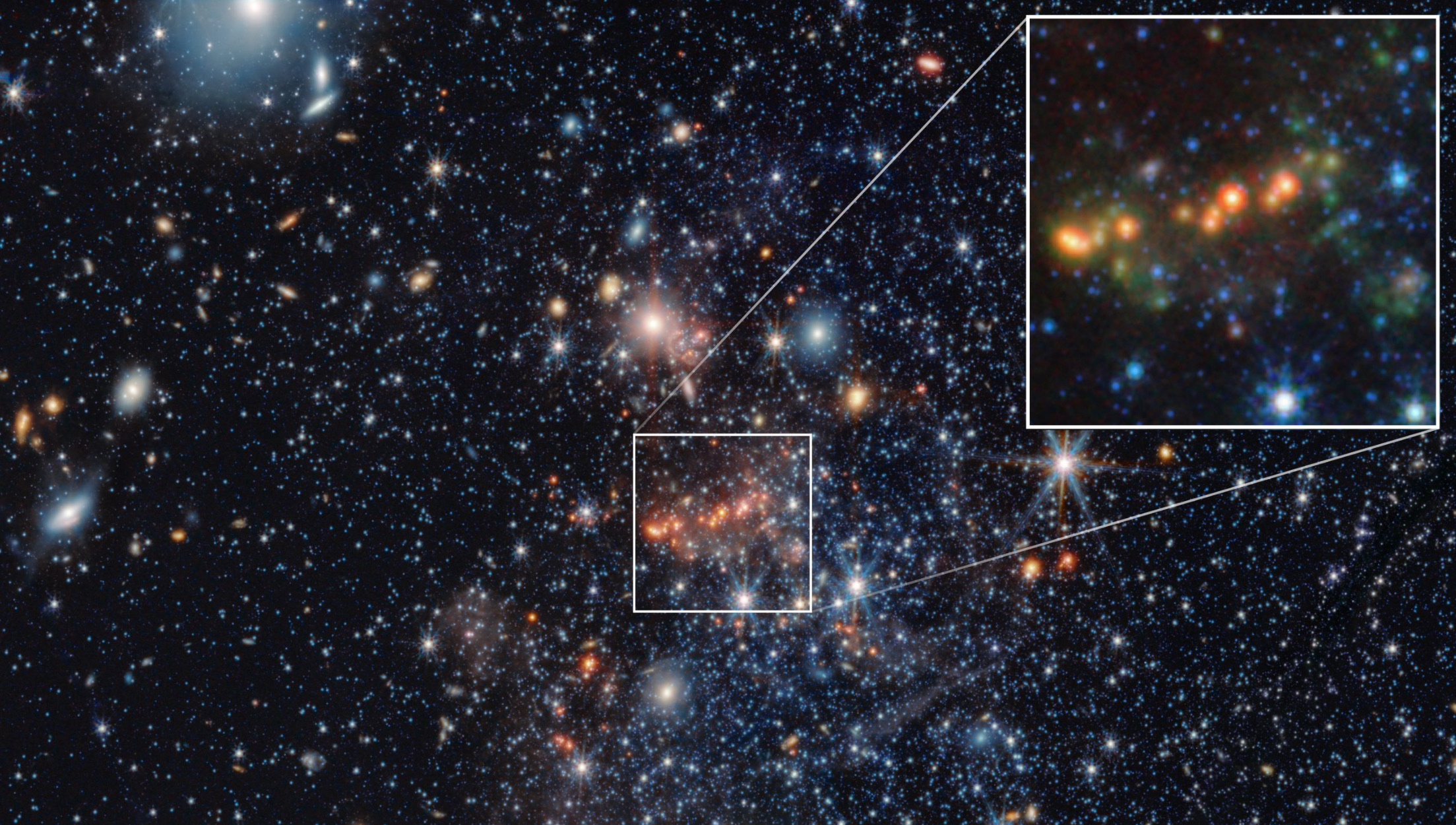
The James Webb Space Telescope (JWST) continues to redefine our understanding of the universe, enabling scientists to peer back in time and explore conditions similar to those of the early universe. A recent study led by Claudio Gavetti, a doctoral candidate at the National Institute of Astrophysics (INAF) and Roma Tre University, has leveraged JWST's capabilities to investigate cosmic dust production in the dwarf galaxy Sextans A. The findings, published in The Astrophysical Journal, shed light on how stars in their final evolutionary stages can generate cosmic dust even in chemically primitive environments.
Sextans A, located on the outskirts of our Local Group, is characterized by an exceptionally low metallicity, containing only about 1% to 7% of the heavy elements found in our Sun. This makes it a compelling analogue for galaxies in the primordial universe, which formed shortly after the Big Bang. By studying Sextans A, researchers gain valuable insights into the processes that enriched the early universe with dust and new chemical elements.
The research team utilized JWST's Near Infrared Camera (NIRCam) and Mid-Infrared Instrument (MIRI) to achieve unprecedented levels of detail in observing Sextans A. These observations, combined with cutting-edge theoretical models that integrate stellar evolution and dust formation in circumstellar winds, allowed the team to map the entire population of evolved stars in the galaxy. The focus was particularly on stars in the asymptotic giant branch (AGB) phase, a late stage in the life cycle of stars with masses similar to our Sun, during which they expel gas and dust into the interstellar medium.
"Studying galactic conditions reminiscent of the early universe remains challenging," Gavetti remarked. "Observing a nearby galaxy like Sextans A, with similar chemical conditions, offers a precious opportunity to understand the evolution of the first generations of stars and their role in transforming the interstellar medium."
Cosmic dust, despite constituting a small fraction of the universe's mass, plays a crucial role in the formation of stars and planets. It consists of tiny solid grains composed of elements like carbon, silicon, and oxygen. Understanding how this dust is produced in environments lacking heavy elements is key to reconstructing the chemical evolution of the universe.
Flavia Dell’Agli, a researcher at INAF and co-author of the study, emphasized the significance of the JWST data: "The James Webb allows us to observe environments with a level of detail previously unattainable. The value of these data lies not only in the imagery but also in the ability to compare them with theoretical models to verify their accuracy in describing stellar evolution."
This research builds on a broader scientific effort to explore the origins of the universe's complex chemical composition. Previous studies, such as the identification of a rapidly growing black hole with characteristics typical of the early universe and the detection of neutrinos from ancient supernovae, underscore the multifaceted approach scientists are taking to unravel the mysteries of the cosmos.
As the JWST continues to provide new observational data, it opens the door for further research into the processes that shaped the early universe. The insights gained from Sextans A not only enhance our understanding of cosmic dust production but also offer a glimpse into the conditions that led to the formation of stars and galaxies as we know them today.
The implications of this study extend beyond academic curiosity. By comprehending the mechanisms behind dust formation in primitive environments, astronomers can refine models of galactic evolution and improve predictions about the lifecycle of stars and the formation of planetary systems in the universe's infancy.