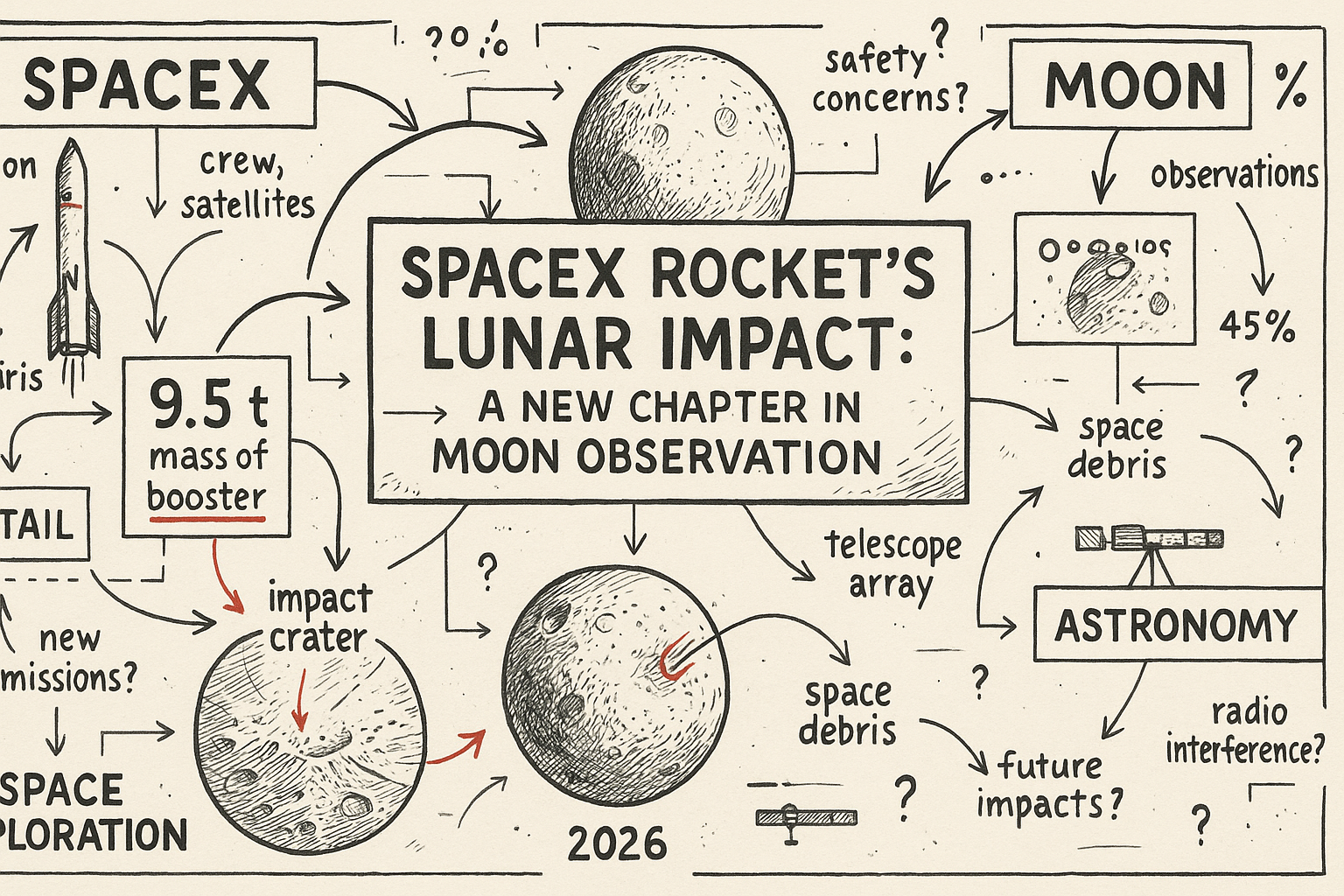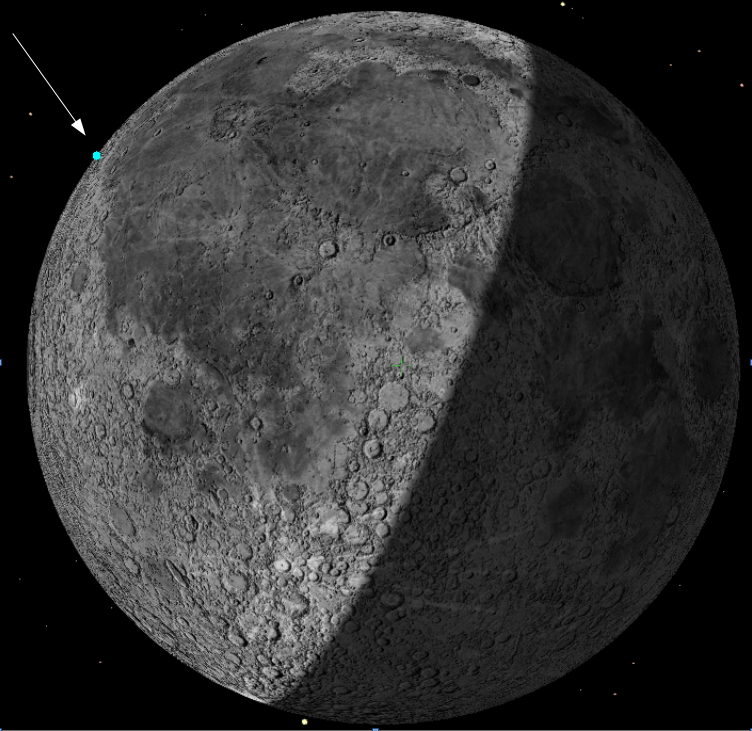
On August 5, 2026, an intriguing event is set to unfold as a SpaceX Falcon 9 rocket's upper stage, designated as 2025-010D, is predicted to crash into the Moon. This collision is expected to occur near the Einstein Crater, marking a rare opportunity for scientists and astronomers worldwide to study the effects of an artificial impact on the lunar surface in real time. The event has sparked interest within the scientific community, as it presents a unique chance to gather critical data that could inform future lunar exploration missions.
The Falcon 9 rocket involved in this event initially launched in January 2025, successfully delivering two private robotic landers, the Blue Ghost and Hakuto-R, toward the Moon. After fulfilling its mission, the rocket's upper stage was left adrift, unable to return to Earth or venture into deep space due to fuel depletion. Since then, it has been cataloged as space debris, drifting through space until its path intersected with the Moon's gravitational pull.
The impact is scheduled to occur at approximately 6:35 UTC (1:35 a.m. CDT) on August 5. According to astronomer Bill Gray, who has been tracking the rocket's trajectory, the object will strike the Moon at a velocity of about 8,750 kilometers per hour (5,400 mph). The upper stage of the Falcon 9, measuring roughly 12 meters in length and 4 meters in width, weighs approximately 4,000 kilograms. Its collision with the Moon is expected to create a crater between 20 to 30 meters in diameter, a significant yet smaller impact compared to natural asteroids due to the rocket's hollow structure.
One of the primary objectives of observing this impact is to study the resulting lunar dust dynamics. Upon impact, a massive cloud of lunar dust is anticipated to be ejected several kilometers above the Moon's surface. This phenomenon offers a direct observation opportunity for both professional and amateur astronomers, potentially visible from Earth with the right equipment and conditions. The dust plume's behavior could yield insights into the Moon's surface properties and inform the planning of future lunar seismological experiments.
The event will be observable particularly well from the eastern parts of the United States, Canada, and much of South America, as the Moon will have risen in these regions by the time of impact. The Moon, nearing its last quarter phase, will also be in proximity to the planet Saturn, providing a striking celestial backdrop for observers. Enthusiasts are encouraged to use sky simulation tools like Stellarium to determine visibility in their locations.
This impending impact underscores a broader issue within space exploration: the management of space debris. As Bill Gray pointed out, the event highlights a certain carelessness regarding the disposal of leftover space hardware. With increasing lunar ambitions, such as NASA's recent investment in commercial lunar landings to establish a permanent Moon base, managing space debris becomes a critical aspect of ensuring the safety and sustainability of space operations.
In conclusion, the upcoming impact of the SpaceX Falcon 9 rocket on the Moon offers a unique observational opportunity for scientists and space enthusiasts alike. The data collected from this event could provide valuable insights into lunar surface conditions and inform the strategies for future lunar exploration. As space agencies and private companies continue to push the boundaries of space exploration, events like this serve as both a scientific boon and a reminder of the need for responsible space debris management.