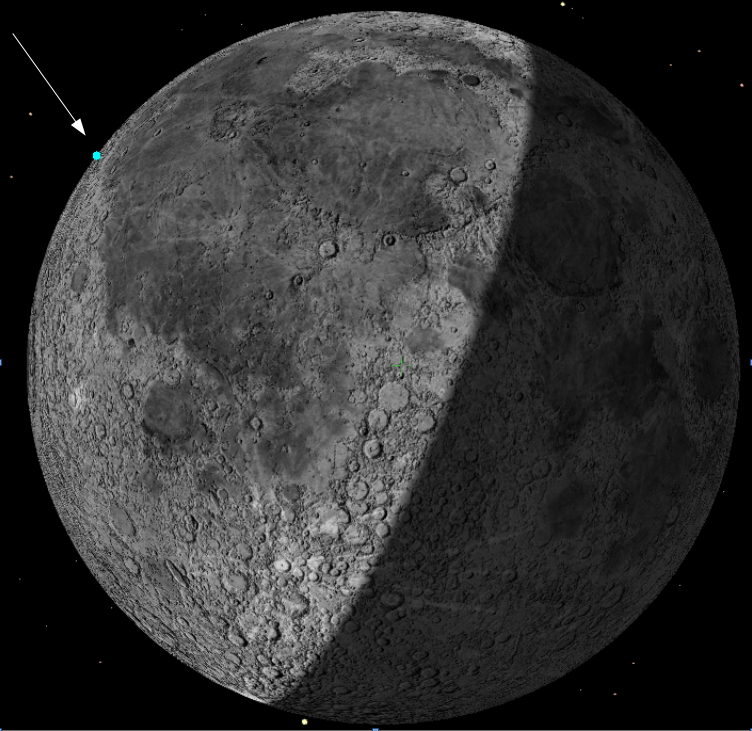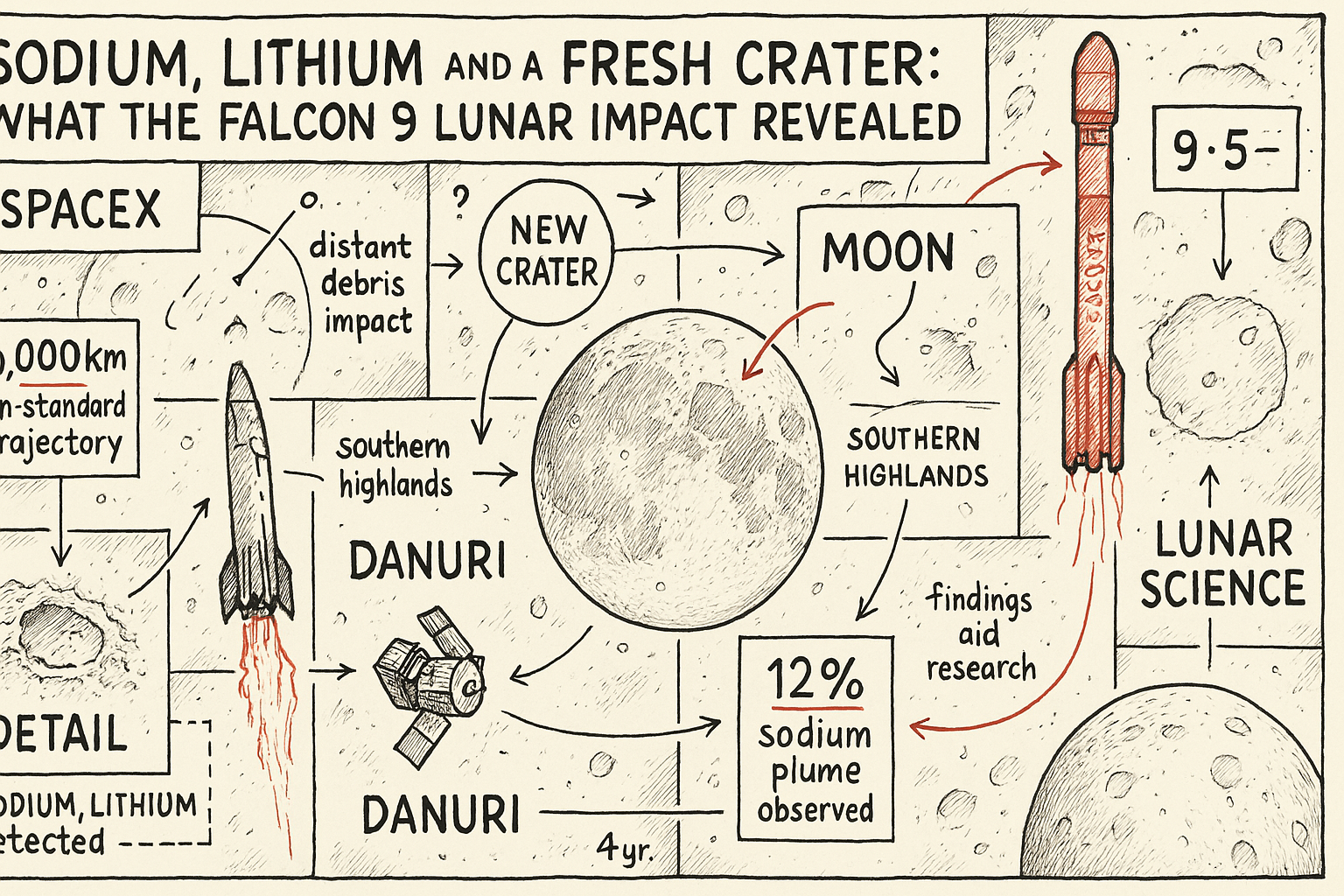
A spent SpaceX Falcon 9 upper stage struck the Moon at about 06:35 GMT on Wednesday 5 August 2026, hitting the surface at roughly 8,690 km/h (5,400 mph) near the lunar terminator, the boundary between the sunlit and shadowed hemispheres. NASA had tracked the object toward an impact zone near the Einstein and Bell craters and confirmed the collision afterwards. No spacecraft was in position to witness it directly.
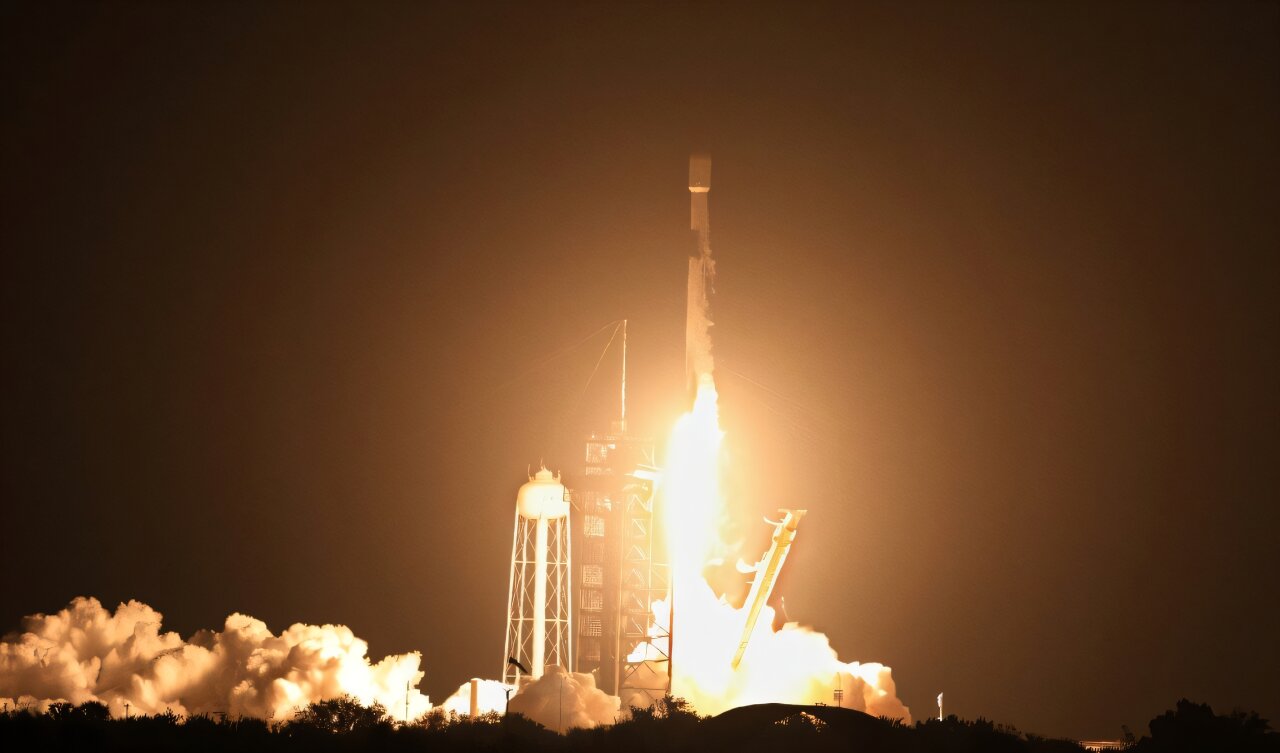
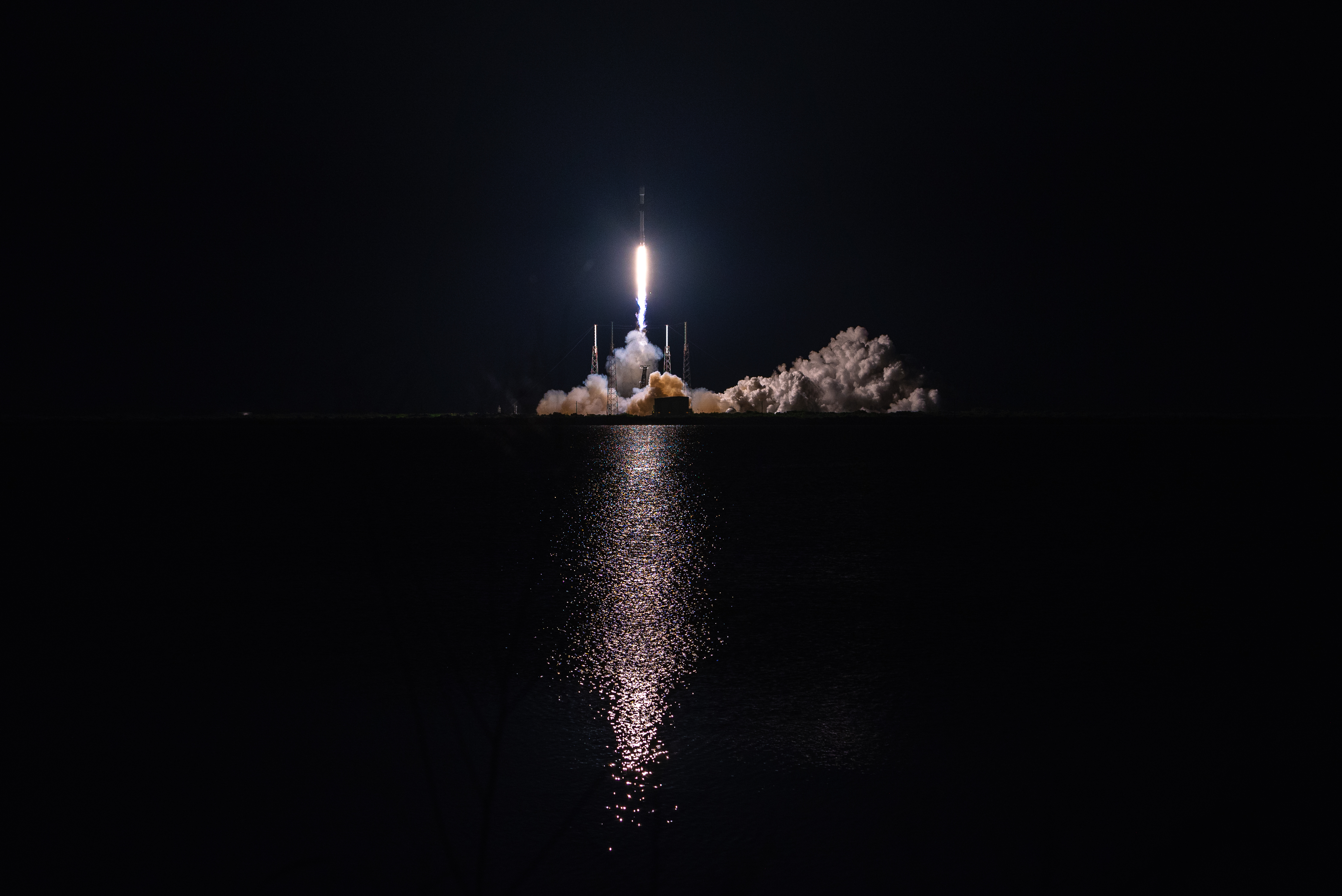
The stage was not a piece of debris left over from a failed mission. It was the upper stage that carried ispace's Resilience and Firefly's Blue Ghost landers toward the Moon in January 2025. Falcon 9 upper stages are expendable and SpaceX normally disposes of them in Earth's atmosphere, but this one had used almost all of its propellant delivering its payloads. The roughly four-tonne body, about the height of a five-storey building, was left circling Earth until solar activity and gravitational perturbations nudged it onto a collision course with the Moon.
The most detailed science came from the ground. The European Southern Observatory's Very Large Telescope in Chile recorded spectral lines in the plume of lunar dust raised by the impact, identifying sodium and lithium gas. The chemical fingerprints remained visible for five to ten minutes, and the plume spanned a few tens of kilometres, according to Carl Schmidt, an astronomer at Boston University's Center for Space Physics. Schmidt noted that the sodium is believed to have come from the lunar soil itself, while the lithium may have originated in the rocket stage. Astronomers at the Instituto de Astrofisica de Andalucia in Spain believe they also captured video of material ejected from the surface around the predicted impact time.
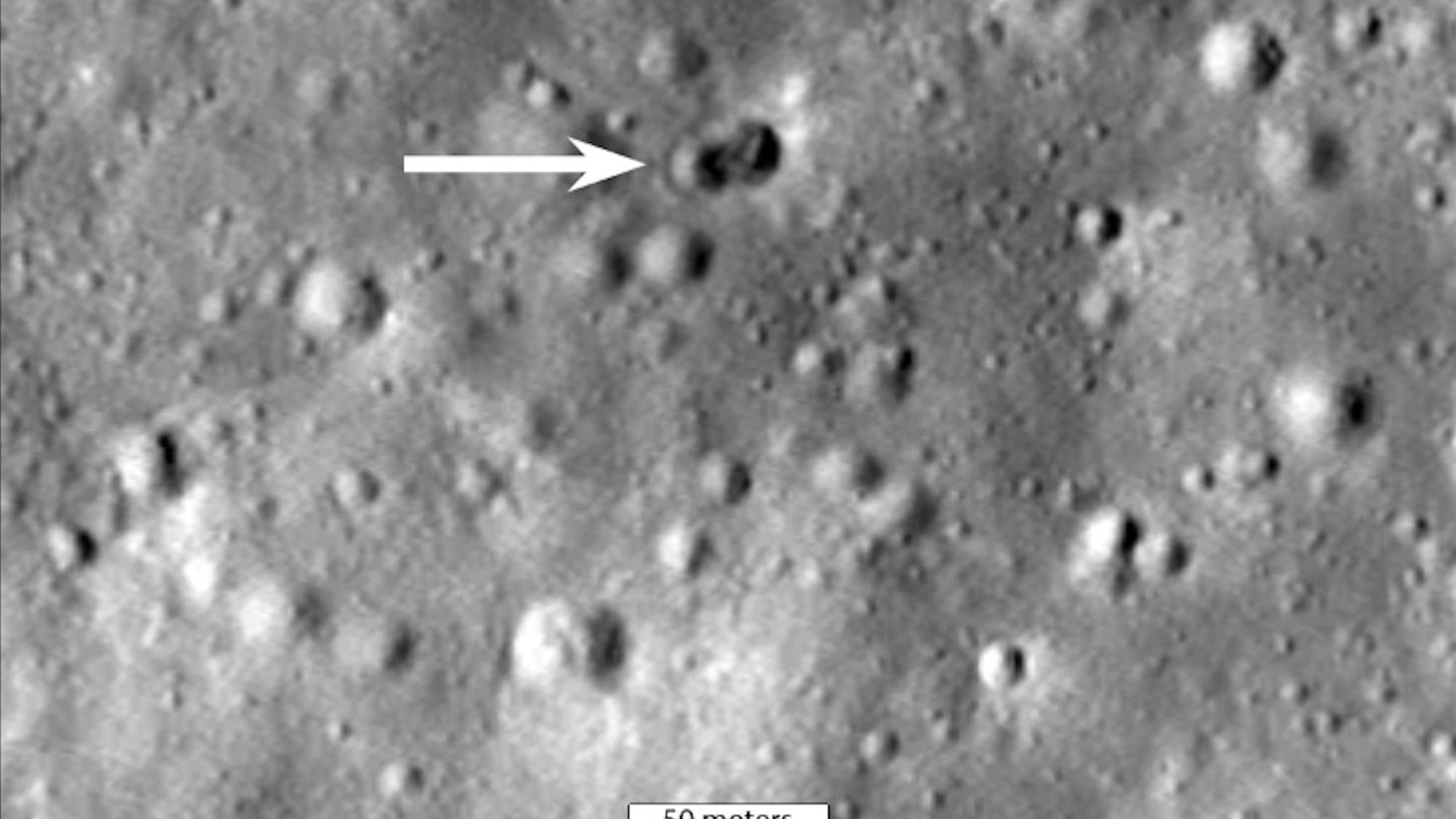
The visual confirmation arrived the following day. The Korea Pathfinder Lunar Orbiter, known as Danuri, imaged the fresh crater, and the Korea Aerospace Research Institute released before-and-after comparisons, pairing the new images with a 2015 view of the same terrain from NASA's Lunar Reconnaissance Orbiter. KARI said the Danuri data will be combined with follow-up observations from LRO for international collaborative research. LRO is expected to image the site as well.
The scientific value of the event is real but bounded. An impact of known mass, known velocity and known composition is a rare calibration opportunity: it gives researchers a controlled data point against which to test models of how natural impacts excavate and redistribute lunar material, and it offers reference data for future seismic experiments on the surface. Benjamin Fernando of Los Alamos National Laboratory has pointed to the same event as a way to assess hazards from artificial space debris impacts.
That last point is the part with consequences. NASA and SpaceX are already studying how to prevent similar collisions, and the reason is straightforward: this stage reached the Moon because nobody was tracking it as a lunar hazard, and nobody had a disposal plan for a vehicle with no fuel left. As traffic in cislunar space grows and NASA works toward a sustained human presence on the surface, an uncontrolled four-tonne object arriving unannounced stops being a curiosity and starts being an operational problem.